Mar 17, 2026
Website Development
Why We Build Every Startup Website on Framer
When founders see "built on Framer" in our packages, some of them pause. They have heard of WordPress. They have heard of Webflow. Framer is the one who requires a brief explanation. Here is that explanation, and why it matters more than you might think.
Every agency has a platform preference. Ours is Framer, and we made that choice deliberately after building startup websites on multiple platforms and watching how each one performed in the real world.
This is not a sponsored post. Framer has not paid us to write this. We build on Framer because it is the right tool for what early-stage startups actually need, and because the alternatives have meaningful drawbacks that most agencies do not talk about honestly.
Here is the full picture.
What Early-Stage Startups Actually Need From a Website
Before we get into platform specifics, it is worth clarifying what a pre-seed or recently funded startup actually needs from its website. The requirements are more specific than most people assume and differ from those of an established business, an e-commerce brand, or a content publisher.
A startup website at this stage needs to do four things well.
It needs to load quickly and look credible the first time anyone sees it, because that first impression plays a significant role in how investors and prospects evaluate it.
It needs to be buildable quickly, because a startup without a website is losing ground every day it remains unlaunched, and a six-week agency engagement is not compatible with the pace of early-stage company building.
It needs to be technically structured to be readable by both search engines and AI engines, because discovery is increasingly happening through AI-powered search, and most websites are not built to support it.
And it needs to be maintainable by a small, non-technical team, because the founders who hire us to build their site won't have a developer on staff to manage it going forward.
Framer performs better against all four requirements than any other platform we have evaluated. Here is why.
Speed: Why It Matters More Than You Think
Page speed is one of those things that sounds like a technical detail until you understand what it actually affects.
For traditional SEO, page speed is a confirmed ranking factor. Google uses Core Web Vitals, a set of performance metrics that includes load time, as a ranking signal. Slow pages rank lower. This has been true for years, and it is more consequential now than ever because Google AI Overviews pull from organically ranked content. If your pages are slow and rank poorly, they are less likely to be cited in AI-generated summaries.
For human visitors, the impact is more immediate and less forgiving. Studies consistently show that users begin abandoning websites after two to three seconds of load time. For a startup website being evaluated by an investor or enterprise prospect who is already operating on a full calendar and has limited patience, a slow site is one they will not stay on long enough to be convinced.
Framer's hosting infrastructure is built for performance. Pages built on Framer load fast by default, not because of anything the builder does specifically, but because of how the platform generates and serves code. Framer uses a modern static site generation approach that produces lightweight, efficiently structured output served from a fast global content delivery network.
Compare this to WordPress. A WordPress site's performance depends heavily on the theme used, the number of plugins installed, the hosting plan selected, and whether performance optimizations are configured correctly. A WordPress site built carelessly, which describes a significant percentage of startup websites, will load slowly, score poorly on Core Web Vitals, and quietly undermine the site's SEO and AI search visibility without the founder ever knowing why.
Webflow performs better than WordPress in terms of speed, but still generates heavier code than Framer in most real-world builds. The gap is not dramatic in every case, but it is consistent, and consistency matters when you are making a platform choice that will affect every client build you do.
LLM Extractability: The Factor Most Agencies Have Never Heard Of
This is the most important technical differentiator between Framer and its competitors for startup websites in 2026, and it is the one that almost no one in the agency world is talking about yet.
LLM extractability refers to how easily an AI language model can read, parse, and extract meaningful information from your website. When ChatGPT, Perplexity, Google Gemini, or any other AI engine evaluates your site for potential citation in a search response, it does not experience your website the way a human visitor does. It reads the underlying code of your page and attempts to extract structured, meaningful content.
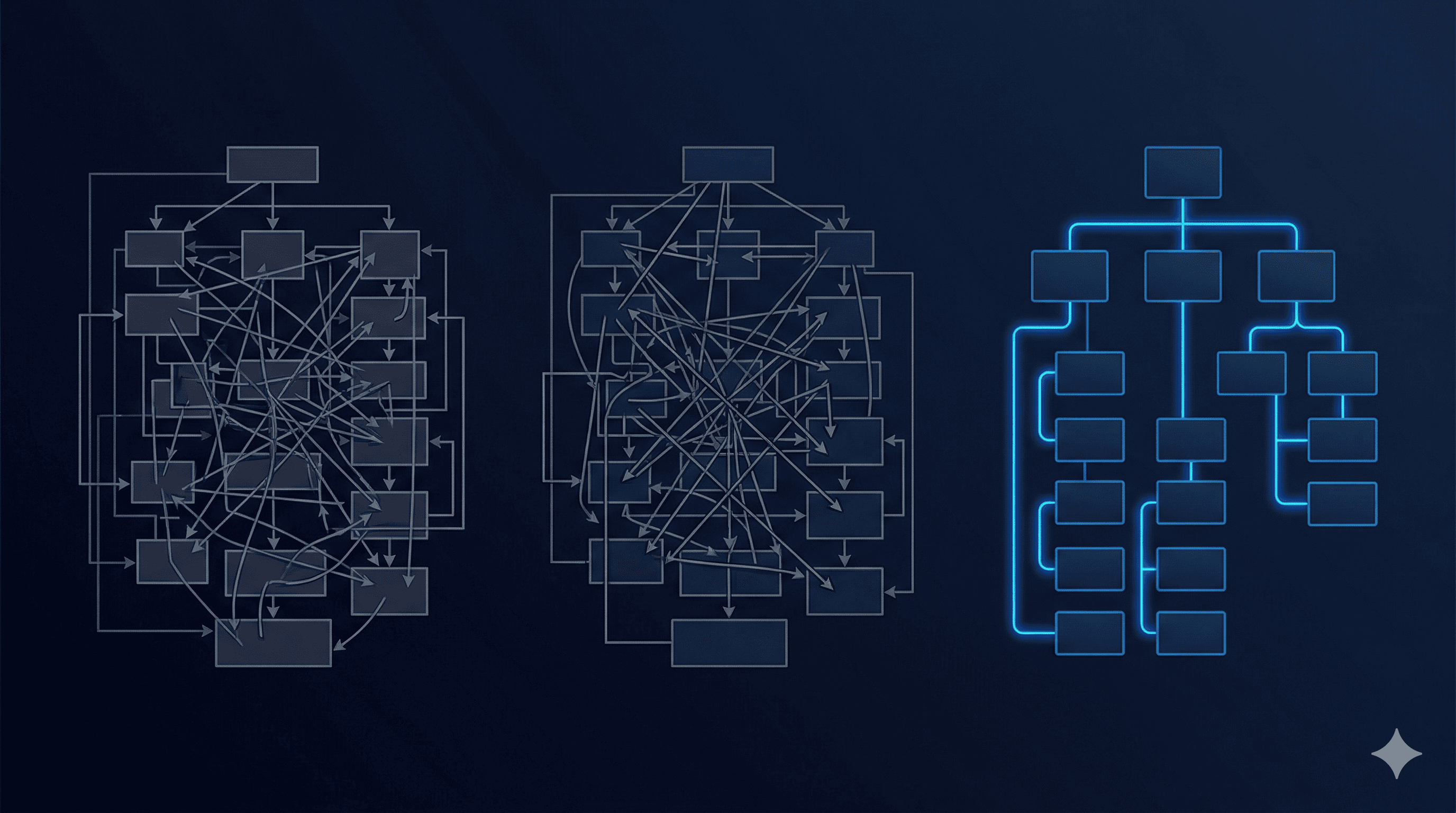
The quality of that extraction depends almost entirely on how clean and well-structured your code is. A page with a logical heading hierarchy, semantic HTML elements, clearly demarcated content sections, and minimal extraneous markup is significantly easier for an AI engine to parse than a page with nested divs, inconsistent heading levels, plugin-generated markup, and structural complexity that has nothing to do with the content itself.
Framer generates exceptionally clean code. The DOM structure of a Framer-built page is lean, logical, and consistent. Content is organized to reflect the page's visual hierarchy, making it far easier for AI engines to understand what each section is about and whether it is relevant to a given query.
WordPress, particularly WordPress using popular page builder plugins like Elementor or Divi, generates some of the messiest DOM structures in the industry. A page that looks clean and well-organized to a human visitor may be a tangle of nested containers, inline styles, plugin-generated markup, and legacy code that AI engines struggle to parse efficiently. This directly affects whether your content gets cited in AI-generated search responses, and it is one of the primary reasons many WordPress-built startup websites are effectively invisible to AI search despite having good content.
Webflow falls somewhere between WordPress and Framer on this dimension. Webflow generates cleaner code than most WordPress page builders, but it still produces more structural complexity than Framer in typical builds. For a startup website where AI search visibility is a priority, Framer has a measurable structural advantage.
Clean DOM Structure: Why Your Website's Code Quality Is a Business Problem
The DOM, or Document Object Model, is the internal structure of your web page as the browser and search engines see it. It is not something most founders think about. It is also not something most agencies talk about honestly with their clients.
A clean DOM is one in which the content hierarchy is logical and consistent, heading tags are used correctly and in order, content sections are clearly demarcated with appropriate semantic elements, and there is minimal structural noise between the content and the code.
A clean DOM matters for three specific reasons.
First, it affects search engine ranking. Google's crawlers evaluate DOM structure as part of their assessment of page quality and content relevance. Pages with well-structured, semantically correct HTML rank better than pages with messy, inconsistent structure, assuming content quality is equal.
Second, it affects AI search extractability, as described above. The cleaner the DOM, the more accurately AI engines can understand what your page is about and whether it should be cited in response to a relevant query.
Third, it affects accessibility. Clean, semantic HTML is the foundation of an accessible website. This matters both ethically and practically, as accessibility signals are increasingly factored into search quality assessments.
Framer produces a clean DOM structure by default because of the platform's architecture. Designers work in a visual editor that maps directly to clean HTML output. There are no plugin layers, no theme overrides, no legacy markup accumulated over years of updates. The code Framer output is what goes to the browser, and it is consistently well-structured.
This is not something you can reliably guarantee with WordPress without significant developer intervention. And it is one of the reasons we decided to build exclusively on Framer rather than offer multiple platform options to clients.
Build Timeline: Why 10 Business Days Is Possible on Framer and Difficult Elsewhere
When we tell founders their website will be live in 10 business days, the most common reaction is skepticism. They have been burned before. They have hired freelancers who promised fast delivery and disappeared. They have worked with agencies whose six-week timelines stretched to four months.
Ten business days is possible because of how Framer works, not just because of how we work.
Traditional WordPress website development follows a sequential process that is difficult to compress. A theme is selected, or a custom design is created in a separate tool like Figma. The design is then converted into WordPress templates by a developer. Plugins are installed and configured. Content is entered into the CMS. Testing is conducted across browsers and devices. Each stage has handoffs that introduce delays, and the gap between the design and the final built product almost always produces surprises that require additional time to resolve.
Webflow is faster than WordPress because it eliminates the developer handoff for simple sites, but it still involves a visual design phase that is separate from the build phase, and the learning curve for building efficiently in Webflow is significant.
Framer collapses the design and build phase into a single process. Designers work directly in the production environment, which means what you see in the editor is exactly what goes live. There is no handoff between design and development because they are the same activity. Template foundations provide a well-designed structural starting point that we customize for each client's brand and content, rather than starting from a blank canvas every time.
This is how we consistently meet the 10-business-day target. It is not a gimmick or a shortcut. It is a structural advantage of the platform that allows us to move at a pace that would be genuinely difficult to replicate on any other major website platform.
Maintainability: What Happens After We Hand It Off
A website that a founder cannot update will become outdated within months. Outdated websites signal inactive companies. Inactive-looking companies lose the Google moment.
One of the most common failure modes for startup websites is that they are built by an agency or freelancer and then handed to a team with no technical ability to maintain them. The team cannot update copy, add new pages, publish blog posts, or make any changes without going back to the agency and paying for the change. So they do not change anything. The website sits exactly as it was built, slowly becoming less accurate and less current, until the company finally decides to redo it entirely.
Framer is built for non-technical editing. Once we hand off a completed site, the founding team can update copy, swap images, publish blog posts, and make content changes directly in the Framer editor without writing a line of code. The editing interface is visual and intuitive. Most founders can figure it out within an hour of their first use.
Framer also introduced on-page editing in late 2025, allowing content changes to be made directly on the published site in a browser, without even opening the Framer editor. Click on the text you want to change, type the new text, and publish. This is genuinely as simple as it sounds.
For a startup team without a dedicated marketing or web person, this level of maintainability is not a convenience. It is a prerequisite for keeping the site current, which is a prerequisite for it continuing to do its job.
The Honest Limitations
Framer is the right platform for what we do. It is not the right platform for everything.
If you need a complex e-commerce store with product inventory management, Framer is not the answer. Shopify is.
If you need a sophisticated membership platform with gated content, user accounts, and community features, Framer is not the right tool. There are purpose-built platforms for that.
If you need a content-heavy publication with hundreds of articles, complex taxonomy, and advanced editorial workflows, Framer's CMS, while capable, may not be the right fit for that scale of content operation.
If you need deep custom back-end functionality, API integrations that go beyond standard embeds, or complex data processing, you need a custom development engagement, not a Framer build.
For an early-stage startup that needs a fast, credible, AI-search-ready web presence to support investor conversations, sales development, and recruiting, none of those limitations apply. Framer is the right tool for the job, and we are confident enough in that assessment to build our entire service model around it.
Why This Choice Matters for You
When you hire 10spring to build your website, you are not just hiring us to make something that looks good. You are hiring us to make something that performs, is technically sound, is readable by AI engines, loads fast enough to hold an investor's attention, and that your team can maintain after we hand it off.
Every one of those outcomes depends on the platform we build on. And every one of them is better served by Framer than by the alternatives we have evaluated.
That is why we build on Framer. Not because it is the most well-known platform. Not because it is the easiest to sell to skeptical clients. After building startup websites on multiple platforms and watching how they perform in the real world, it is the one that consistently produces the best outcome for what early-stage startups actually need.
If you have questions about whether Framer is the right foundation for your startup website, book a call. We are happy to walk through your specific situation and give you an honest assessment
10spring builds fast, credible websites for pre-seed and recently funded startups. Live in 10 business days, built on Framer, and optimized for Google and AI search from day one.