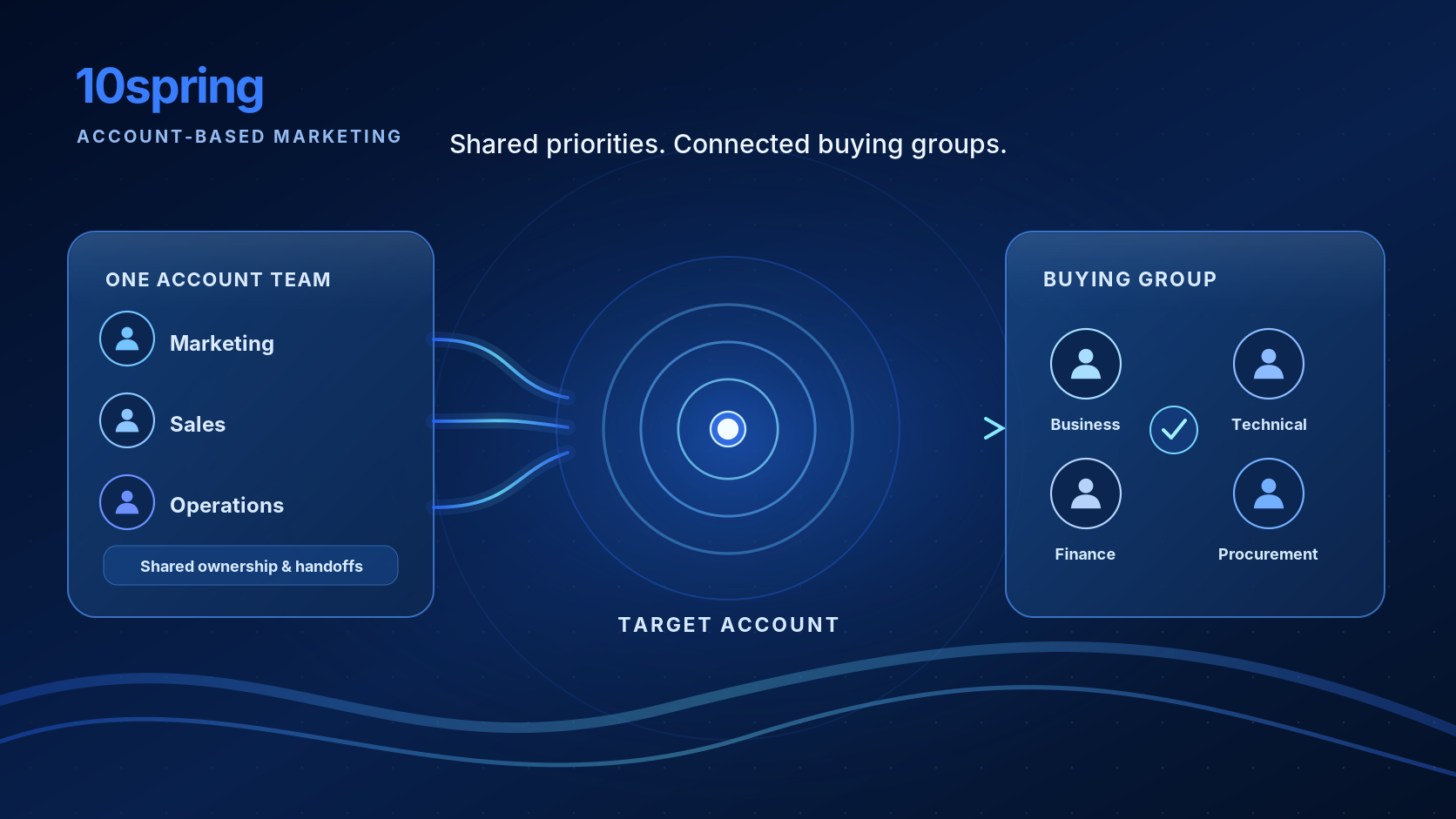
Account-based marketing is easy to describe and hard to run well. In principle, it means choosing the accounts that matter most, understanding the people who will make the buying decision, and coordinating marketing and sales around those accounts instead of around anonymous leads. In practice, it is as much an operating discipline as a marketing tactic.
This article covers where account-based marketing (ABM) fits, why buying-group dynamics make it relevant, and what the research says about timing and relevance. It then covers how to run and measure an ABM program without overstating its results. It draws on public research from Forrester, Gartner, 6sense, G2, and Momentum ITSMA, and it notes where those sources have limits.
What ABM is, and where it fits
ABM treats a defined set of named accounts as markets in their own right, not as segments of a broad audience. Programs, content, and outreach are built around each account's situation and its buying group, and marketing and sales work from the same account priorities.
It tends to fit when four conditions hold:
- Deals are high in value, so effort per account can be justified.
- Several people take part in the buying decision.
- The market is finite enough that the best-fit accounts can be named.
- Sales, marketing, and operations can coordinate around a shared account list.
It fits poorly when purchases are low in value, high in volume, and decided by one person. ABM is also not a platform purchase or an advertising tactic. Tools can support an account-based motion. They cannot create the alignment that makes it work.
Why buying groups change the job
Most B2B purchases are group decisions, and the groups are large. The studies count them differently:
- Forrester: Its Buyers' Journey Survey of nearly 18,000 business buyers found an average of 13 internal stakeholders and nine external participants. Forrester's 2026 analysis adds that procurement professionals act as decision-makers in about 53% of buying cycles.
- 6sense: Its 2026 report puts the average buying group at about 10 people.
- Gartner: A 2025 survey of 632 buyers found groups of five to 16 people, spread across as many as four functions.
The counts differ because the studies define the group differently. Some count outside influencers, and some count only people inside the buying company. The direction is consistent. Purchases involve many people, and many of them are not in a marketing contact database.
Agreement is the harder problem. In the same Gartner survey, 74% of buyer teams showed unhealthy conflict during the decision, such as conflicting objectives or disagreement on next steps. Groups that reached consensus were 2.5 times more likely to report a high-quality deal.
That changes the job. The goal is not to capture one lead. It is to help a group of people with different priorities reach a decision they can defend.
Much of the decision forms before sales is involved
6sense surveyed more than 4,600 recent B2B buyers for its 2026 report. It found an average buying cycle of about 10.3 months, with buyers spending roughly 60% of that time selecting vendors before they contact a seller. The vendor favored before seller contact went on to win about 82% of the time.
Two cautions apply. 6sense sells account-based marketing and revenue platforms, so its conclusions align with its commercial interests. And the report describes its findings as associational, not causal. The pattern is still consistent with other research. Gartner's March 2026 release reported that 67% of surveyed B2B buyers preferred a rep-free experience.
Two implications follow:
- Engagement has to start before an account raises its hand. If the preference forms before a seller is in the room, account-level marketing has to build familiarity and credibility earlier.
- Assets have to work without a seller present. A buying group doing its own research needs material that stands on its own.
Where that research happens is changing. G2's 2026 survey of 1,076 B2B software buyers found that 51% start with an AI chatbot more often than with Google, and 71% rely on AI chatbots at some point. 6sense found that most buyers use large language models during evaluation, but only about a fifth call them an influential source. Forrester found that buyers check AI output with trusted people and are more likely to engage a provider based on expert input than on AI tools.
The surveys differ in who they sampled, and the question is still open. What holds either way is that accounts research your company in AI Search Engines and on Google, and then validate what they find. What they find needs to be accurate and consistent.
Relevance at the group level beats personalization at the individual level
ABM is often equated with personalization. The Gartner survey suggests the distinction matters. Tailoring content to the relevance of the whole buying group improved consensus by 20%. Content focused on individual-level relevance had a 59% negative impact on consensus. Buyers who experienced buying-group relevance were three times more likely to report a high-quality deal.
Gartner's explanation is that individual-level content can reinforce each person's existing view, which makes a shared direction harder to reach. This was a survey of buyers about seller content, so apply it to marketing assets with judgment. The principle is still useful.
In practice, personalization should mean shared understanding. Reflect the account's situation, goals, and risks. Give each role what it needs to evaluate the decision. Anchor all of it to a common business case that the group can discuss together.
The decisions that make an ABM program
Most successful programs make the same six decisions, in roughly this order:
- Choose accounts deliberately. Define fit criteria from evidence about where the business wins and keeps customers. Agree on the list with sales. Keep it small enough to serve well, and review it on a schedule.
- Map the buying group. Identify roles across the business, technical, financial, and procurement sides. Note who is known, who is unknown, and who is likely to block.
- Decide how much tailoring each account earns. Many programs tier accounts. A small set gets fully custom work, a larger set gets work tailored to a cluster, and a broad set gets programmatic treatment. Resource each tier honestly.
- Build account-level assets. Create material that addresses the account's situation, supports the group's discussion, and works without a seller present.
- Coordinate the touches. Marketing, sales, and operations should work from one view of each account, with clear ownership and handoffs.
- Measure account progression. Track movement toward qualified opportunities and customers, not only activity.
The operating model matters more than the tools
An account-based motion depends on shared definitions. What counts as a target account? What counts as engagement? When does an account become an opportunity, and who owns it at each stage?
Those questions sit in the CRM, the data, and the handoffs between teams. If account and contact data is incomplete, nobody can see the buying group. If marketing and sales define engagement differently, the two teams will disagree about which accounts to prioritize. Fixing those foundations usually comes before any new tool, and a new tool built on weak definitions tends to inherit the weaknesses.
Measure progression, not activity
Impressions, clicks, and account engagement scores are diagnostic signals. They show whether the work is reaching people. They do not show whether it is moving accounts toward a decision. A sound measurement plan connects three layers.
- Marketing activity and infrastructure. Account reach, engagement across the buying group, and campaign and CRM indicators.
- Conversion performance. How many target accounts progress to qualified opportunities, and how many people in each buying group are engaged.
- Business impact. Qualified pipeline, new customer acquisition, and new recurring revenue where applicable, including growth within existing accounts. Attribute outcomes only where reliable data supports the link.
If engagement rises and opportunities do not, look for friction in the conversion pathway before adding more outreach. Set baselines before the program starts. Where possible, compare target accounts with similar accounts outside the program.
Be careful with ROI claims. In Momentum ITSMA's 2024 benchmark of more than 300 B2B marketers, sponsored by Demandbase, 90% of organizations had an ABM program and 81% said it delivered higher ROI than other marketing. Those figures show how widely ABM is adopted and how practitioners feel about it. They are self-reported, and they do not prove that ABM caused the results.
Where ABM programs go wrong
These failure points reflect judgment, not survey data:
- Too many accounts. A list so long that no account gets real attention is a segmentation exercise with a new name.
- Personalization without a shared business case. Individual tailoring can add effort and still leave the group without common ground.
- Marketing running it alone. Without sales ownership of the same accounts, the program produces engagement that nobody follows up.
- Activity as the scorecard. Engagement scores can rise while pipeline stays flat.
- Ignoring the installed base. Practitioners in the Momentum ITSMA study named growing existing accounts among the top benefits. A program that looks only at new logos may miss much of the value.
Practical takeaways
- Treat ABM as an operating discipline. The foundation is shared definitions, data, and ownership, not a platform.
- Choose accounts with sales, from evidence. Keep the list small enough to serve well and review it regularly.
- Map the whole buying group. Include finance, technical, and procurement roles, not only the likely champion.
- Aim for group-level relevance. Build one shared business case, then adapt it by role.
- Start before accounts raise their hand. Build assets that work without a seller present.
- Judge the program by progression and outcomes. Tie baselines to qualified opportunities, customers, and revenue, and state the limits of attribution.
10spring works alongside internal marketing teams. If you want to pressure-test your account strategy, Book A Call. Let's accelerate your pipeline together.
Sources and further reading
All sources accessed November 13, 2026.
- Barbara Winters, Forrester. The State Of Business Buying: Risk-Averse Buyers Demand Proof, Not Promises. Blog post, January 21, 2026. Based on Forrester's Buyers' Journey Survey of nearly 18,000 business buyers. The full report is not publicly available.
- 6sense. 2026 B2B Buyer Experience Report: The Secret Life of B2B Buyers. Report, 2026. The publisher sells account-based marketing and revenue platforms.
- Gartner. Gartner Sales Survey Finds 74% of B2B Buyer Teams Demonstrate "Unhealthy Conflict" During The Decision Process. Press release, May 7, 2025. Survey of 632 B2B buyers, August to September 2024.
- Gartner. Gartner Sales Survey Finds 67% of B2B Buyers Prefer a Rep-Free Experience. Press release, March 9, 2026. Survey of 646 B2B buyers, August to September 2025.
- G2. In the Answer Economy, Don't Win the Click, Win the Answer. Research summary of The Answer Economy: How AI Search Is Rewiring B2B Software Buying, April 15, 2026. Survey of 1,076 B2B software buyers and decision-makers, fielded March 2026.
- Momentum ITSMA. The Global Account-Based Marketing Benchmark. Study, 2024/25, sponsored by Demandbase. Adoption and ROI figures.
- Momentum ITSMA. The best of ABM is yet to come. First look at the 2024 Global Account-Based Marketing Benchmark, a survey of more than 300 B2B marketers. Top reported benefits.