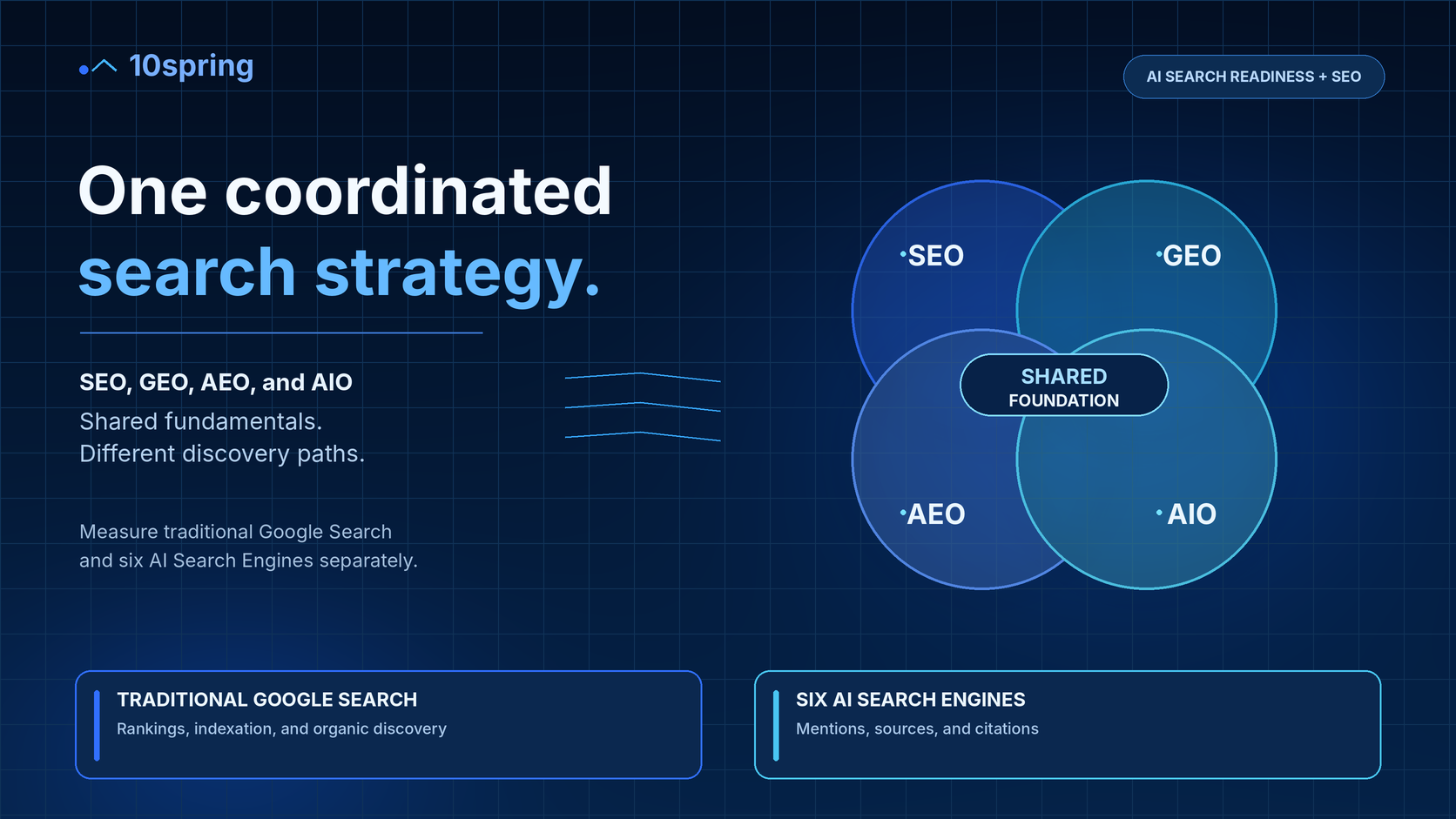
SEO, GEO, AEO, and AIO now compete for space in the same planning meetings. B2B marketing teams are asking a fair question. Is AI Search Readiness a separate discipline, or is it SEO with a new label?
The evidence supports a more useful answer than either. Much of the work overlaps. Some of it does not. And the studies that measure the overlap disagree often enough that no plan should rest on a single number.
This article defines the four terms and explains how they fit into one coordinated plan. It then looks at what research says about how pages cited by AI Search Engines relate to pages that rank in Google Search. It covers where the work differs, which strategies hold up under both views, and how to measure progress without overstating it. It draws on Google's documentation and the academic paper that introduced GEO. It also uses studies from Ahrefs and BrightEdge, research from SparkToro and Gumshoe.ai, crawler documentation from OpenAI and Anthropic, and buyer research from G2 and Gartner. It notes where each source has limits.
Why the vocabulary got crowded
Buyer behavior moved first. G2's 2026 survey of 1,076 B2B software buyers found that 51% start their research with an AI chatbot more often than with Google. Gartner's March 2026 release reported that 67% of surveyed B2B buyers preferred a rep-free experience. Buyers form opinions before a seller is involved, and some of that research now happens inside AI Search Engines.
The vocabulary followed. A research paper first posted in 2023 and published at the 2024 KDD conference gave Generative Engine Optimization a formal definition. Vendors, agencies, and platforms then added labels of their own. Each term points at a real concern. But different groups coined them for different purposes, so they do not divide the work cleanly.
Treating them as four separate programs is the common mistake. It can split budgets, owners, and reporting across work that depends on the same pages and the same facts about a company.
Definitions: four terms, one plan
These working definitions keep the terms useful without pretending the boundaries are sharp.
- SEO (Search Engine Optimization). Improving technical accessibility, relevance, and authority so a site can earn visibility in traditional organic search. For a B2B company, that means crawlable pages, clear topical coverage, and credible links and mentions.
- GEO (Generative Engine Optimization). Helping generative systems discover and use accurate, trustworthy information about a brand. The paper that introduced the term describes generative engines as search systems that use large language models to retrieve sources and write summarized answers with citations. It presents GEO as a way for content creators to improve their visibility in those answers.
- AEO (Answer Engine Optimization). Structuring useful, direct answers to the questions buyers ask, across both search and AI experiences. It concerns how answers are written and organized on the page.
- AIO (Artificial Intelligence Optimization). A broader term for improving how AI Search Engines interpret and surface company information. Use it with care. Many practitioners also use AIO as shorthand for Google's AI Overviews, which is a specific feature and not a discipline.
AI Search Readiness + SEO is the plan that coordinates all four. The underlying questions are the same for any buyer-facing information. Can the systems find it? Can they understand it? Do they have reason to trust it?
The six AI Search Engines in scope are ChatGPT, Claude, Perplexity, Grok, Gemini, and Google AI Overviews. Traditional Google Search is a seventh track, and it is measured separately. Google AI Overviews is a feature of Google Search, not a standalone large language model. That is why it counts both as a Search feature and as an AI Search Engine to track, and why its relationship to rankings gets its own treatment below.
Google's own position is worth reading closely. Its guide to generative AI features, last updated July 10, 2026, says that optimizing for generative AI search is not different from SEO. It explains that these features are built on Google's core ranking and quality systems. It acknowledges that people use the terms AEO and GEO, and it advises checking third-party advice about them against its guidance on evaluating SEO providers.
That position is a useful corrective. It describes Google's own features. It does not settle the question for ChatGPT, Claude, Perplexity, Grok, or Gemini, which run their own retrieval systems. The next section shows why that distinction matters.
The working position in this article follows from both points. SEO, GEO, AEO, and AIO are overlapping disciplines. They are coordinated inside one plan. They are not four separate programs.
What the evidence says about overlap
If AI Search Engines simply repeated Google's rankings, there would be little new to plan. If they ignored rankings, SEO would be irrelevant to them. The studies below sit between those poles, and each comes with limits.
Google AI Overviews moved away from the top 10. In July 2025, Ahrefs reported that 76% of URLs cited in AI Overviews ranked in Google's top 10 for the same query. A March 2026 update covering 863,000 keywords and about 4 million cited URLs put the figure at 37.9%. Ahrefs notes that AI Overviews now run on Gemini 3 and that it improved how it parses citations, so the two figures are not a clean before and after. BrightEdge reported about 17% top 10 overlap in February 2026 using a different dataset and method. Ahrefs suggests that Google now draws more citations from the results of related sub-queries than from the original results page. It presents that as an interpretation, not a confirmed cause.
The other AI Search Engines overlap even less. A separate Ahrefs study from August 2025 asked 15,000 long-tail questions in Google, Bing, and four assistants: ChatGPT, Gemini, Copilot, and Perplexity. On average, about 12% of cited URLs appeared in Google's top 10 for the same prompt, and about 10% appeared in Bing's top 10. For ChatGPT's in-text citations, the figures were 8.0% for Google and 8.1% for Bing. Perplexity was the outlier at 28.6% for Google's top 10, and Ahrefs notes that Perplexity runs its own index built from its own crawler. For the other assistants, Ahrefs reported that more than 80% of citations came from pages that did not rank for the prompt at all.
Treat those figures as a snapshot. Ahrefs collected the data in early July 2025 and says results may have changed. Copilot is not one of the six AI Search Engines, but ChatGPT, Gemini, and Perplexity are, and the pattern holds across them. Ahrefs is also a vendor of search and AI visibility tools, so its studies reflect its own dataset.
Why the overlap is partial. Google's guide describes query fan-out, in which a generative feature issues several related searches to build one answer. Ahrefs sees the same mechanism in the assistants it studied. In its example, a page that ranks sixth for three related variations of a question can be cited over a page that ranks first for only one of them. The assistant may never search the exact words a buyer typed.
So a page can be cited without ranking for the prompt, and a top-ranking page can be left out. Read that as a case for covering a topic with breadth and depth. It is not a case for ignoring rankings. Ahrefs's own conclusion is that ranking well helps, though not always for the queries a team would assume.
Answers vary from run to run. SparkToro and Gumshoe.ai had about 600 volunteers run 12 identical prompts nearly 3,000 times across ChatGPT, Claude, and Google's AI features, according to Search Engine Land's report. The odds of getting the same brand list twice were under 1 in 100. The odds of getting the same list in the same order were about 1 in 1,000. Yet some brands appeared in roughly 60% to 90% of responses for a given intent, even as their positions moved.
The authors concluded that position tracking is close to meaningless. They suggested measuring how often a brand appears across many prompts and many runs, which they called imperfect but closer to reality. Both organizations sell research or measurement tools, and the authors list open questions, including how many runs are needed for reliable numbers.
Where the work is shared
The overlap studies show that citations differ. They do not show that the foundations differ. Four things matter to every engine.
- Pages that can be reached and indexed. Google says a page must be indexed and eligible to show with a snippet to appear in its generative features. It also says indexing and serving are never assured. A page that cannot be crawled cannot be considered, in any engine.
- Content a machine can read. Google says JavaScript is fine when it is not blocked, and that semantic HTML helps. Other engines may differ. A December 2024 analysis by Vercel and MERJ found that crawlers from OpenAI, Anthropic, Meta, ByteDance, and Perplexity did not render JavaScript, while Gemini used Googlebot's rendering. That rests mainly on data from one documentation site and Vercel's network, and Vercel is a hosting company. Crawler behavior can change. Test your own key pages instead of relying on one study.
- Content worth citing. Google's guide recommends non-commodity content with a first-hand point of view, clear headings, and writing for people. That is also the content a buying committee finds useful. It is difficult to cite a page that says what every competitor says.
- Authority beyond your own site. Google notes that generative features can reflect what people say about products across blogs, videos, and forums. An Ahrefs study of 75,000 brands found that branded web mentions correlated at 0.66 to 0.71 with AI brand visibility. Ahrefs states that correlation is not causation. In G2's survey, buyers named citations from a software review site first when asked what most increases their confidence in a chatbot's answer.
None of these four is exotic. A team that fixes them improves its position for traditional organic search and for the AI Search Engines at once. That is the practical meaning of overlap.
Where the work differs
The disciplines separate on a few specific points. Most of them are about access, retrieval, and evidence.
Crawler access is set engine by engine. OpenAI documents separate crawlers: OAI-SearchBot for ChatGPT search, GPTBot for training, and ChatGPT-User for fetches that a user triggers. Each is set on its own in robots.txt. OpenAI says sites that opt out of OAI-SearchBot will not be shown in ChatGPT search answers, though they can still appear as navigational links. It says robots.txt rules may not apply to ChatGPT-User, and that search-related robots.txt changes can take about 24 hours to take effect.
Anthropic describes three bots: ClaudeBot for training data, Claude-SearchBot for improving search results, and Claude-User for fetching pages when a user's question requires it. Anthropic says that disabling Claude-SearchBot or Claude-User may reduce a site's visibility in Claude's search results. Perplexity, per Ahrefs, uses its own crawler and index.
The risk is a blanket rule. A policy written to opt out of model training can, if it is too broad, also block the bots that surface a site in search. Decide training access and search access as separate questions, with the right legal and security voices in the room.
Retrieval differs by engine. Google's features draw on Google's index. Ahrefs says Perplexity has its own index, and that Copilot draws on Bing results. A page that performs well in one retrieval system may be invisible in another. That is a reason to measure the six AI Search Engines and Traditional Google Search separately instead of averaging them.
Evidence-rich writing may carry extra weight. The GEO paper tested several ways of changing source content on a benchmark of 10,000 queries called GEO-bench. It reported visibility gains of up to about 40%. Adding citations, quotations, and statistics were among the most effective tactics. Keyword stuffing, a long-standing SEO technique, did little.
The limits matter. The main experiments used a custom two-step engine that retrieved the top five Google results and wrote answers with GPT-3.5-turbo. A test on Perplexity used a subset of 200 queries and reported gains of up to about 22% on one metric and up to about 37% on another. The authors say the best strategy depends on the domain. They tested two generative engines and did not measure effects on traditional rankings. These are research results, not B2B pipeline results.
There is also an apparent tension. Google says rewriting content for AI is unnecessary and that fake or manufactured mentions are ineffective. The two views fit together if the evidence is real. A named, dated, verifiable source helps a human reader and a retrieval system alike. A statistic invented to look authoritative helps neither.
Strategies that hold up under both views
The sequence below works whether a team thinks of itself as doing SEO, GEO, AEO, AIO, or all four. It is ordered so that cheaper, more certain work comes before more speculative work.
- Diagnose before producing. Audit robots.txt by bot name. Check server logs for each crawler. Confirm that key pages are indexed and that their content appears in the HTML a crawler receives. Then record a baseline: how the six AI Search Engines and Google Search currently answer a defined set of buyer questions. Repeat each question several times, because a single run is not evidence.
- Make the information easy to understand. Write one consistent description of who you serve, what you do, and what you do not do. Keep it the same across your site, profiles, directories, and sales materials. Put direct answers to real buyer questions near the top of the pages where those questions belong, under clear headings.
- Build content worth citing. Lead with first-hand knowledge: original data, specific methods, honest trade-offs, and named, dated sources. Cover the real sub-questions of a topic on a few strong pages. Do not create a page for every query variation. Google's guide warns against scaled content made for query variations or fan-out queries.
- Earn corroboration outside your own site. Buyers verify what they read, and so do retrieval systems. Review sites, analyst coverage, trade press, and the communities where your buyers talk all give them something to check. Pursue these because buyers use them, not to manufacture mentions.
- Deprioritize what Google says is unnecessary. Google's guide says Google Search does not use llms.txt or special AI markup. It says there is no ideal page length, no need to chunk content, and no required structured data or special schema for generative features. Those statements cover Google Search. Other engines have not published equivalent guidance, so test instead of assuming either way, and keep these items below the fundamentals.
- Measure in layers. The next section covers how.
How to measure without overstating
Start with a rule: visibility counts are diagnostic signals. They are not the result. Judge the work on qualified opportunities, pipeline, new customers, and recurring revenue, attributed only where reliable data supports the link.
With that rule in place, the available instruments are limited.
- Google Search Console. Google announced Generative AI performance reports on June 3, 2026. As Search Engine Journal describes them, they show impressions from AI Overviews and AI Mode by page, country, device, and date. They exclude queries, clicks, click-through rate, and average position. The same article advises against blending generative and traditional impressions into one total or one click-through rate. Google's guide also cautions against third-party tools that claim access to Google's internal metrics.
- Bing Webmaster Tools. Microsoft launched an AI Performance report in public preview in February 2026. It tracks citations in Copilot, Bing's AI summaries, and select partner integrations, and early coverage noted that it lacked click data. It is specific to Microsoft's experiences, so it says little about the other AI Search Engines.
- Sampled prompt tracking. For the other AI Search Engines, use a fixed set of buyer questions, run each several times, and record the share of runs in which your company is named or cited. Treat the result as a direction, not a rank. The SparkToro and Gumshoe.ai findings are the reason.
- Referral traffic. It is real but small, and it is incomplete. Leadfeeder's October 2026 study of 1,200 customer accounts put AI referrals at about 1.8% of combined AI and organic search visits, roughly flat for a year. Leadfeeder sells visitor identification software. Seer Interactive's tracking guide notes that some ChatGPT visits arrive without referral information and land in Direct.
Put together, these produce a modest conclusion. A flat referral line does not mean AI Search Engines have no influence, because a buyer can form a shortlist from an answer without clicking. A rising line does not mean revenue. If visits grow and qualified opportunities do not, look at the conversion pathway for friction before celebrating.
No one can control what an AI Search Engine says, and no one can guarantee a citation. Google itself says indexing and serving are not assured. The honest commitment is to remove obstacles, improve the information, and report what is observed.
Practical takeaways
- Use the four terms as vocabulary, not as org charts. SEO, GEO, AEO, and AIO overlap. Plan them together, under one owner and one set of facts about the company.
- Expect partial overlap with Google rankings. Recent studies put the share of AI citations that also rank in Google's top 10 between roughly 8% and 38%, depending on the engine, dataset, and date. Measure Traditional Google Search and each AI Search Engine separately.
- Check access first. Review robots.txt by bot name, confirm indexing, and test whether key content appears without JavaScript. Separate training decisions from search decisions.
- Write for the buyer's verification step. Name your sources, date your claims, and state who your offering fits and who it does not.
- Cover topics, not keywords. A few thorough pages that answer the real sub-questions of a buyer's problem beat many thin pages built for query variations.
- Earn mentions you would be comfortable defending. Reviews, coverage, and community presence matter because buyers use them. Manufactured mentions are ineffective, according to Google.
- Measure in layers and set a baseline. Treat citations and impressions as diagnostics. Judge the work on qualified opportunities, pipeline, and customers, and never promise a ranking or a citation.
10spring works alongside internal marketing teams. If you want to pressure-test your AI Search Readiness + SEO plan, Book A Call. Let's accelerate your pipeline together.
Sources and further reading
All sources accessed November 13, 2026.
- Google Search Central. Optimizing your website for generative AI features on Google Search. Documentation, last updated July 10, 2026.
- Pranjal Aggarwal, Vishvak Murahari, Tanmay Rajpurohit, Ashwin Kalyan, Karthik Narasimhan, and Ameet Deshpande. GEO: Generative Engine Optimization. Paper, KDD 2024; arXiv version revised June 28, 2024. Experiments on a research benchmark and two generative engines.
- Louise Linehan, Ahrefs. AI Overview citations and the top 10: 38% update. Study, March 2, 2026. Data from Ahrefs Brand Radar. Ahrefs sells search and AI visibility tools.
- Louise Linehan, Ahrefs. Only 12% of AI Cited URLs Rank in Google's Top 10 for the Original Prompt. Study, August 11, 2025. Data collected in early July 2025.
- Search Engine Journal. SEO Pulse: AI Overview citations diverge from rankings, Bing rewrites rules. News article, 2026. Reports the BrightEdge February 2026 analysis alongside Ahrefs.
- Search Engine Land. AI recommendation lists repeat less than 1% of the time: Study. News article, 2026. Reports research by Rand Fishkin (SparkToro) and Patrick O'Donnell (Gumshoe.ai). The page does not state a publication date.
- Louise Linehan, Ahrefs. Top Brand Visibility Factors in ChatGPT, AI Mode, and AI Overviews (75k Brands Studied). Study, December 12, 2025.
- Vercel and MERJ. The Rise of the AI Crawler. Blog post, December 17, 2024. Published by a hosting vendor; the data comes mainly from nextjs.org and the Vercel network.
- OpenAI. Overview of OpenAI Crawlers. Documentation.
- Anthropic. Does Anthropic crawl data from the web, and how can site owners block the crawler? Help Center article. The page shows no specific update date.
- Carolyn Shelby, Search Engine Journal. Google reports AI search impressions: how to read them. Article, August 4, 2026.
- Will Scott, Search Influence. Inside Bing's New AI Performance Report: What 20,000 Copilot Citations Taught Us. Blog post, February 12, 2026. Written by an agency from its own report data.
- Ann Smarty, Practical Ecommerce. Bing's AI Performance Report Gets Better. Article, 2026.
- Search Engine Land. Bing Webmaster Tools testing new AI Performance report. News article, 2026. Written before the public preview.
- Leadfeeder. AI Referrals in B2B: Traffic, ICP Fit and Return Visits. Study, October 28, 2026. Data from 1,200 customer accounts. Leadfeeder sells visitor identification software.
- Seer Interactive. Your AI Traffic Is Hiding: A Practical Guide to Tracking ChatGPT, Claude, and More. Guide. Only the public summary was available.
- G2. In the Answer Economy, Don't Win the Click, Win the Answer. Research summary, April 15, 2026. Survey of 1,076 B2B software buyers and decision-makers, fielded March 2026.
- Gartner. Gartner Sales Survey Finds 67% of B2B Buyers Prefer a Rep-Free Experience. Press release, March 9, 2026. Survey of 646 B2B buyers, August to September 2025.