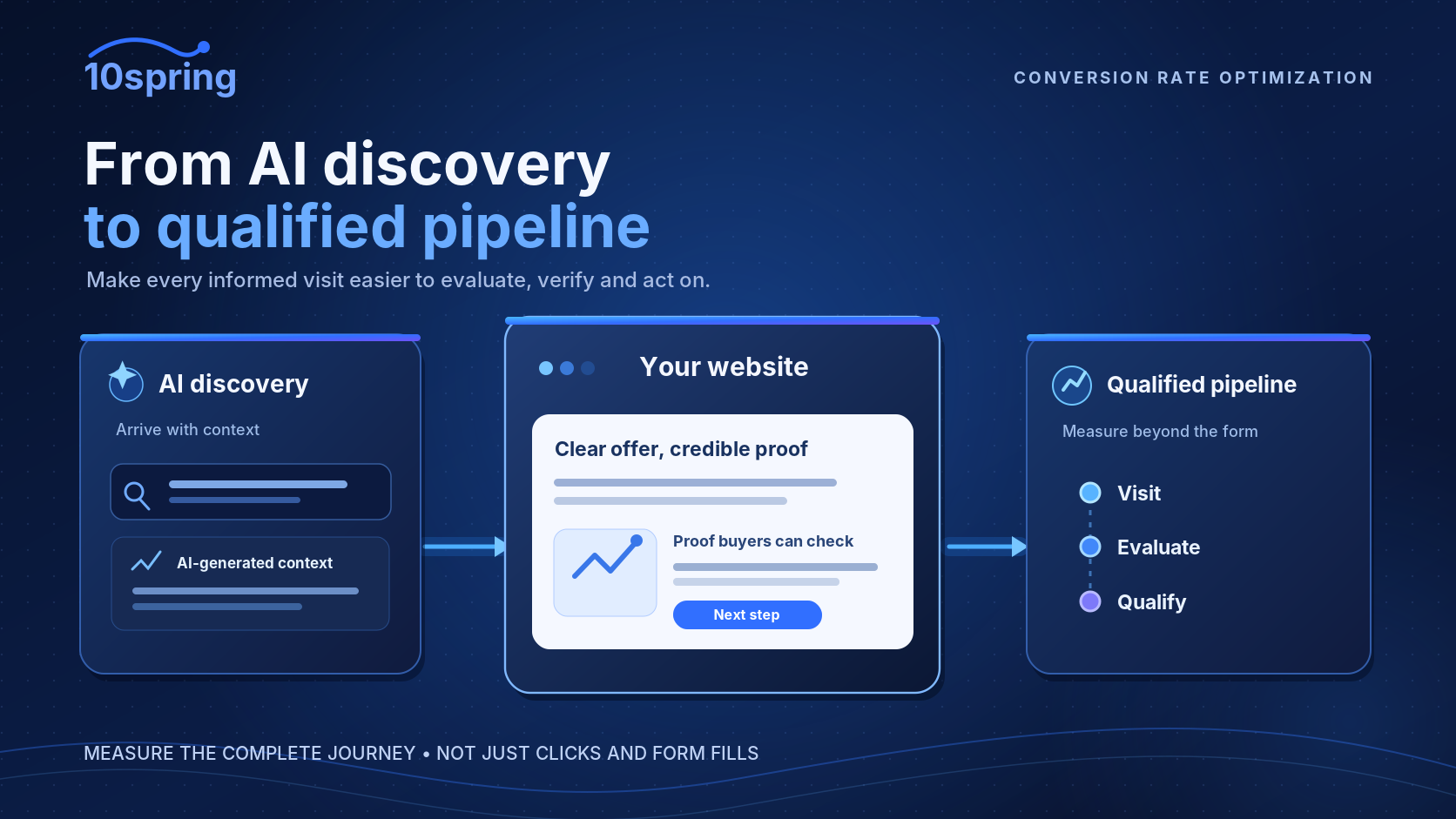
Conversion Rate Optimization (CRO) is usually defined as raising the share of visitors who take a desired action. For a B2B website, that definition is too narrow. The action that matters is not a form fill. It is a qualified opportunity that becomes pipeline and, eventually, a customer.
AI Search Engines make the gap between those two things easier to see. Visitors may arrive in smaller numbers, later in their research, and with a view of your company already shaped by an AI-generated answer. The page they land on has a different job than it did when search was mostly a list of links.
This article covers what is changing for B2B buyers and what the evidence says about visitors who arrive from AI Search Engines. It then covers what a page needs to do for an informed visitor, and how to measure and test when traffic is limited. It draws on research from Gartner, Forrester, G2, Pew Research Center, Leadfeeder, Amsive, TrustRadius, and Google, and it notes where that research has limits.
What is changing, and what is not
Buyers arrive better informed. Gartner's March 2026 release reported that 67% of surveyed B2B buyers preferred a rep-free experience. G2's 2026 survey of 1,076 B2B software buyers found that 51% start with an AI chatbot more often than with Google. Forrester found that buyers check AI output with trusted people. A TrustRadius survey of 1,862 buyers reported that 94% fact-check AI-generated information. Its publisher sells review-site and buyer-intent products, and the public write-up gives no methodology, so treat that figure as directional.
Clicks are changing too. Pew Research Center tracked the browsing of 900 U.S. adults in March 2025. When a Google results page showed an AI summary, users clicked a traditional result link in 8% of visits, compared with 15% of visits without one. Only 1% of visits to pages with a summary included a click on a source cited in it. That is a snapshot from early 2025, and Google's features have changed since. The direction is the useful part: some of the research that once happened on your site now happens before the click.
What is not changing is the job after the click. The page still has to be understood, trusted, and acted on. Google's guide to its generative AI features says no special markup, llms.txt file, or content rewritten into smaller chunks is needed. So CRO is not a form of AI optimization. It is the work that decides what a visit is worth once a buyer arrives.
Do AI-referred visitors convert better?
The popular claim is that they do, and some published figures are large. A July 2026 Demand Gen Report column summarized three of them. Semrush estimated that visitors from AI tools convert at 4.4 times the rate of traditional organic visitors. Seer Interactive's analysis of one B2B software company found 15.9% for ChatGPT visitors against 1.76% for Google organic. A Microsoft Clarity analysis of more than 1,200 websites found a 1.66% sign-up rate against 0.15%. The column's author notes that the studies use different methods and samples. He also co-founded a consultancy that works on AI-driven vendor research.
Other analyses point the other way.
- Amsive found no significant difference. The agency analyzed six months of GA4 data from 54 sites. Average conversion was 4.87% for LLM referrals and 4.60% for organic, a gap that was not statistically significant. The B2B subset showed a wider gap, 2.17% against 1.16%, but it was not significant either. Amsive did not say how it identified LLM sessions, and its conversion events were not tied to customer outcomes.
- Leadfeeder found a lower share of fit. Its October 2026 study of 1,200 customer accounts measured fit, not conversion. AI referrals were about 1.8% of combined AI and organic search visits, roughly flat for a year. Of the companies arriving from AI referrals, 15.8% matched the customer's own ideal customer profile, against 20.4% for organic search. Leadfeeder sells visitor identification software. Its sample skews toward customers who already define a profile, and its fit rates are lower bounds from one four-week window.
The honest reading is that no benchmark transfers. The studies define AI traffic differently, count different outcomes, and miss visits that arrive without a referrer. Your own data, segmented carefully, is the only evidence that applies to your funnel.
What the page has to do for an informed visitor
Assume the visitor arrives with an expectation, and design for confirmation. The points below are hypotheses to test, not rules, for reasons covered later.
- Match what the visitor was told. A Gartner survey found that 69% of B2B buyers reported inconsistencies between a seller's website and what sellers told them. A visitor who read a summary of your company in an AI-generated answer is looking for the same story. Align the claims on the page with your positioning, your sales conversations, and your profiles on third-party sites.
- Make verification easy. If buyers fact-check, give them something to check: who the offering is for, how it works, what it does not do, and links to evidence outside your own site. In G2's survey, buyers named citations from a software review site first when asked what most increases their confidence in a chatbot's answer.
- Offer more than one way forward. Buyers who prefer to avoid sellers still need a next step. A demo request suits a buyer who is ready. A comparison, a self-serve explainer, or a short way to ask a question suits one who is not.
- Ask only for what the next step needs. Each added form field is a possible reason to leave. Test that trade-off against lead quality, not just completion rate.
- Keep the basics sound. Google says its ranking systems use Core Web Vitals and recommends good scores, but good scores do not guarantee top rankings. Google adds that other page experience factors still make a site more satisfying to use.
Measure outcomes, not just conversions
A conversion rate depends on two choices: what counts as a conversion, and what counts as a visitor. Both need care.
Start with the outcome. A form-fill rate is a useful signal, but it is not the result. Amsive acknowledges in its own study that form fills and demo requests are not tied to lead-to-customer conversion. Follow conversion through the stages that matter, from visitors to qualified opportunities to pipeline and customers, attributed only where reliable data supports the link. If conversion rises but opportunity quality does not, look for friction in the conversion pathway before treating the result as a win.
Then be honest about what you can see.
- Some AI visits arrive untagged. Seer Interactive's tracking guide notes that ChatGPT visits without referral information land in Direct, and that tags are not guaranteed. Treat visible AI referrals as a floor, not a total.
- Google's AI features are not separable. When Google added AI Mode data to Search Console in 2025, it counted toward the Performance totals and could not be filtered on its own. Check how current reporting works before you build a view on it.
- Influence leaves no click. An AI-generated answer that shapes a shortlist may show up later as a direct visit or a branded search, if it shows up at all.
Set baselines before you change anything, so results are compared with a starting point and not a feeling.
Test with the traffic you have
Testing is the core of CRO, and it is humbling. Microsoft's Bing team reported in 2013 that when ideas were evaluated in controlled experiments, fewer than a third moved the metric they were meant to improve. That was a very large consumer platform, so do not read it as a B2B benchmark. The lesson that transfers is that confidence in an idea predicts its result poorly.
The second problem is arithmetic. A standard two-proportion calculation, at 5% significance and 80% power, shows the scale. A page converting at 2% needs roughly 21,000 visitors per variant to detect a 20% relative improvement, from 2.0% to 2.4%. At a 1% baseline, the same test needs about 43,000 per variant. Many B2B pages do not see that traffic in a reasonable period. AI referrals, at about 1.8% of search visits in Leadfeeder's network, are far too few to test on their own.
With limited traffic, four habits help.
- Start with qualitative evidence. Review sales calls, session recordings, and form abandonment, and run usability tests with real buyers. They show where visitors get stuck faster than a test can.
- Test larger changes. A different structure, offer, or message is more likely to produce a measurable difference than a new button color.
- Fix obvious friction without a test. A broken form or a page that fails to load does not need an experiment.
- Treat before-and-after results with caution. Seasonality, campaigns, and traffic mix all move conversion, so record what else changed.
Know where CRO stops
Conversion work cannot fix a problem that sits before or after the page. If the visitors are a poor fit for what you sell, a better page converts the wrong audience more efficiently. If positioning is unclear, the page can only mirror the confusion. If leads wait days for a follow-up, the form was never the bottleneck. A short diagnosis comes first: is the leak before the page, on the page, or after the form?
Practical takeaways
- Define conversion in terms of qualified opportunities, not form fills alone.
- Do not import a benchmark for AI-referred visitors. Segment your own traffic, and read the result as a floor, because some visits arrive untagged.
- Design pages for confirmation: consistent claims, checkable specifics, and more than one way forward.
- Treat every change as a hypothesis. Most ideas do not move the metric they target.
- Match the method to your traffic: qualitative research first, larger changes, and fixes without tests when the problem is obvious.
- Set baselines before you change anything.
- Diagnose whether the leak is before the page, on the page, or after the form.
10spring works alongside internal marketing teams. If you want to pressure-test where your website loses qualified buyers, Book A Call. Let's accelerate your pipeline together.
Sources and further reading
All sources accessed November 13, 2026.
- Gartner. Gartner Sales Survey Finds 67% of B2B Buyers Prefer a Rep-Free Experience. Press release, March 9, 2026. Survey of 646 B2B buyers, August to September 2025.
- Gartner. Gartner Sales Survey Finds 61% of B2B Buyers Prefer a Rep-Free Buying Experience. Press release, June 25, 2025. Survey of 632 B2B buyers, August to September 2024.
- G2. In the Answer Economy, Don't Win the Click, Win the Answer. Research summary, April 15, 2026. Survey of 1,076 B2B software buyers and decision-makers, fielded March 2026.
- Barbara Winters, Forrester. The State Of Business Buying: Risk-Averse Buyers Demand Proof, Not Promises. Blog post, January 21, 2026. Based on Forrester's Buyers' Journey Survey of nearly 18,000 business buyers. The full report is not publicly available.
- Grace Wells, HG Insights (TrustRadius). Trust More, Verify Everything: What the 2026 B2B Buying Disconnect Report Says. Blog post, July 15, 2026. Survey of 1,862 buyers and 444 vendors. Methodology not published. The publisher sells review-site and buyer-intent products.
- Athena Chapekis, Pew Research Center. Google users are less likely to click on links when an AI summary appears in the results. Short read, July 22, 2025. Browsing data from 900 U.S. adults, March 2025.
- Shane H. Tepper, Demand Gen Report. The Conversion Reversal Most Demand Gen Teams Haven't Priced In. Column, July 24, 2026. Summarizes Semrush, Seer Interactive, and Microsoft Clarity figures. The author co-founded a consultancy in this field.
- Will Guevara, Amsive. Does LLM Traffic Convert Better Than Organic? A New Data-Backed Study. Blog post, September 3, 2025. GA4 data from 54 sites. Amsive is a marketing agency.
- Leadfeeder. AI Referrals in B2B: Traffic, ICP Fit and Return Visits. Study, October 28, 2026. Data from 1,200 customer accounts. Leadfeeder sells visitor identification software.
- Seer Interactive. Your AI Traffic Is Hiding: A Practical Guide to Tracking ChatGPT, Claude, and More. Guide. Only the public summary was available.
- Search Engine Land. Google AI Mode traffic data comes to Search Console. News article, 2025.
- Microsoft Bing. Large Scale Experimentation at Bing. Blog post, August 8, 2013.
- Google Search Central. Optimizing your website for generative AI features on Google Search. Documentation, last updated July 10, 2026.
- Google Search Central. Understanding page experience in Google Search results. Documentation, last updated September 22, 2026.