Data current as of November 2026.
THE SHORT ANSWER
B2B companies get cited in AI search by making accurate, well-supported business information easy to find, easy to understand, and credible across the sources AI systems draw on. That work overlaps with strong SEO, so the two should run as one program. No one can guarantee a citation. What a company can do is improve its readiness, measure what it observes, and iterate.
The shortlist forms before the sales call
A B2B buying committee rarely starts with your sales team. It starts with a question typed into an AI search engine. By the time a buyer contacts you, the shortlist is often already formed.
G2’s 2026 research on software buyers shows how quickly that has changed. In its survey, 51% of B2B software buyers now start their research with an AI chatbot more often than with Google, up from 29% in 2025 (G2, April 2026). In the same research, 69% of B2B software buyers chose a different vendor than they first planned because of AI chatbot guidance (G2, April 2026).
For a company selling a high-ACV product in a long, complex sales cycle, those figures raise a practical question. When a buyer asks an AI search engine which vendors to consider, does your company appear, and is the description accurate?
This article covers what it means to be cited in AI search, why ranking on Google no longer settles the question, and what makes a B2B company easier for AI search engines to find, understand, and trust. It also explains how to balance that work with traditional SEO, which still drives most search traffic to B2B sites, and how to measure progress without overclaiming.
Why citation matters to a buying committee
AI answers are no longer a side channel for B2B research. Forrester’s 2026 research on business buying found that GenAI tools were the most frequently cited meaningful interaction type for researching purchases (Forrester, State of Business Buying 2026, via Digital Commerce 360). G2’s findings point the same way.
- 71% of surveyed buyers rely on AI chatbots at some point in software research. (G2, April 2026)
- 82% of surveyed buyers sourced software recommendations from an AI chatbot in the last 24 months. (G2, July 2026)
- 85% of surveyed buyers think more highly of a vendor when AI includes it in an answer. (G2, April 2026)
The last figure deserves attention. Inclusion in an AI answer signals how highly buyers regard a vendor, and it happens before your team even knows the evaluation exists. Omission is invisible. Nobody tells you which evaluations you were never part of.
Complex sales cycles amplify the impact. A buying group includes people with different concerns, such as operations, security, finance, and the executive sponsor. Each person asks different questions, and each question is a chance for your company to be included or excluded. For that reason, this guide treats citation as a readiness problem across the entire buying group, not just a top-of-funnel visibility goal.
One limitation applies throughout. These findings describe what buyers report and do. They don’t prove that any specific tactic produces a citation, and nothing in this article guarantees anything.
What being cited actually means
People use “cited” loosely. For measurement, it helps to distinguish three outcomes.
- Appearing. Your company appears in the answer to a relevant buyer question. This is the idea behind AI share of voice: how often your brand appears in a defined set of relevant answers, compared with selected competitors.
- Being referenced. The answer points to your content, or to a source that describes you. These citations and sources indicate what may be shaping the response.
- Being described accurately. The answer correctly states your offering, differentiation, and customer fit. A mention that gets your offering wrong does not help you.
Six AI search engine experiences, plus Google
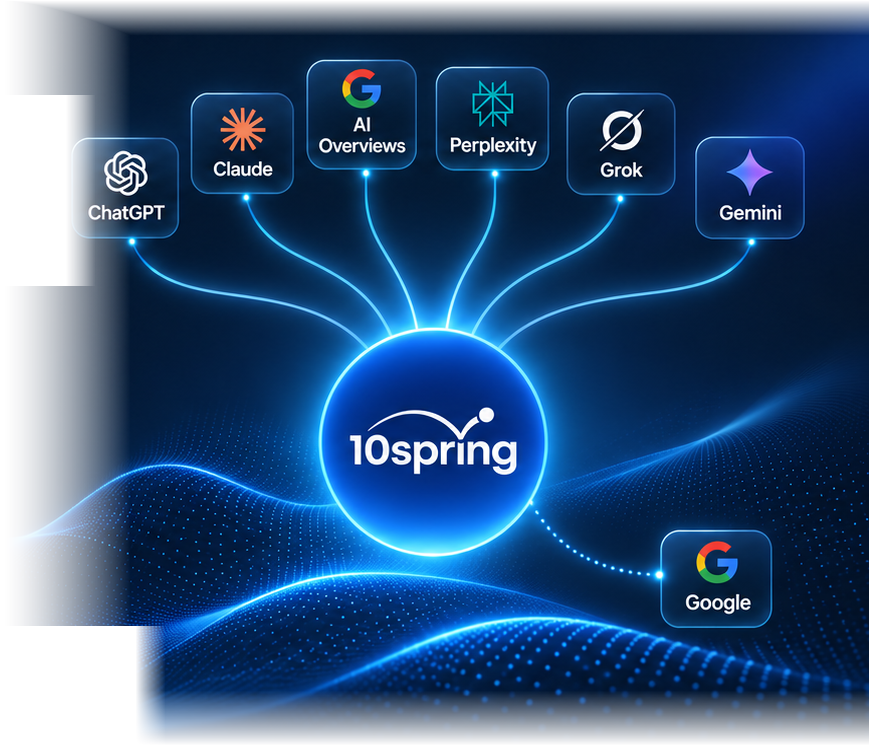
Buyers don’t rely on a single tool. 10spring evaluates how a company appears across six AI search engines and maintains a separate view of traditional Google Search.
- ChatGPT. Buyer questions, category recommendations, and vendor comparisons. 1B+ weekly users (OpenAI, August 2026, via SiliconANGLE)
- Claude. Research synthesis, explanations, and evidence-based comparisons. 56M monthly active app users, growing about 640% year over year (Sensor Tower, June 2026, via PYMNTS)
- Perplexity. Source-rich answers and linked reference visibility. No current company-confirmed user count
- Grok. Brand and category presence in AI-generated responses. About 117M monthly active users of its AI features, as of March 31, 2026 (SpaceX S-1, via Pulse 2.0)
- Gemini. Google’s AI assistant research and recommendation flows. 1B+ monthly app users (Google, August 2026)
- Google AI Overviews. AI answer summaries embedded in the Google search experience. 2.5B+ monthly users; Google AI Mode: 1B+ (Google I/O, May 2026, via Digit)
Audience figures use different definitions, so read them as scale, not as a ranking.
G2 also found that ChatGPT is the most-used AI search engine for B2B software research, at 63% (G2, via Demand Gen Report). Google AI Overviews is a feature of Google Search, not a standalone AI search engine, and platform coverage and answer behavior may change over time. Traditional Google Search remains a separate measurement track covering organic rankings, search demand, click-through behavior, and on-site conversion.
Answers also vary by system, prompt, time, and context. For that reason, visibility is something you observe across a defined set of buyer questions. It’s not a rank you hold.
Ranking is not the same as being cited
Traditional SEO has a clear scoreboard: where a page ranks for a query. AI answers change that, because the answer often appears before the list of links or replaces it. Four findings show what has changed.
- 82% of tracked B2B technology queries now trigger a Google AI Overview, up from 36% a year earlier (BrightEdge, February 2026).
- Only 38% of AI Overview citations come from pages in the top 10, down from 76% in July 2025 (Ahrefs, March 2026, via Search Engine Journal).
- The top organic result gets 58% fewer clicks when an AI Overview appears (Ahrefs, December 2025 data).
- Brands cited in an AI Overview get 35% more organic clicks and 91% more paid clicks than brands that aren’t cited (Seer Interactive, September 2025).
Read those figures together. Ranking in the top 10 is a weaker signal of citations than it was in mid-2025, so ranking well no longer reliably indicates which pages an AI Overview will cite. Seer’s figures show an association between being cited and earning clicks. They do not show that citation causes clicks.
The practical conclusion is not to abandon rankings. Instead, stop treating them as the sole measure. A B2B company needs to appear in the results list and be visible within the answer.
The readiness framework: findable, understandable, credible
AI answer engines and traditional search discover information differently, yet they share many underlying signals: clear positioning, crawlable content, technical quality, and earned credibility. 10spring organizes the work into three questions:
- Can AI systems find your information?
- Can they understand it?
- Do they have reason to trust it?
1. Make your information findable
AI search engines can’t use information they can’t access. Technical accessibility is the first layer for both AI search and traditional SEO.
- Keep important pages crawlable and technically sound.
- Present key facts, such as definitions, specifications, and statistics, as readable text on the page rather than in images.
- Organize the site around buyer intent so that each major buyer question has a clear home.
- Show when information on pages that carry data or claims was last updated.
2. Make your information understandable
Findability is not enough. The content also has to answer the questions buyers ask, using language that is specific and consistent.
- Answer buyer questions directly. Structure content around the questions a buying committee asks, such as category fit, differentiators, and comparison criteria. Lead with the direct answer, then provide supporting detail.
- Cover the topic, not just the keyword. Topical coverage means answering related questions too, such as implementation, integration, and security.
- Keep brand and entity information consistent. Use the same company name, category, description, and key facts across your website, profiles, directories, and review sites. When using structured data, ensure it matches the same information.
- State your fit and your limits. Say who the product serves and who it doesn’t. A clear fit is easier for a buyer to evaluate and for any summary of your company to get right.
3. Make your information credible
Buyers judge whether a claim is supported. The sources behind an AI answer may shape how it portrays you. Credibility comes from what you show and what others say about you.
- Show your sources. Back claims and statistics with named, dated, and linked sources, and state the scope of each. This article follows that rule.
- Earn third-party validation. Reviews, analyst coverage, press, partner pages, and other trusted external sources carry weight with buyers. G2’s July 2026 research found that review sites (38%) narrowly surpassed AI search engines (37%) as the top source shaping shortlists.
- Build authority over time. Original content, expert commentary, and relevant earned coverage build authority that supports both search rankings and citation readiness. Content Development and Digital PR, two of 10spring’s nine Execution Channels, support this work.
Most of this is disciplined marketing practice applied to a new kind of reader. None of it guarantees a citation, and it shouldn’t be sold as if it does. The framework provides improved readiness and a concrete way to measure it.
Build for the entire buying committee, not just the shortlist
Appearing on a shortlist starts the evaluation. It doesn’t finish it. G2’s 2026 buyer behavior research shows how heavily the later stages weigh in a complex deal.
- Evaluation is now the longest stage of the software buying journey for 40% of buyers, ahead of research at 36% (G2, July 2026). That’s 40% of buyers, not 40% of the buying cycle.
- Finance involvement in software decisions jumped from 31% to 46% in a single year (G2, July 2026).
- 49% of buyers say their CFO reversed an already-approved purchase in the last 12 months (G2, July 2026).
- IT security review is the biggest source of delay, cited by 39% of buyers (G2, July 2026).
That changes what good content looks like. An AI-generated answer may help put your company on the list. The people who evaluate you next ask harder questions:
- How does it integrate?
- How is security handled?
- What is the business case?
When finance joins, a clear, well-supported ROI story is essential.
Build content for those questions on purpose.
- Publish plain-language answers to security, compliance, and implementation questions so both buyers and AI search engines can find them.
- Provide finance stakeholders with evidence to assess cost, risk, and expected value, including sources and stated assumptions.
- Make comparison criteria explicit so a buyer can see how to evaluate your category and where you fit.
- Keep your story consistent from AI-visible content through the sales conversation. A buyer who hears one account in an answer and another in the meeting has reason to doubt both.
Balancing AI Search Readiness and SEO
Marketing leaders often ask whether AI search should take budget from SEO. Evidence shows buyers use both, so the better question is how to coordinate them.
Buyers use both
80% of surveyed buyers still use Google somewhere in the software buying journey, and 61% use AI search alongside Google (G2, April 2026; MarTech). Google also holds 89.94% of worldwide search share (StatCounter, September 2026).
Two views of the same market
Survey data and traffic data answer different questions. The table presents them side by side.
What surveyed buyers report
- 51% of B2B software buyers start research with an AI chatbot more often than with Google (G2, April 2026).
- 80% still use Google somewhere in the software buying journey (G2, April 2026).
What traffic and usage data show
- 2.4% is AI search’s share of B2B search sessions in Q3 2026 (Octane11).
- About 96.6% is traditional organic search’s share of those sessions (Octane11).
- 1.08% of all website traffic across ten industries came from AI referrals, and 2.80% in the IT industry, in U.S. data from May to September 2025 (Conductor).
- 1.65% of US desktop events in Q1 2026 were on AI tools (Datos, via PPC Land).
Octane11’s shares describe B2B search sessions in its own tracked data, not all website traffic. Conductor’s figures cover all website traffic across ten industries, not only B2B.
These numbers don’t contradict each other. G2 reports where surveyed software buyers say they begin. Octane11, Conductor, and Datos count sessions, visits, and events that analytics and clickstream data can capture. An AI answer can shape a shortlist without sending the buyer to your site. Octane11 also notes that AI referrals arrive without campaign tags or a company name, making them hard to attribute to accounts.
A low referral share does not indicate that AI has little influence, because an answer can inform a decision without generating a click. A high rate of stated AI use does not mean search has stopped mattering. In Octane11’s B2B data, traditional organic search still accounts for the overwhelming majority of search sessions, and AI search, though small, has risen in 2026. The share of your own site’s visits from organic search varies, so check your analytics before deciding how much weight it carries for your business.
One system, two scorecards
AI Overviews appear within Google results, so a single results page can display both a summary and a list of links. That means the work can’t be cleanly divided between an AI team and an SEO team. The two efforts share a foundation.
AI Search Readiness
- Answer clarity and topical coverage
- Brand and entity consistency
- Source and citation readiness
Shared foundation
- Content
- Authority
- Measurement
Traditional SEO
- Technical search accessibility
- Intent-led site architecture
- Organic performance and conversion paths
10spring treats this as a single coordinated plan, not four disconnected optimization products. SEO, GEO, AEO, and AIO describe overlapping capabilities, and none is sold as a separate service.
How to decide where effort goes
There is no standard split between AI Search Readiness and SEO, and 10spring doesn’t prescribe one. The right balance depends on where buyers find you today, where you are missing, and what you can measure. A diagnostic answers three questions.
- Are there foundational gaps? Crawl issues, a weak site structure, thin content, or inconsistent company information affect both channels. Fix these first.
- Does organic performance hold up when AI answers omit or misrepresent you? Prioritize answer clarity, entity consistency, and external credibility.
- Do AI answers describe you well while organic conversion paths leak? Prioritize intent-led architecture, page quality, and Conversion Rate Optimization (CRO).
Then keep two scorecards. Measure the six AI experiences together, and keep traditional Google Search as a separate seventh track. Compare the two over time rather than merging them into a single number.
How to measure whether it’s working
Measurement is where AI search work most often goes wrong, because there is a temptation to report a single score. 10spring’s approach is simpler. Establish a baseline, monitor selected commercial-intent prompts and traditional search signals, and connect improvements to business outcomes where attribution is supported. Four measures do most of the work.
- AI share of voice. How often your brand appears in a defined set of relevant answers compared with selected competitors.
- Citations and sources. Which answers reference your business, and what sources may be shaping those responses.
- Message accuracy. Whether answers accurately describe your offering, differentiation, and customer fit.
- Organic and pipeline signals, including search visibility, qualified traffic, on-site conversions, and attributable opportunities where data permits.
Three limits apply:
- Observed, not fixed. Results are based on a defined set of prompts and platforms at a point in time, so they reflect observed visibility, not a permanent ranking. Specific measurement capabilities depend on platform access and available data.
- Attribution gaps. AI referrals are difficult to attribute, so part of AI’s influence may not appear in analytics.
- Correlation is not causation. A rise in citations alongside a rise in the pipeline does not show that one produced the other.
10spring’s standard: no proprietary AI score, no guaranteed citations, and no unsupported promise that search visibility will produce a specific revenue result.
What the work looks like
AI Search Readiness + SEO follows the same four-phase operating model used across 10spring engagements, tailored to the search and commercial friction a business actually faces. The phases are diagnostic and iterative and aren’t a fixed timeline.
- Phase 1: Diagnostic and Fast Wins Protocol. Audit the existing search foundation, AI answer visibility, and the highest-priority opportunities.
- Phase 2: Friction Analysis of Mechanical Failures. Identify gaps in site structure, positioning, source credibility, and conversion paths.
- Phase 3: Infrastructure Deployment. Implement targeted technical, content, authority, and measurement improvements.
- Phase 4: Measurement, Analysis, and Iteration. Evaluate observed changes and refine priorities using actual market and performance data.
The work is delivered through one of two engagement models:
- As a Specialized Campaign, AI Search Readiness + SEO is a scoped initiative to diagnose and improve visibility for a specific AI-search and traditional-search visibility problem.
- Within a Pipeline Engine, AI Search Readiness + SEO serves as an Execution Channel and becomes part of the ongoing growth infrastructure within a broader pipeline engagement. Pipeline Engines are customized to stage: the GTM Engine for startups and early growth, the Scale Engine for the middle market, and the Optimization Engine for enterprise.
Neither model is a fixed bundle or a rate card, and neither guarantees a result by a set date. Objectives, deliverables, and timelines are established during discovery.
A readiness self-check
Use these ten questions to see where your company stands. Any “no” or “not sure” indicates a place to start.
- Have you listed the questions your buying committee asks before contacting a vendor, including those on security, finance, and implementation?
- Does your site answer each of those questions directly, using text that both readers and crawlers can access?
- Are your key pages crawlable and technically optimized?
- Do your company name, category, description, and key facts match across your website, profiles, directories, social media, and review sites?
- Do you state who your product fits and who it doesn’t fit?
- Are your claims and statistics supported by named, dated, and linked sources?
- Do third-party sources, such as reviews, analyst coverage, press, or partner pages, support your positioning?
- Have you tested how ChatGPT, Claude, Perplexity, Grok, Gemini, and Google AI Overviews describe your company in response to a defined set of buyer questions?
- Do those answers accurately describe your offering, differentiation, and customer fit?
- Do you track organic search performance and conversion paths separately from AI visibility, using a documented baseline?
If several answers are “no” or “not sure,” the Diagnostic and Fast Wins Protocol is where the work begins. A 10spring AI Search Audit helps you understand where you appear, where your competitors appear, and what to prioritize next.
Frequently asked questions
How do B2B companies get cited in AI search engines?
No one controls what an AI system says, and no one can guarantee a citation. B2B companies can improve readiness by making their information findable (crawlable, technically sound pages), understandable (direct answers and consistent company information), and credible (named sources and third-party validation). Then they measure what they observe across a defined set of buyer questions.
Does AI Search Readiness replace traditional SEO?
No. Buyers use both AI research experiences and traditional search. We coordinate the technical, editorial, and authority work across both rather than treating them as competing strategies.
Which AI experiences do you evaluate?
Our current coverage framework includes ChatGPT, Claude, Perplexity, Grok, Gemini, and Google AI Overviews. Traditional Google organic search is assessed separately. Specific measurement capabilities depend on platform access and available data.
Can you guarantee that an AI engine will cite our brand?
No. AI answers vary by system, prompt, time, and context. We improve readiness and monitor observed visibility; we do not guarantee citations, rankings, or placement.
How long until we see results?
There is no universal timeline. We establish an initial baseline, identify fast wins, and prioritize work according to your site’s current condition, competition, and available resources. We report observed changes rather than promising a fixed date.
Do you replace our marketing or revenue team?
No. We work alongside your existing team and technology stack, aligning execution with your sales motion, internal expertise, and business priorities.
What is the difference between SEO, GEO, AEO, and AIO?
They are overlapping capabilities, not four separate services. SEO (Search Engine Optimization) improves technical accessibility, relevance, and authority for traditional organic search via Google and Bing. GEO (Generative Engine Optimization) makes relevant, trustworthy brand information easier for generative search systems to discover and use. AEO (Answer Engine Optimization) structures clear, direct answers to the questions buyers ask across search and AI experiences. AIO (Artificial Intelligence Optimization) is an umbrella term for improving how AI-driven experiences interpret and surface a company’s information. At 10spring, SEO, GEO, AEO, and AIO work together as one capability: AI Search Readiness + SEO.
Let’s accelerate your pipeline together.
We build the digital marketing infrastructure to close high-ACV deals in long, complex sales cycles. If you want to see how your company appears across ChatGPT, Claude, Perplexity, Grok, Gemini, Google AI Overviews, and Google Search, start with an audit.
Sources and further reading
Every statistic in this article is linked to its source at the point of use. The table lists what each source measured and when. If a figure reached us through secondary reporting, the source name indicates this.
- G2, The Answer Economy — Survey of 1,076 B2B software buyers, fielded March 2026. Figures used: 51% (up from 29% in 2025), 69%, 71%, 85%, and the 61% and 80% figures. (Published April 15, 2026)
- G2, 2026 Buyer Behavior Report (news release) — Survey of more than 1,000 buyers. Figures used: 82%, review sites at 38% versus AI chatbots at 37%, finance involvement rising from 31% to 46%, and IT security review at 39%. (July 22, 2026)
- G2, 2026 Buyer Behavior Report: The Evaluation Maze — Survey of more than 1,000 buyers. Figures used: evaluation as the longest stage for 40% of buyers (research at 36%), and 49% reporting a CFO reversal of an approved purchase. (July 22, 2026)
- MarTech — Reporting on G2 research. Used alongside G2 for the 61% and 80% figures. (2026)
- Demand Gen Report — Reporting on G2 research. Used for ChatGPT as the AI chatbot most used for B2B software research (63%). (2026)
- Forrester, State of Business Buying 2026, via Digital Commerce 360 — GenAI tools as the single most cited meaningful interaction type for researching purchases. (January 2026)
- BrightEdge — Tracking of B2B technology queries from February 2025 to February 2026: 82% trigger a Google AI Overview, up from 36% a year earlier. (February 2026)
- Ahrefs, via Search Engine Journal — Study of 863,000 keywords: 38% of AI Overview citations come from top-10 pages, down from 76% in July 2025. (March 2026)
- Ahrefs, via Stan Ventures — Analysis of 300,000 keywords: the top organic result gets 58% fewer clicks when an AI Overview appears. (December 2025 data)
- Seer Interactive — Comparison of clicks for brands cited and not cited in AI Overviews: 35% more organic clicks and 91% more paid clicks for cited brands. (September 2025)
- Google I/O, via Digit — Google AI Overviews at 2.5B+ monthly users and Google AI Mode at 1B+. (May 2026)
- SiliconANGLE — ChatGPT at 1B+ weekly users, as stated by OpenAI. (August 2026)
- Google, Gemini app — Gemini app at 1B+ monthly users. (August 11, 2026)
- Sensor Tower, via PYMNTS — Claude at 56M monthly active app users, growing about 640% year over year (Sensor Tower estimate). (June 2026)
- SpaceX S-1, via Pulse 2.0 — Grok at about 117M monthly active users of its AI features. (As of March 31, 2026)
- StatCounter — Google’s share of worldwide search: 89.94%. (September 2026)
- Datos, via PPC Land — US clickstream data: AI tools at 1.65% of desktop events in Q1 2026, and Google at 94.3% of US desktop search in March 2026. (Q1 2026)
- Octane11, State of B2B AI Search — B2B search sessions (organic, AI, and Reddit Organic combined) in Octane11’s tracked data, September 2025 to September 2026: AI search at 2.4% in Q3 2026 and traditional organic search at roughly 96.6%. (Published November 3, 2026)
- Conductor, 2026 AEO / GEO Benchmarks Report — AI referral share of all website traffic across ten industries (1.08%) and in the IT industry (2.80%). U.S. data from May to September 2025. (Released November 2025)
How to read these figures
- G2’s research covers B2B software buyers. It does not represent every B2B category.
- Audience figures use different definitions, such as weekly users, monthly users, app users only, or AI features inside a larger product. Read them as scale, not as a ranking. Perplexity appears without a figure because no current company-confirmed user count exists.
- Survey results show what buyers report. Analytics and clickstream data show what can be observed. They measure different things.
- Octane11’s shares describe B2B search sessions in its own data, not all website traffic.
- Several of the organizations cited sell search, analytics, or marketing products or services. We cite their research for what it measured and note its scope.
- Some findings are associations, not causes, including Seer’s comparison of cited and uncited brands.
Update log. November 2026: Initial version.