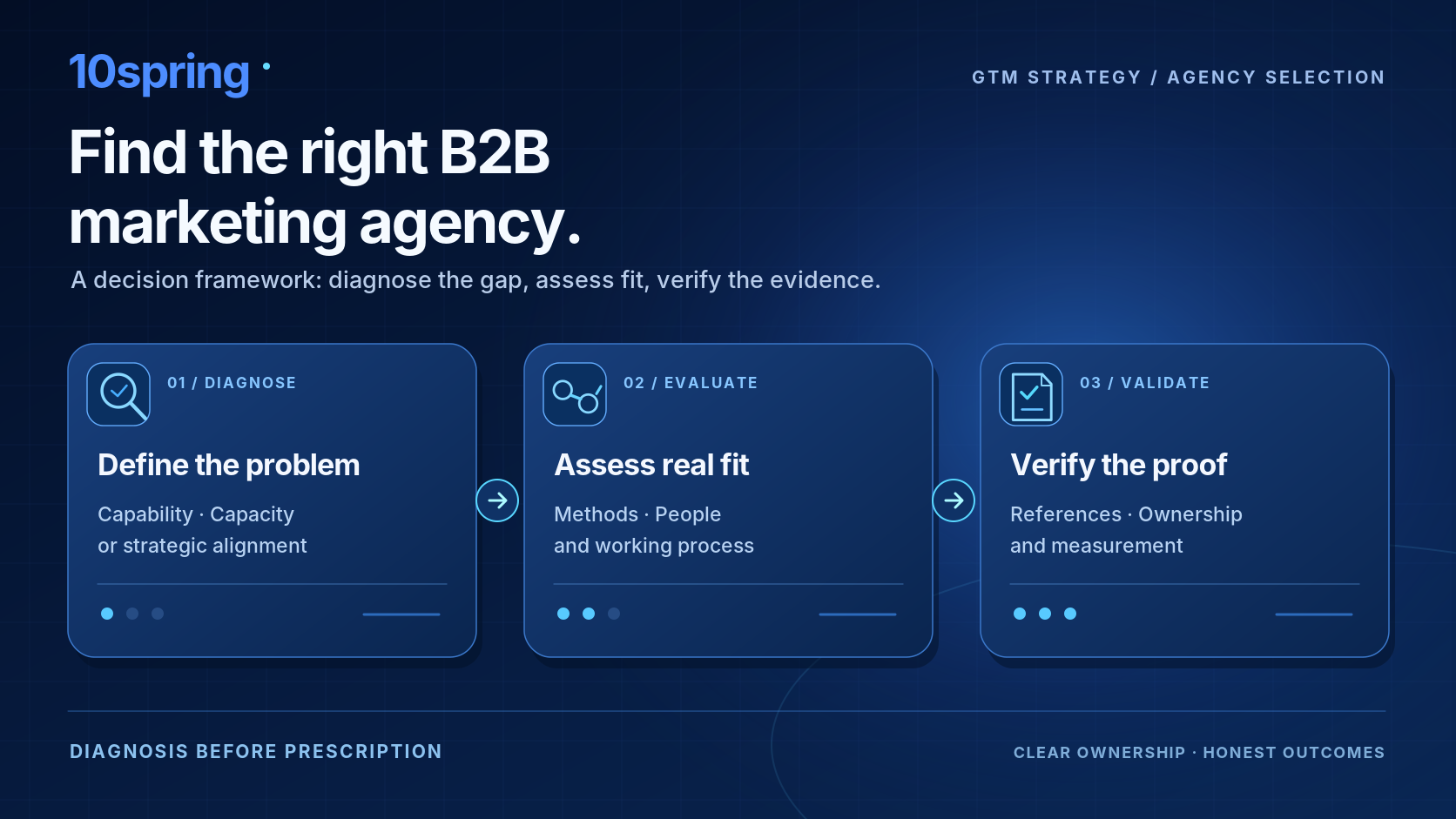
Most B2B marketing leaders will work with an agency at some point. In Forrester's 2026 B2B Brand and Communications Survey, 93% of respondents used agencies in some capacity. Finding the right one is harder than it looks. Proposals tend to resemble each other, and the differences that matter, such as method, staffing, and measurement, can be hard to see in a pitch.
A note on perspective: 10spring is a B2B growth marketing agency, so read this the way you would read any vendor's advice. The guidance below is meant to hold up whichever agency you choose, including the choice not to hire one.
This article covers what to define before you search, what to evaluate, how to run a process that reveals fit, and which warning signs to catch early. It draws on research from Forrester, the ANA, the 4As, and Google, and it notes where that research has limits.
Start with the problem, not the shortlist
The most common mistake is to start with a list of agencies. The better start is a written problem. What is failing in the pipeline, how do you know, and what would change if it were fixed?
That work sorts the need into one of three kinds.
- A capability gap: your team lacks a skill it will not build soon.
- A capacity gap: your team has the skill but not the hours.
- A strategy or alignment gap: no one has agreed on the audience, the positioning, or the definition of a qualified opportunity.
An agency can address the first two directly. The third usually has to be settled with your own sales and leadership teams first.
Then define what success is worth in business terms. A 2024 study by the ANA and the 4As shows how rare that is. It found that only 5% of brand-side respondents and 10% of agencies had a formal, corporate-backed definition of value. The survey covered 173 people at brands and agencies among the largest U.S. advertisers, all with at least three years in a relationship. Treat it as a signal for mid-market B2B, not a benchmark. The point still carries over. If you cannot say what a good outcome is worth, you cannot compare proposals or judge the work later.
Why the market is hard to read
Forrester's 2023 analysis of agency pitches named several problems with the traditional process. Procurement-led reviews can screen out good agencies on cost alone. Marketers often prepare poorly. The process pulls staff into briefs, meetings, and presentations. And many agencies look alike, so evidence of a good fit is hard to find. Forrester's alternative was a partnership approach, with selection run in short, time-boxed rounds and continuing through onboarding and periodic assessment.
Conditions have also shifted. In Forrester's 2026 survey, the share of marketers expecting overall agency budget increases fell 13 percentage points from 2025, and nearly half expect flat spending. Forrester reads that as marketers becoming more disciplined about where agencies add value. It expects broad "agency services" positioning to lose ground to specialized capabilities with measurable outcomes and real-world proof points.
For a buyer, that suggests weighing depth in the capability you need over breadth of services, then testing whether the depth is real.
What to evaluate
Seven questions separate agencies more reliably than a pitch deck does.
- How do they decide what to do first? Strong agencies diagnose before they prescribe. They ask for access to your data, your CRM, and conversations with your sales team, and they test assumptions before proposing tactics. An agency that arrives with a plan before it understands your pipeline is probably selling what it already has.
- Is the depth real? Ask who has done this specific work, what method they used, and what they would do differently. Ask for references you can call. Logos and awards are weak evidence on their own.
- How will they measure success? Look for a hierarchy that ends in revenue. Activity signals such as traffic, rankings, and visibility are diagnostic. Conversion performance shows whether visitors and prospects become qualified opportunities. Business impact means qualified pipeline, new customers, and recurring revenue, attributed only where reliable data supports the link.
- Can they explain their approach to AI search? Forrester's 2026 data snapshot found that 54% of B2B marketing leaders say data strategy and AI readiness matter when selecting an agency. Only 10% are satisfied with agencies' ability to execute on them. Forrester's public summary does not state the sample size. Google's guide to its generative AI features says no special markup, llms.txt file, or content rewritten into smaller chunks is needed, and structured data is not required. A good agency can explain what it would change on your site and why, and how it measures visibility in AI Search Engines, including the limits of that measurement.
- Who will do the work? Ask who will be on your account, how experienced they are, and how much of the work is done by the people you meet versus other staff or subcontractors.
- What will you own? Ask who holds the ad accounts, analytics, and data, what documentation you receive, and how the agency works alongside your team. You should be able to continue the work if the relationship ends.
- What do they say they cannot do? Ask which outcomes they cannot control, what they would need from you, and what would tell them the fit is wrong. Honest limits are a good sign.
Run a process that reveals fit
A traditional RFP often rewards the best presentation, not the best fit. A process built to show how an agency thinks works better.
- Write a one-page brief. Cover the problem and the evidence for it, the constraints, how success will be judged, a budget range, and the decision-makers. The ANA and 4As surveyed their members in 2022 about pain points in agency search. Topics included budget disclosure, clear criteria for agency success, and the involvement of key decision-makers. Without a budget range, agencies guess, and proposals become hard to compare.
- Shortlist a small number. Three to five is usually enough to compare without overwhelming your team.
- Replace the pitch with a working session. Give each finalist the same real, small problem and the same data, and watch how they reason. Forrester's RFP template lists speculative assignments among the burdens of agency reviews, so ask for thinking, not free creative work.
- Call references with specific questions. Ask what the agency did when something went wrong, how the first quarter went, and whether the reporting matched business results.
- Start with a defined, paid scope. A bounded first project or diagnostic shows how the agency works before you commit to a longer engagement. Agree in writing how either side can end the relationship and what you keep.
Warning signs
- Guaranteed outcomes. No agency controls rankings, citations in AI Search Engines, lead volume, or revenue. A promise of any of them tells you how the agency sells, not how it performs.
- A solution before a diagnosis. A detailed plan that arrives before anyone has seen your data.
- Tactics sold as essential that Google says are not required. Google's guidance on its AI features is a useful test, though it covers Google's features, not every AI Search Engine.
- Reports that stop at activity. Impressions, clicks, and lead counts without a link to qualified pipeline.
- No questions about your sales process. Marketing results depend on how leads are qualified and followed up.
- Vague answers about staffing or ownership. If it is hard to learn who does the work or who owns the accounts, expect that to continue after you sign.
- Pressure to decide quickly. A good fit survives a few weeks of scrutiny.
Keep the relationship measurable after you sign
The ANA and 4As study identified five themes behind long-term relationships: trust, value, cost, transparency, and respect. Of the respondents, 56% named trust as the most important factor. In the same study, 90% of brand-side respondents said overall value and long-term return outweighed cost. ANA's Greg Wright described cost as an entry point in selection, with value becoming the dominant factor over time. The study recommends regular 360-degree reviews of the relationship.
In practice, that means four habits.
- Set baselines before work starts. Capture traffic, conversion rates, and qualified opportunities so progress can be compared with a starting point.
- Review against the business hierarchy on a schedule. Look at activity, conversion, and business impact together, not activity alone.
- Revisit the scope as your needs change. The right split between your team and an agency moves over time.
- Keep shared documentation current. The work should not depend on any one person at the agency.
Practical takeaways
- Write the problem down before you build a shortlist, and sort it into a capability gap, a capacity gap, or a strategy gap.
- Define what success is worth in business terms before you compare proposals.
- Favor depth in the capability you need over breadth of services, and verify it with references.
- Ask how each agency decides what to do first. Diagnosis before prescription is the signal to look for.
- Test AI search claims against Google's published guidance, and treat guaranteed outcomes as a warning sign.
- Replace the pitch with a working session on a real, small problem.
- Agree on measurement, ownership, and exit terms in writing before work begins.
10spring works alongside internal marketing teams. If you want to pressure-test your agency brief or the problem you are hiring to solve, Book A Call. Let's accelerate your pipeline together.
Sources and further reading
All sources accessed November 13, 2026.
- Karen Tran, Forrester. As AI Use Expands, B2B Marketers Become More Selective About Agency Spend. Blog post, July 15, 2026. Based on Forrester's 2026 B2B Brand and Communications Survey. The full report is not publicly available.
- Forrester. B2B Brand And Communications Agencies Fail To Meet The AI Needs Of Marketers. Data snapshot, March 17, 2026. Only the public summary was available.
- John Arnold, Forrester. Need A New B2B Marketing Agency? Ditch The Pitch, And Do This Instead. Blog post, May 8, 2023. The full report is available only to Forrester clients.
- Forrester. Marketing Services Request For Proposal (RFP) Template. Template, September 27, 2024. Only the public summary was available.
- 4As and ANA. 4As and ANA Study Finds Value Outweighs Cost in the Client-Agency Review Process. Press release, June 2024. Online survey of 173 respondents from brands and agencies, conducted with Advertiser Perceptions.
- ANA and 4As. ANA/4A's Agency Search Simplification Report. Report, September 29, 2022. Based on a February 2022 member survey. Only the public summary of topics was available.
- Google Search Central. Optimizing your website for generative AI features on Google Search. Documentation, last updated July 10, 2026.