Most teams that try to track AI traffic open their analytics, find a small number, and either dismiss it or overreact to it. Both reactions miss the problem. The number is small partly because buyers research inside AI Search Engines and never click. It is also unreliable because the visits that do arrive are often unlabeled, and the labels depend on decisions made by companies you do not control.
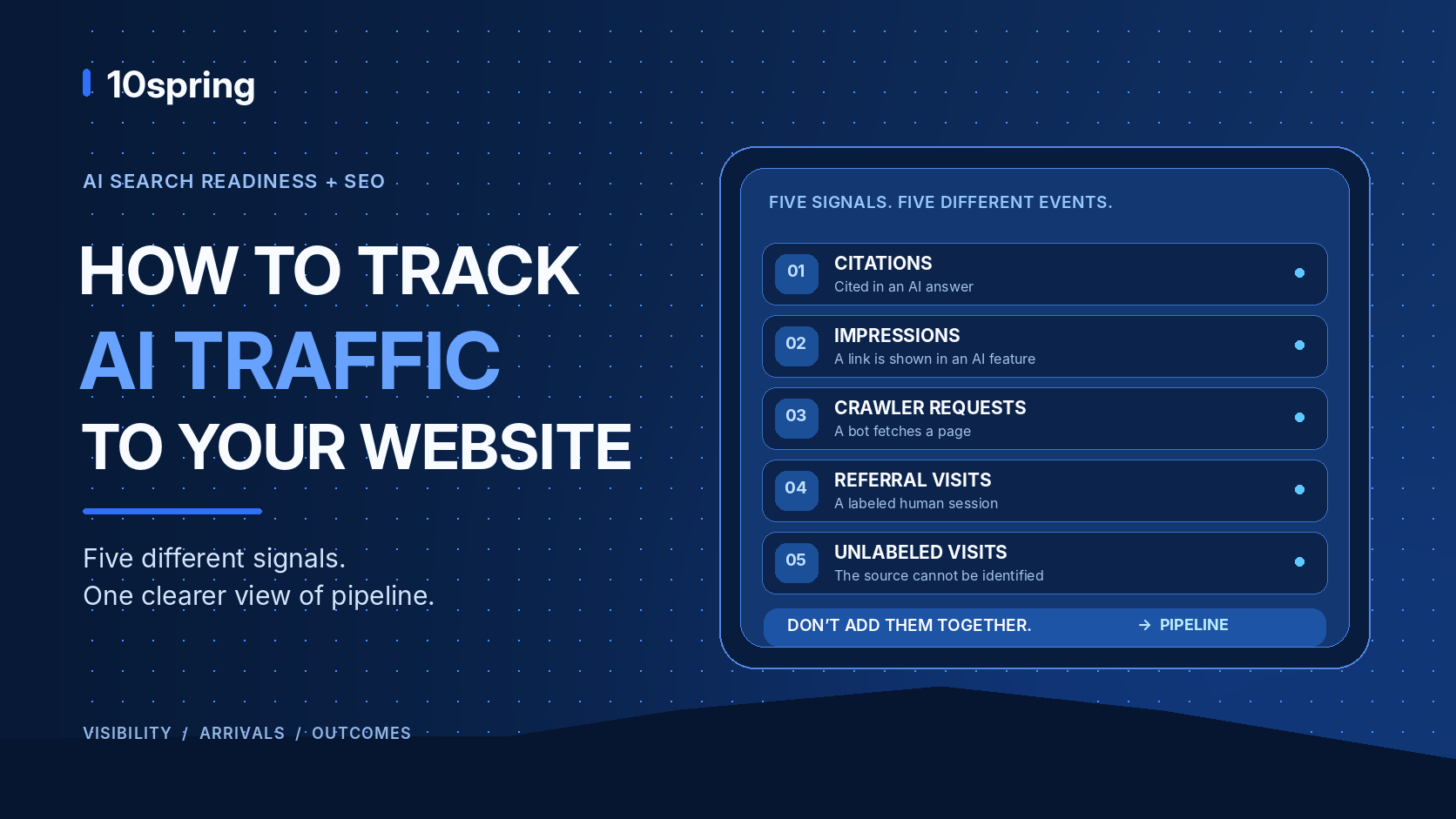
This article treats tracking as a layered question. It separates five signals that people lump together as AI traffic: citations, impressions, crawler requests, referral visits, and unlabeled visits. It then shows how to read each one in Google Analytics 4 (GA4), Search Console, Bing Webmaster Tools, and your server logs. It adds buyer-reported sources and connects everything to qualified opportunities and pipeline, not to sessions.
It draws on documentation from Google, OpenAI, and Anthropic. It also uses trade press coverage of the reports in GA4, Search Console, and Bing Webmaster Tools, and research from Leadfeeder, Microsoft Clarity, Cloudflare, Adobe, Refine Labs, G2, and Pew Research Center. Practitioner reports about an October 2026 change in how ChatGPT tags links round out the evidence. Many of these sources sell analytics tools or services, and most samples are small or skewed. It notes where research has limits. It reflects what was published as of November 13, 2026, and platform behavior in this area changes often, so check each setting in your own accounts.
Why AI traffic is hard to see
Start with the gap between buyer behavior and clicks. G2 surveyed 1,076 B2B software buyers in March 2026 and reported that 51% start their research with an AI chatbot more often than with Google. Yet referral data shows only a sliver of visits. Leadfeeder studied about 33.8 million identified company visits to B2B websites and found that AI referrals were 1.8% of combined AI and organic search visits. That share rose from 0.98% in January 2025 and then stayed between 1.4% and 2.1% for the following fourteen months. Microsoft Clarity looked at publisher and news sites and reported AI referrals at under 1% of overall traffic.
Click behavior explains part of the gap. In a March 2025 browsing study of 900 U.S. adults, Pew Research Center found that people clicked a traditional result in 8% of visits when a Google AI summary appeared, against 15% when it did not. That study covers Google summaries and general adults, not B2B buyers, so treat it as direction, not a benchmark.
Three effects keep the visible number below the real influence.
- Answers without clicks. A buyer gets what they need inside the answer and never visits a source.
- Clicks without labels. The buyer clicks, but the browser, app, or platform strips the information analytics needs to name the source.
- Delayed visits. The buyer notes your name, closes the tab, and returns later by typing your address or searching for your brand. Analytics records Direct or branded search.
The opposite risk also exists. A small set of labeled visits can look strong or weak by chance, and a platform change can move the number overnight. The goal is not to find one true AI traffic number. It is to build a defensible view from several imperfect signals and to be clear about what each one can support.
Five things people call AI traffic
Before choosing tools, separate the signals. Each one answers a different question, and each lives in a different place.
- Citations. The number of times an AI Search Engine cited a page in an answer. Bing Webmaster Tools reports this for Microsoft Copilot and related surfaces.
- Impressions. The number of times a link to your page appeared in a Google AI Overview or AI Mode response. Search Console reports this.
- Crawler requests. Requests from bots that AI companies operate, visible in server or content delivery network logs. A request means a machine read a page, not that a person visited.
- Referral visits. A person clicks a link in an answer and arrives with a referrer or tag that analytics can read.
- Unlabeled visits. A person arrives from an answer without a usable label, so analytics files the visit under Direct or another channel.
These measure different events, so do not add them together. A citation is not a visit, and a crawler request is not a citation. Read them as answers to separate questions: are we present, are we retrieved, and are people arriving?
What a referral visit looks like in GA4
GA4 added a native AI Assistant channel to the Default Channel Group on May 13, 2026, according to Search Engine Journal's report on the Google Analytics Help Center entry. When GA4 sees a referrer from a recognized chatbot, it sets the medium to ai-assistant and groups the session under AI Assistant. Google names ChatGPT, Gemini, and Claude as examples. It has not published the full list of recognized referrers or said how that list will be updated.
Three limits follow from that design.
- Detection depends on the referrer. Search Engine Journal's analysis notes that visits without a referrer header still land in Direct. In-app browsers, mobile apps, and copied links are common causes.
- Coverage is unclear. Google's August 2025 guidance on custom channel groups named ChatGPT, Gemini, Microsoft Copilot, Claude, and Perplexity. The newer announcement names only three, so confirm in your own property how Copilot and Perplexity visits are classified.
- Google's own surfaces sit elsewhere. Google's documentation says that sites appearing in AI Overviews and AI Mode are reported in Search Console within the Web search type. Practitioners report that GA4 files those clicks under Organic Search, where they cannot be separated from ordinary results.
To check your own property, open the traffic acquisition report and add session source and medium as a dimension. Look for the ai-assistant medium. Then scan Referral, Unassigned, and Direct for sources such as chatgpt.com, perplexity.ai, claude.ai, and copilot.microsoft.com that landed outside the channel you expected.
A live test is more reliable than any guide. Ask ChatGPT a question your site answers, click the cited link yourself, and watch the Realtime report to see which source and medium GA4 assigns. Repeat for each AI Search Engine you care about. Results can vary by account type, device, and app version, so repeat the test from more than one setup.
When to build a custom channel group
If the native channel misses sources you care about, a custom channel group can fill the gap. Google's August 2025 guidance described building one with a regular expression that matches AI source names. Keep the rule simple. Match the session source against a maintained list of domains. Channel rules are evaluated in order, so place the AI rule above the Referral rule. Otherwise the broader rule may claim the visit first.
Two cautions apply. Coverage of the native channel does not say whether a custom group and the native channel can conflict. Compare the two for a few weeks before you retire either one. A custom list is also a maintenance job. New AI Search Engines and domain changes will break it quietly, so review unmatched referral sources each quarter.
Do not rewrite historical channel definitions without a note. Trend comparisons break when definitions change, and the person reading the report next year will not know why.
Why ChatGPT visits go missing
The most instructive recent case is what happened to ChatGPT visits in October 2026. Cedric Huesler, who works at Adobe, reported that after the GPT-6 rollout ChatGPT began opening links in a new tab with a browser setting that withholds the referrer. He also reported that it dropped the utm_source=chatgpt.com tag from those links. With no tag and no referrer, analytics had nothing to read, and the visits fell into Direct. Search Engine Journal summarized his data.
His numbers came from about 500 pages where ChatGPT had driven at least 5% of visits. Comparing October 9 to 13 with the prior week, ChatGPT visits fell by about 31,000 a day while Direct visits rose by about 26,000 a day. Search traffic fell 7%, which he described as in line with search elsewhere. Direct rose on two of every three pages that lost ChatGPT traffic.
Huesler said OpenAI confirmed to him on October 14 that this was a bug. He reported that a fix began rolling out early on October 15. By 9 a.m. Pacific that day, tagged clicks were back to roughly 95% to 100% of the level a week earlier.
Treat this evidence with care. It comes from one practitioner, rests on four days of sampled data, and he called the findings early. SEO consultant Glenn Gabe said he was not yet seeing the change on paid or free accounts. OpenAI's release notes for October 1 to 15 did not mention link tracking. The lessons do not depend on the exact numbers.
- Referrers are fragile. Huesler reported that most ChatGPT clicks still arrive without a referrer, and he recommended counting the UTM tag instead.
- Tags are a platform decision. A tag that exists today can disappear with a product release, and the platform may not announce it.
- Step changes in Direct deserve a question. When Direct jumps and a labeled AI source drops on the same day, look for a tracking change before you conclude that demand moved.
- Annotate everything. Record platform changes, site releases, and campaign launches in a shared change log so later readers can interpret breaks in the trend.
What Search Console and Bing Webmaster Tools add
Google launched Search Generative AI performance reports in Search Console on June 3, 2026. According to Search Engine Journal, it announced a rollout to all sites worldwide on August 31. The reports count an impression each time AI Overviews or AI Mode displays a link to your site. They break the data down by page, country, device, and date. They combine AI Overviews and AI Mode into a single count, and they do not report clicks, click-through rate, or queries. Practitioners who reviewed the report say its data begins in May 2026 with no earlier history, so confirm your own start date.
Clicks from those features still count in the standard Performance report. Search Engine Journal reports that no Search Appearance filter isolates them, and that a click on a link inside an AI Overview or AI Mode response counts as one click. That leaves a gap you can see but not close. You can see impressions in the generative AI report and clicks in the standard report, but you cannot join them for a single page and query.
The practical method is a page-level comparison. List the pages that gain generative AI impressions. Check the same pages in the standard Performance report and in GA4 Organic Search sessions for changes in clicks and engagement. Read the result as a correlation at best.
Microsoft launched an AI Performance report in Bing Webmaster Tools in early 2026 as a public preview. Search Engine Land described its metrics: total citations, the average number of unique pages cited per day, grounding queries, and page-level citation counts. It covers Microsoft Copilot, Bing's AI summaries, and select partner integrations. Grounding queries are sample phrases AI systems used to retrieve and cite content, not the exact prompts people typed. The report does not measure clicks or traffic, so, as Search Engine Land put it, publishers still cannot tell whether the visibility delivers value.
Both reports measure visibility, not demand. They are worth setting up for what they reveal about which pages and topics AI Search Engines surface. Neither breaks out ChatGPT, Claude, Perplexity, or Grok, so they leave much of the picture to other sources.
What server logs can and cannot tell you
Analytics tags run in the browser, and AI crawlers do not run them. Server or content delivery network logs are the only place to see crawler activity. They show which systems requested which pages, when, and with what response.
OpenAI documents four user agents. OAI-SearchBot supports ChatGPT search results, and robots.txt rules apply to it. GPTBot crawls content that may be used to train models. ChatGPT-User handles certain user-initiated actions, such as visiting a page when a user asks a question. OpenAI says robots.txt rules may not apply to it because a user started the request. OAI-AdsBot checks landing pages submitted as ChatGPT ads. OpenAI publishes IP ranges for each.
Anthropic documents three. ClaudeBot collects public web content that may help train its models. Claude-User accesses sites when a Claude user asks a question that requires it. Claude-SearchBot crawls content to improve the relevance of search results. Anthropic's support page says it publishes a list of its crawler IP addresses. Perplexity runs a two-tier setup, with PerplexityBot for indexing and Perplexity-User for retrieval, according to Search Engine Journal.
Two practical points follow.
- Verify before counting. Any program can claim a bot's name in its user agent string. Check the source IP against the operator's published ranges before you count a request.
- Separate by purpose. Training crawlers such as GPTBot and ClaudeBot say little about how people find you. Retrieval and user-initiated fetches, such as OAI-SearchBot, ChatGPT-User, Claude-SearchBot, Claude-User, and Perplexity-User, sit closer to live questions. Count them by page and watch the trend.
A fetch does not mean a citation or a visit. It means a system retrieved a page, possibly to help answer someone's question. Pages that are fetched often for user requests are worth a closer look, but the log cannot say what the answer contained or whether anyone clicked.
Do not confuse crawl volume with traffic. Cloudflare's Radar crawl-to-refer ratio compares crawler requests for HTML pages with the human visits a platform refers. For the first week of August 2025, Cloudflare reported ratios of nearly 50,000 to 1 for Anthropic, 887 to 1 for OpenAI, and 118 to 1 for Perplexity. Those figures come from Cloudflare's customer base and are more than a year old. Cloudflare updates Radar continuously, so check current readings before you quote one. The structural point holds either way: crawler activity far exceeds the visits it returns.
Unlabeled visits and the buyers who never click
Some AI-influenced visits never carry a label. A buyer reads a recommendation in an AI Search Engine, closes the tab, and later types your name into a browser or searches for it. Analytics records Direct or branded search, and no AI source appears at all.
Huesler's October data offers a small glimpse of this effect. He reported that the share of mobile Direct visitors who saw the consent banner, a sign of a first visit, rose from 36% to 44%. That moved toward the 55% he saw among ChatGPT visitors, and he said the new Direct visitors behaved like ChatGPT visitors. That is one practitioner's sample from a tracking failure. You cannot reuse it as a method without the same data.
Direct traffic has many causes, including bookmarks, email, untagged campaigns, and shares in private messages. A rise in Direct is a prompt to investigate, not evidence of AI influence. Three downstream signals can be read alongside AI visibility, with the limits of correlation in view.
- Branded search. Impressions and clicks in Search Console for queries that include your company or product name.
- Direct landing pages. Whether Direct sessions land on deep content pages, where people rarely type an address, or only on the homepage.
- Sales conversations. Whether prospects mention an AI Search Engine without being asked.
If branded search and Direct rise after AI visibility rises, the pattern is consistent with AI influence. It is also consistent with a campaign, a launch, a conference season, or a competitor's misstep. Compare against a baseline and against periods with no changes.
Ask buyers how they found you
Self-reported attribution is the most direct way to see influence that clicks miss. Add a free-text field that asks how the person heard about you to the forms where buyers raise their hand, and record the answer in its own CRM field. Use a text box, not a dropdown, so buyers can name an AI Search Engine you did not think to list. Put it at the end of the form, and never overwrite your source fields. Making it required raises the number of answers but can add friction, so test the effect on completion.
Refine Labs tested the idea on its own funnel. Over 12 months and 620 conversions from a strategy call form, it asked a mandatory free-text question with no prompts. HubSpot's software attribution credited 78% of conversions to web search, direct and organic. Self-reported answers credited web search 12% of the time and credited dark social sources, such as podcasts, word of mouth, and communities, 85% of the time. Refine Labs concluded that software attribution shows where demand is captured and self-reported attribution shows where demand is created.
Three limits apply. Refine Labs counted mentions, not respondents, and the test ran on its own funnel, which relies on social media and podcasts. The page is dated October 2024, before AI Search Engines were a common answer. So it shows that the two methods measure different things. It is not an estimate of AI influence.
Self-reported data has its own limits too. Only some buyers answer, and those who do may be more engaged. Buyers misremember. And the data cannot yield a conversion rate, because you do not know how many people in total saw you in an AI Search Engine. Use it to find sources you cannot see and to test whether the sources analytics credits match what buyers say.
Add the same question to discovery calls, and record the answer in a structured field. Sales conversations capture detail that forms cannot, such as which question the buyer asked and whether the answer named you or a competitor. Classify answers monthly, group variants such as ChatGPT and "chat gpt" under one label, and keep the original text, since buyers often name more than one source.
What prompt tracking can and cannot show
Prompt tracking tools run a set of questions against AI Search Engines on a schedule and record whether your brand appears. They measure a sample of visibility, not visits. A SparkToro and Gumshoe study, reported by Search Engine Land, found that brand recommendation lists from AI Search Engines almost never repeat from one run to the next. That is a reason to run each prompt many times and report a share or a range, not a single ranking.
Choose prompts from real buyer language, drawn from sales calls, support tickets, and your own search data, not from guesses. Keep the set stable so trends mean something, and note every change. Many of these tools are sold by vendors that benefit from reporting visibility problems. Ask how a tool runs its prompts, how often, and how it handles variability. Treat the output as an activity signal that needs outcome data beside it.
Does AI traffic convert better
Many articles on this topic claim AI visitors convert far better than other visitors. The evidence is mixed, and most of it is not about B2B.
- Microsoft Clarity. Its November 2025 study covered 1,277 domains, with one month of conversion data. It reported sign-up rates of 1.66% for AI referrals, against 0.15% for search, 0.13% for direct, and 0.46% for social. Clarity sells analytics tools, and the post does not explain how AI referrals were identified.
- Adobe. For U.S. retail sites in July 2026, Adobe said shoppers from AI referrals converted at a rate 60% higher than shoppers from other sources and produced 53% more revenue per visit. Adobe said the pattern had reversed from a year earlier. It declined to share conversion figures or AI's share of retail traffic.
- A 973-site e-commerce study. As summarized by PPC Land, it found that ChatGPT referrals underperformed traditional channels on conversion and revenue per session. That summary is secondhand.
- Leadfeeder. Its October 2026 B2B study found that AI referrals matched the ideal customer profile at 15.8%, against 20.4% for organic search. Part of the gap is geographic, and adjusting for country narrows it from 4.6 to 2.9 percentage points. Leadfeeder calls its rates directional for all B2B websites, and its fit rates are lower bounds because industry is unknown for roughly 26% to 29% of visits.
Google has said that clicks from results pages with AI Overviews tend to be higher quality, but its documentation page publishes no figures for that claim. Taken together, these studies do not support a rule that AI visitors are better. They suggest that quality depends on the site, the buyer, the period, and the AI Search Engine. A B2B team should check its own data.
Compare each source on qualified opportunity creation, not only on form fills or engagement. Volumes will be small, so compare by quarter instead of by week, and note the sample size beside every rate. A conversion rate calculated on twelve sessions is an anecdote.
A revenue-first measurement plan
A defensible plan has three layers, read from the bottom up.
- Layer 1: activity and infrastructure signals. Crawler fetches by purpose, Search Console generative AI impressions, Bing citations, and sampled prompt visibility. These are diagnostic. They show whether AI Search Engines can reach and surface your content.
- Layer 2: conversion performance. Sessions from the AI Assistant channel and any custom group, self-reported sources, and, most important, the qualified opportunities and customers linked to them.
- Layer 3: business impact. Pipeline, customers, and recurring revenue, attributed only where reliable data supports it.
Start with a baseline. Record where each signal stands today, with dates, so later changes have a reference point. Compare over quarters, not days, because volumes are small and platform changes cause breaks in the data. Keep the change log current.
If Layer 1 rises and Layer 2 stays flat, do not conclude that AI Search Engines are failing as a source. First look at the path from landing page to qualified opportunity. Does the page a visitor lands on answer the question that sent them? Is the next step clear? Does sales see the source? Traffic that rises without outcomes usually points to friction in the conversion pathway.
Connecting a first-touch source to opportunity and revenue also takes CRM discipline. Source fields must not be overwritten. The definition of qualified must be consistent. Sales must log what buyers say. This is routine RevOps work, and it decides whether any of the signals above can reach Layer 3.
No measurement plan can promise a citation, a visit, or revenue from an AI Search Engine. The platforms decide what to show, and answers change from one run to the next. The plan's job is to tell you, within honest limits, whether your work is being seen, whether people are arriving, and whether they become pipeline.
Where this leaves AI traffic tracking
Tracking AI traffic is less about finding a missing number than about accepting what each tool can and cannot see. GA4 sees referral visits that carry a readable label. Search Console and Bing see impressions and citations on their own surfaces. Logs see machines. Buyers can tell you what they remember.
None of these sees all of it, and platform behavior can change a week after you build a report. Teams that handle this well keep a few simple habits. They test their setup with live clicks, keep a change log, ask buyers directly, and judge the work on qualified opportunities and pipeline. They accept uncertainty without letting it become an excuse for inaction.
Practical takeaways
- Separate the five signals. Citations, impressions, crawler requests, referral visits, and unlabeled visits measure different events, so never add them together.
- Test your setup with real clicks. Click a cited link from each AI Search Engine you care about and confirm the source and medium your analytics assigns.
- Check the AI Assistant channel against Referral and Direct. Google has not published the full list of recognized sources, so look for AI sources that landed elsewhere.
- Treat Direct jumps as questions. The October 2026 ChatGPT tagging bug showed how a platform change can move labeled visits into Direct overnight.
- Set up Search Console and Bing reports for visibility. They show impressions and citations on Google and Microsoft surfaces, not clicks from those features.
- Read server logs by purpose. Count retrieval and user-initiated fetches separately from training crawlers, and verify IP addresses before you trust a user agent.
- Ask buyers how they found you. Use a free-text field on forms and a structured field in discovery calls, and read the answers alongside analytics.
- Run prompt tracking as a sample. Repeat prompts, report ranges, and keep the prompt set stable.
- Compare conversion on your own data. Public studies disagree, so judge AI sources on qualified opportunities, with sample sizes shown.
- Measure in layers and set a baseline. Judge the work on qualified opportunities, pipeline, and customers, compare over quarters, and keep a change log.
10spring works alongside internal marketing teams. If you want to pressure-test how your team measures AI Search Engine traffic against pipeline, Book A Call. Let's accelerate your pipeline together.
Sources and further reading
All sources accessed November 13, 2026.
- G2. In the Answer Economy, Don't Win the Click, Win the Answer. Research summary, April 15, 2026. Survey of 1,076 B2B software buyers and decision-makers, fielded March 2026. G2 sells software review and marketing products.
- Leadfeeder. AI Referrals in B2B: Traffic, ICP Fit and Return Visits. Study, October 28, 2026. Sample of 1,200 Leadfeeder accounts with defined ideal customer profiles, about 33.8 million identified company visits. Leadfeeder sells visitor identification software, and the sample skews toward customers who defined an ICP.
- Microsoft Clarity. AI Traffic Converts at 3x the Rate of Other Channels (Study). Blog post, November 6, 2025. Over 1,200 publisher and news sites for traffic trends, 1,277 domains for one month of conversion data. Clarity sells analytics tools, and the post does not describe how AI referrals were identified.
- Pew Research Center. Google users are less likely to click on links when an AI summary appears in the results. Short read, July 22, 2025. Browsing data from 900 U.S. adults, March 2025. Read through search excerpts because a direct fetch was unavailable. Covers Google summaries and general adults, not B2B buyers.
- Chief Marketer. AI Delivers High-Value Shoppers to Retailers, New Data Finds. Trade press summary of Adobe Analytics data for July 2026. The page excerpt reviewed does not state a date. Adobe's own report was not reviewed, and Adobe sells analytics products.
- Digital Commerce 360. Adobe AI referral traffic data, July 2026. Trade press summary. The URL shows August 19, 2026. Used only for context on Adobe's retail data.
- PPC Land. AI traffic converts at 3x higher rates than traditional channels. Trade press summary of the Clarity study. The page excerpt reviewed does not state a date. It also describes a 973-site e-commerce study secondhand, and the original study was not reviewed.
- Search Engine Journal. Google Analytics Adds AI Assistant As Default Channel Group. Article, May 14, 2026, citing Google's Analytics Help Center. Google's own page was not reviewed because a direct fetch was unavailable. Check the current Help Center text.
- Search Engine Journal. ChatGPT Traffic Drop Appears To Be A Tracking Problem. Article about Cedric Huesler's Adobe analysis. The page text reviewed does not state a date, and secondary coverage places it on October 15, 2026. Evidence is from one practitioner and four days of sampled data. Other sources quoted in the piece sell SEO or AI search services.
- Search Engine Journal. Search Console Generative AI Performance report coverage. Article, November 2, 2026. The page title was not displayed in the capture reviewed. Used for the August 31 worldwide rollout and for what the report counts and omits.
- Google Search Central. Introducing Search Generative AI performance reports in Search Console. Blog post, June 2026. The article body could not be read in the capture reviewed. Report details come from Search Engine Journal and practitioner coverage.
- Google Search Central. AI features and your website. Documentation, last updated December 10, 2025.
- Neil Patel. Google Search Console AI search data and the Generative AI report. Blog post. The page excerpt reviewed does not state a date. Used only for the report's May 2026 data start. Neil Patel's firm sells marketing services.
- Search Engine Land. Bing Webmaster Tools officially adds AI Performance report. Article. The page does not state a date. Search Engine Land first reported the test on January 27, 2026, and the report launched as a public preview in early 2026.
- OpenAI. Overview of OpenAI Crawlers. Documentation. The page shows no date, and user agent version numbers change.
- Anthropic. Anthropic crawlers. Support article. The page mentions an October 30, 2026 update about an AI training signal. Older third-party guides say Anthropic does not publish IP ranges, so confirm against the current page.
- Search Engine Journal. Anthropic's Claude Bots Make Robots.txt Decisions More Granular. Article. The page excerpt reviewed does not state a date, and Search Engine Roundtable reported the same Anthropic update on February 25, 2026. Used for Perplexity's two crawler agents.
- Cloudflare. AI crawler traffic by purpose and industry. Blog post, August 28, 2025. Crawl-to-refer ratios cover August 1 to 7, 2025, from Cloudflare's customer base. Cloudflare sells network and security services and has a commercial interest in AI crawler controls.
- Refine Labs. Attribution Mirage. Blog post, shown as October 15, 2024, though the page's own dating is inconsistent. A 12-month test of 620 conversions on the publisher's own funnel. Percentages count mentions, not respondents. Refine Labs sells demand generation services.
- Search Engine Land. AI recommendation lists rarely repeat, study finds. Article on a SparkToro and Gumshoe study. The page excerpt reviewed does not state a date. Both study sponsors sell AI visibility or audience research products.