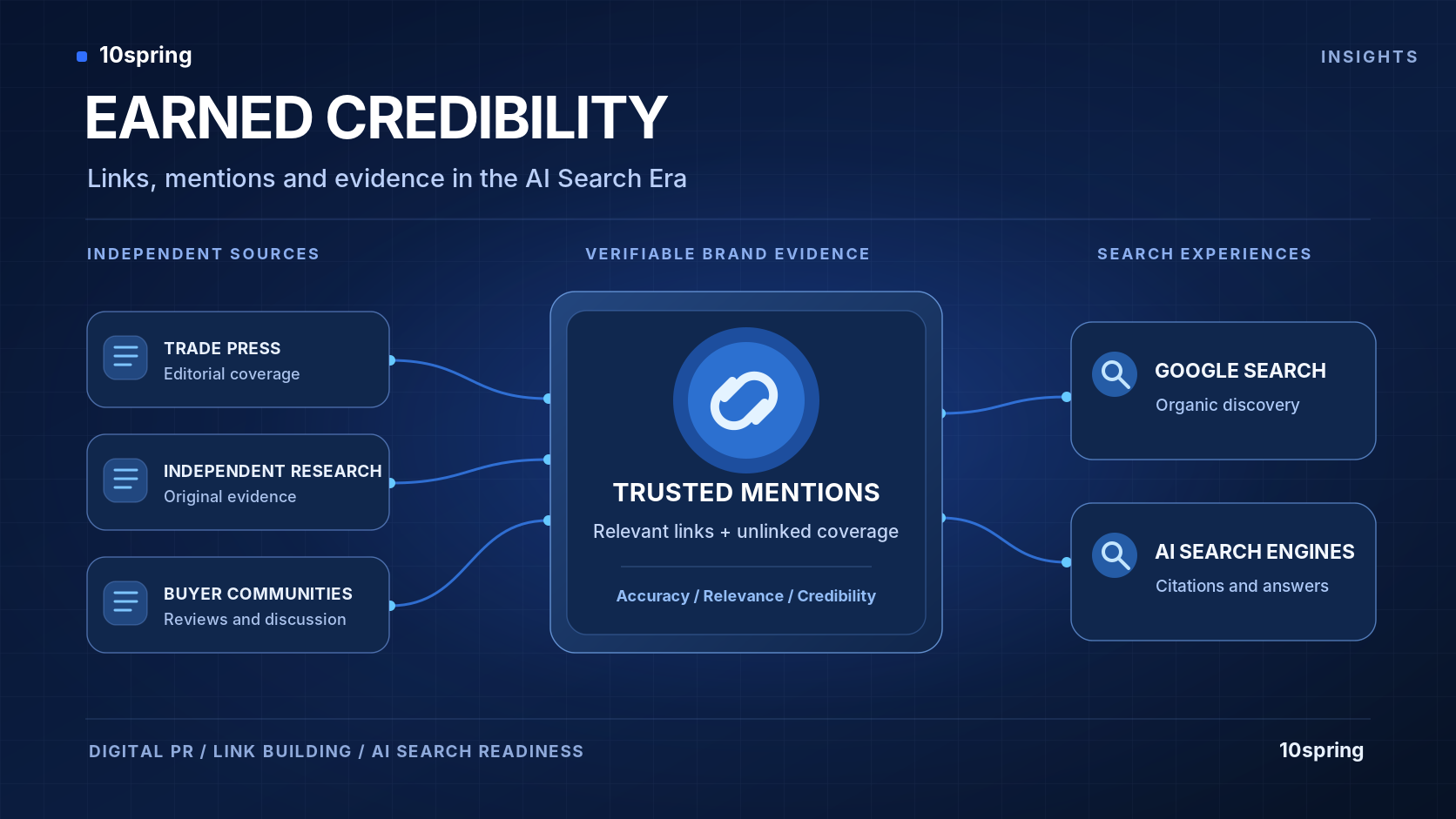
Every few years, someone asks whether link building still works. The question has returned with force. Buyers now ask ChatGPT, Claude, Perplexity, Grok, Gemini, and Google AI Overviews for answers, and the answer often appears before any click. Do links from other websites still matter?
The short answer is yes, with changes. Links still feed Google Search, and Google says its generative features are built on the same ranking systems. But the evidence that link counts predict visibility in AI Search Engines is mixed. Some of the strongest findings point at something wider than links: being mentioned, with or without a link, on pages that buyers and retrieval systems already trust.
This article covers what Google says about links today and what research finds about links and AI visibility. It looks at the evidence on earned coverage, then asks what a B2B team should do differently, what to stop doing, and how to measure without overstating. It draws on Google's documentation, studies from Ahrefs, Semrush, SALT.agency, and Muck Rack, and buyer research from G2 and Forrester. It notes where each source has limits, including which ones sell tools that benefit from a particular answer.
Why the question keeps coming back
Three things keep it alive.
First, Google has spent years downplaying links. In 2023, Google's Gary Illyes told a Pubcon Pro audience that links are important but overestimated. He said they have not been a top-three ranking factor for some time, and that a page can rank without them. He did not say links are unimportant, and he questioned whether any fixed top three exists.
Second, the click is less certain. Pew Research Center tracked the browsing of 900 U.S. adults in March 2025. When a Google results page showed an AI summary, users clicked a traditional result link in 8% of visits, compared with 15% of visits without one. That is a snapshot from early 2025, and Google's features have changed since. The direction is the point. A ranking earned partly through links pays off less directly when the answer appears on the results page.
Third, the research disagrees. Studies of links and AI visibility reach different conclusions depending on the engine, the dataset, and the metric. The sections below show where they conflict and where they agree.
What Google says about links today
Google's guidance has three parts that matter here.
Links remain part of the ranking system. Google's ranking systems guide, updated in December 2025, says PageRank continues to be part of its core ranking systems, although it works very differently from how it did at launch. The guide explains that link analysis systems help determine what a page is about and which pages might be most helpful for a query.
Generative features sit on top of those systems. Google's guide to generative AI features says these features are built on its core ranking and quality systems. It also says they can reflect what people say about products across blogs, videos, and forums, and that fake or manufactured mentions are ineffective. Read together, the message is that real third-party discussion helps and imitation does not.
Manipulation carries risk. Google's spam policies define link spam as creating links to or from a site mainly to manipulate rankings. The listed examples include:
- Buying or selling links for ranking purposes, including sending a free product in exchange for a write-up with a link.
- Excessive reciprocal link exchanges.
- Using programs or services to generate links.
- Articles, guest posts, and press releases on other sites that use keyword-rich anchor text.
- Links from low-quality directories, and widely distributed links in widgets, footers, or templates.
Google adds that buying and selling links for advertising or sponsorship is a normal part of web commerce. That is not a violation as long as the links are qualified with a nofollow or sponsored attribute. It says it detects violations through automated systems and human review. Violating sites may rank lower or not appear at all.
None of this says links are dead. It says links are one input, they are not the whole recipe, and shortcuts are risky.
What the studies say about links and AI visibility
Several studies have tried to measure the relationship. None can show cause. All rest on correlations in observational data. Most come from companies that sell link analysis or related tools, which gives them an interest in the topic, though not always in a particular answer.
- Ahrefs, 75,000 brands (December 2025). Across ChatGPT, Google AI Mode, and Google AI Overviews, Domain Rating correlated with AI visibility at about 0.27 to 0.33. Backlinks and URL Rating showed very weak correlations. Branded web mentions correlated at about 0.66 to 0.71, and branded search volume at about 0.35 to 0.47. Ahrefs states that correlation is not causation. Its reading is that being mentioned across a broad range of sites matters more than building links for volume.
- Ahrefs, top 50 domains (June 2025 data). Two analyses of the same dataset by Patrick Stox gave different answers depending on the metric. Domain-level link strength showed no relationship for ChatGPT, a very weak one for AI Overviews, and a weak to moderate one for Perplexity. But being mentioned on highly linked pages, meaning pages with many referring domains, correlated at 0.70 for AI Overviews, 0.40 for Perplexity, and 0.12 for ChatGPT. The author notes that 50 domains is a small sample.
- Semrush with Kevin Indig, 1,000 domains (October 2025). Authority Score correlated with AI mentions at 0.65 on one measure and 0.57 on another, but more modestly with share of voice. The study found that referring-domain diversity mattered more than raw link counts. Nofollow links correlated about as strongly as follow links. Authority Score is Semrush's own composite metric, and the study period was not stated.
- SALT.agency, 5,825 travel URLs (December 2025). Backlink metrics correlated moderately with visibility in ChatGPT, Perplexity, and Gemini, at about 0.39 to 0.42, and weakly with AI Overviews at 0.25. About 18.5% of domains with a Domain Rating of 80 or higher landed in the lowest quartile for AI citations. The study covered one sector and four engines, so it may not transfer to B2B.
How to read conflicting studies
Four points hold across the studies.
Links are not sufficient. A strong link profile did not guarantee citations. The SALT.agency finding about high-authority domains with few citations is one example. Ahrefs found a very weak role for backlinks even among brands with a Domain Rating above 40.
Engines differ. ChatGPT showed the weakest relationship with link strength in the Ahrefs analyses, but a moderate one in the SALT.agency data. AI Overviews looked strong on one Ahrefs measure and very weak on another. No single rule covers the six AI Search Engines.
Where you are mentioned seems to matter more than how strong your own domain is. The gap between Ahrefs's two top-50 analyses suggests that appearing on pages that are widely linked and cited can carry more weight than your own domain metrics. That is a pattern to test, not a proven mechanism.
Confounding is likely. Well-known companies tend to attract links, mentions, and citations at the same time. A correlation between any one of those and AI visibility may reflect brand strength more than a mechanism. That is why Ahrefs warns that improving the metrics will not automatically raise AI visibility.
The honest summary is that links correlate with AI visibility moderately in some engines and weakly in others, and no study shows them working alone.
What earned coverage adds
Muck Rack's "What Is AI Reading?" series approaches the question from the other direction. Instead of starting with link metrics, it classifies the sources that ChatGPT, Claude, and Gemini cite. Its May 2026 edition analyzed more than 25 million cited links.
About 84% of citations came from what Muck Rack calls earned media. Journalism accounted for about 27%. Owned content was roughly 16% with paid content included. Paid and advertorial content was about 0.3%, and press releases about 1.1%, down from about 6% in the December 2025 edition. The report attributes most of the press release decline to ChatGPT citing them less often.
Three cautions apply.
- The category is broad. Muck Rack's "earned" label includes journalism, academic and research sources, government and NGO sites, encyclopedic sites, social platforms, and third-party corporate content. In a reply to critics, the authors acknowledge the label is imperfect. They report that journalism alone made up 25% to 27% of citations across three editions. They also say the figures should not be read as media relations driving 84% of AI visibility.
- Muck Rack sells tools. It sells PR software and AI visibility products, so it has an interest in the answer.
- Providers differ. In the May 2026 data, ChatGPT's top domain was Wikipedia, Claude's was PubMed Central, and Gemini's was Reddit. Overlap in top-cited domains across the three was limited.
Two further findings are useful for planning. First, recency matters. In Muck Rack's recency analysis, citations peaked in the first month after an article was published and declined through about month six, leaving a long tail. Second, industry matters. Journalism's share of citations ranged from about 18.6% in manufacturing to about 36.3% in media and entertainment. B2B categories will vary too, so sample your own.
The buyer evidence points the same way. In G2's 2026 survey of 1,076 B2B software buyers, 51% said they start research with an AI chatbot more often than with Google. When asked what most increases their confidence in a chatbot's answer, buyers named citations from a software review site first. Forrester found that buyers check AI output with trusted people. A buyer who verifies an answer goes looking for independent confirmation of your company. The research suggests the retrieval systems lean on the same independent sources.
So is link building still relevant?
Yes, in a narrower and more demanding form. Four reasons support that answer.
- Google Search still uses links. Google says so in its ranking documentation, and it says its generative features are built on the same systems. Link-earning work can continue to affect the search results that AI Overviews draw on.
- Rankings are an incomplete proxy for citations. Ahrefs reported in August 2025 that about 12% of URLs cited by ChatGPT, Gemini, Copilot, and Perplexity appeared in Google's top 10 for the same prompt, using data collected in early July. Its March 2026 update put AI Overviews at 37.9%. Building links to win one ranking for one query leaves much of the picture unaddressed.
- A link is one visible form of corroboration. Buyers look for independent confirmation, and the research suggests retrieval systems lean on third-party sources. A link from a credible page is durable, checkable evidence that someone else has discussed you. It is not the only form. Unlinked mentions and nofollow links appear to count as well.
- Volume metrics mislead. A high Domain Rating did not guarantee citations, and Google's spam policies are aimed at the tactics that inflate link counts.
The practical change is in the goal. Link building as an acquisition tactic, with targets, anchors, and counts, gives way to earning corroboration. That means being discussed accurately on credible pages, with a link when it is natural.
What to do differently
The sequence below suits a B2B team that already earns coverage and wants it to work harder across Google Search and the AI Search Engines.
- Start from the citation map, not a target list. Sample a defined set of buyer questions across the six AI Search Engines and Traditional Google Search. Record which domains and page types get cited, and where competitors are mentioned. That shows which sources matter in your category, whether they are trade publications, analyst pages, review sites, communities, or reference sites.
- Prioritize presence on pages that already get cited. The Ahrefs finding on highly linked pages suggests that where you appear matters. Review sites, analyst and association pages, trade press, and well-read community threads are likelier to carry weight than a site created mainly to host links.
- Give editors and analysts something worth citing. About 99% of cited links in the Muck Rack data came from non-paid sources. Original data with a clear method, named expert commentary, and plain definitions give a writer a reason to reference you. Only publish data you can stand behind.
- Widen the base. Semrush and Ahrefs both point to breadth. Coverage from many credible, relevant sources appears to matter more than many links from a few. Ten placements on one site count as one referring domain.
- Keep the facts consistent. Use one description of who you serve, what you do, and what you do not do. A publication that describes you inaccurately creates a correction task. A publication that describes you accurately, in language that matches your own pages, reinforces what a retrieval system finds elsewhere.
- Ask for accuracy first, a link second. When coverage appears, the useful request is that the facts are correct. A link is welcome. The evidence suggests mentions can help without one.
- Plan for a steady cadence. Muck Rack's recency data shows citations clustering shortly after publication and decaying over several months. A single campaign is a thin basis. A steady record of substantive coverage builds a base that persists.
What to stop doing
Some habits have weak support in the evidence and clear risk in Google's policies.
- Chasing Domain Rating. It correlated modestly at best, and high scores did not guarantee citations.
- Paying for links that pass ranking credit. Google treats buying and selling links for ranking purposes as link spam. Sponsored placements are acceptable when the links are properly qualified, and they should be bought for the audience, not the ranking.
- Keyword-rich anchors in guest posts and press releases. Google lists this pattern as an example of link spam. Press releases also made up only about 1.1% of citations in the Muck Rack data.
- Link exchanges and automated link generation. Both appear on Google's list of examples.
- Manufacturing mentions. Google says fake or manufactured mentions are ineffective. The same applies to inventing statistics or sources to look citable.
- Treating one study as a rule. The studies disagree, and several come from vendors. Test your own category.
How to measure without overstating
Start with a rule. Link counts, mentions, and citations are diagnostic signals. They are not the result. Judge the work on qualified opportunities, pipeline, new customers, and recurring revenue, attributed only where reliable data supports the link.
With that rule in place, a workable set of signals looks like this.
- Link and mention profile. Track referring domains by relevance and credibility, not total count. Track unlinked mentions alongside links, and note whether coverage describes the company accurately.
- Sampled citations. For the AI Search Engines, run a fixed set of buyer questions several times and record how often your company is named or cited, and which sources appear. Treat results as direction, not rank. A study by SparkToro and Gumshoe.ai found that ChatGPT, Claude, and Google's AI features almost never return the same brand list twice, so one run is not evidence.
- Branded demand and referral visits. Watch branded search and referral traffic from covered sites. Seer Interactive's tracking guide notes that some ChatGPT visits arrive without referral information. Treat visible AI referrals as a floor.
- Pipeline signals. Follow visitors through to qualified opportunities. If visits rise and opportunities do not, look at the conversion pathway for friction before crediting or blaming the coverage.
Attribution has limits. A buyer who reads a trade article, asks an AI Search Engine about you, and later books a call has touched several sources. No single placement earns the credit. Set a baseline before a program begins, compare trends over quarters instead of weeks, and report what is observed. No one can guarantee a citation, a ranking, or a result from any placement.
Practical takeaways
- Treat links as one form of corroboration. The goal is to be discussed accurately on credible pages, with a link when it is natural.
- Expect uneven effects by engine. The studies disagree on how much link strength matters in ChatGPT, Perplexity, and AI Overviews. Measure each AI Search Engine and Traditional Google Search separately.
- Map before you pitch. Find out which sources the AI Search Engines cite for your buyers' questions, then prioritize presence there.
- Earn coverage with substance. Original data, named experts, and clear definitions give writers a reason to cite you.
- Prefer breadth to volume. Many relevant referring domains beat many links from a few sites.
- Stay inside Google's spam policies. Avoid paid links that pass ranking credit, keyword-rich anchors in guest posts and press releases, exchanges, and automation.
- Measure in layers and set a baseline. Use mentions and citations as diagnostics, and judge the work on qualified opportunities, pipeline, and customers.
10spring works alongside internal marketing teams. If you want to pressure-test your link and mention strategy for the AI Search era, Book A Call. Let's accelerate your pipeline together.
Sources and further reading
All sources accessed November 13, 2026.
- Google Search Central. Spam policies for Google web search. Documentation, last updated August 28, 2026.
- Google Search Central. A guide to Google Search ranking systems. Documentation, last updated December 10, 2025.
- Google Search Central. Optimizing your website for generative AI features on Google Search. Documentation, last updated July 10, 2026.
- Danny Goodwin, Search Engine Land. Links are not a top 3 Google Search ranking factor, says Gary Illyes. News article, 2023. Reports remarks at Pubcon Pro in Austin. The page does not state an exact date.
- Louise Linehan and Xibeijia Guan, Ahrefs. Top Brand Visibility Factors in ChatGPT, AI Mode, and AI Overviews (75k Brands Studied). Study, December 12, 2025. Ahrefs sells link analysis and AI visibility tools.
- Patrick Stox, Ahrefs. Domain-Level Link Metrics May Not Be Good Predictors of AI Search Mentions. Study, June 2025. Top 50 domains per system, June 2025 data.
- Patrick Stox, Ahrefs. Does Being Mentioned on Highly Linked Pages Influence AI Mentions? Study, July 8, 2025. Top 50 domains per system, June 2025 data.
- Margarita Loktionova and Aleksandr Drozdov, Semrush, with Kevin Indig. Do Backlinks Still Matter in AI Search? Insights from 1,000 Domains. Study, October 16, 2025. Semrush sells SEO and AI visibility tools. The study period is not stated.
- SALT.agency. Research: Backlinks Aren't Dead… But They're Not Enough in AI Search. Study, December 27, 2025. Travel sector only. The publisher is a marketing agency.
- Muck Rack. What Is AI Reading? May 2026. Report, May 2026. More than 25 million links from ChatGPT, Claude, and Gemini. Muck Rack sells PR and AI visibility tools.
- Matt Dzugan and Linda Zebian, Muck Rack, in PR Daily. What does 'earned' mean in the age of AI? Article, September 3, 2026.
- Louise Linehan, Ahrefs. Only 12% of AI Cited URLs Rank in Google's Top 10 for the Original Prompt. Study, August 11, 2025. Data collected in early July 2025.
- Louise Linehan, Ahrefs. AI Overview citations and the top 10: 38% update. Study, March 2, 2026.
- Search Engine Land. AI recommendation lists repeat less than 1% of the time: Study. News article, 2026. Reports research by Rand Fishkin (SparkToro) and Patrick O'Donnell (Gumshoe.ai). The page does not state a publication date.
- Athena Chapekis, Pew Research Center. Google users are less likely to click on links when an AI summary appears in the results. Short read, July 22, 2025. Browsing data from 900 U.S. adults, March 2025.
- Seer Interactive. Your AI Traffic Is Hiding: A Practical Guide to Tracking ChatGPT, Claude, and More. Guide. Only the public summary was available.
- G2. In the Answer Economy, Don't Win the Click, Win the Answer. Research summary, April 15, 2026. Survey of 1,076 B2B software buyers and decision-makers, fielded March 2026.
- Barbara Winters, Forrester. The State Of Business Buying: Risk-Averse Buyers Demand Proof, Not Promises. Blog post, January 21, 2026. Based on Forrester's Buyers' Journey Survey of nearly 18,000 business buyers. The full report is not publicly available.