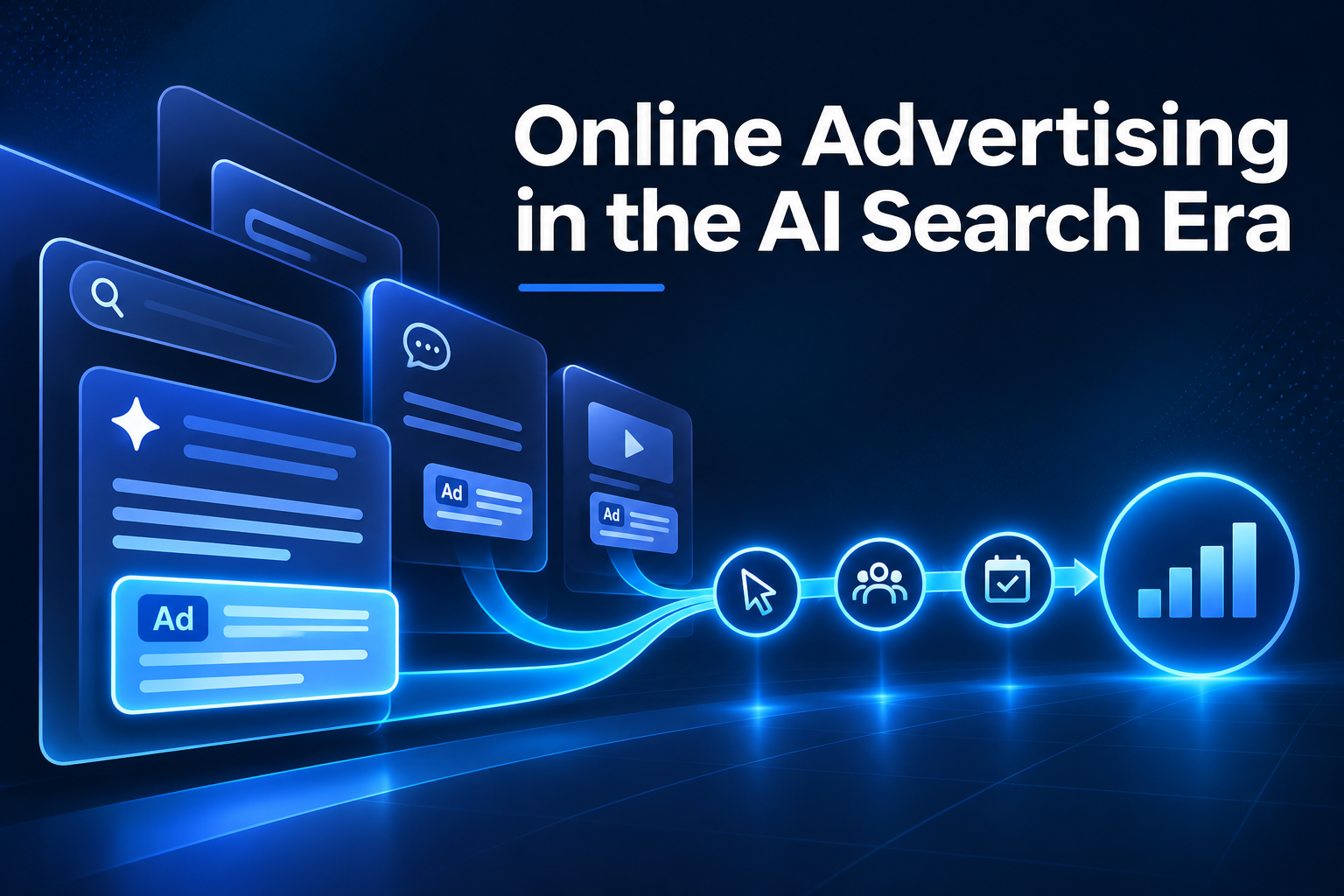
Paid media used to be the most controllable channel in B2B marketing. You chose the keywords, the audiences, and the placements, and you could see where each click came from. That control is shrinking. Google now shows ads inside AI Overviews and is testing new formats in AI Mode. Meta and LinkedIn push advertisers toward automated campaign types. OpenAI sells ads inside ChatGPT. Other chatbot makers have said they will not sell ads in answers at all.
This article walks through each of these changes and separates what the platforms announced from what independent research supports. It covers Google Ads, Meta, Microsoft Advertising, LinkedIn, and ChatGPT Ads. It also records the positions that Perplexity, the Gemini app, Claude, and Grok have taken. It then looks at how consumers say they feel about ads in AI-generated answers and explains why the evidence is thinner than the announcements. It closes with a way to measure paid media against qualified opportunities and pipeline instead of platform-reported clicks.
It draws on official announcements and help pages from Google, Meta, Microsoft, and OpenAI. It also uses Alphabet and Meta earnings coverage, studies from Seer Interactive and Productrise, consumer surveys from Ipsos, DoubleVerify, and Attest, and trade reporting. Many of the performance figures come from the platforms that sell the ads, and several studies come from agencies or software vendors. It notes where research has limits. It reflects what was published as of November 13, 2026, and ad products in this area change month to month.
What changed in paid media
Four changes matter most, and they pull in different directions.
- Ads moved inside AI-generated answers. Google shows ads in and around AI Overviews and is testing new formats in AI Mode. OpenAI shows ads below ChatGPT responses. Microsoft has reported on ads in Copilot since 2024.
- Campaign setup moved to the platform. Google's AI Max and Performance Max, Meta's Advantage+, and LinkedIn's Accelerate campaigns ask advertisers for goals, assets, and budgets, then let the platform decide much of the rest.
- Reporting lags behind placement. Google has said it does not offer separate reporting for ads that show in AI Overviews, so those results blend into ordinary Search reports.
- Not every chatbot sells ads. Perplexity is winding down its ad program, Anthropic says Claude will stay ad-free, and Google's Gemini app has carried no ads so far.
The common thread is control. Platforms are taking on more of the decisions about who sees an ad and where. Advertisers are left to judge the results with their own measurement. The rest of this article follows that thread platform by platform.
Google Ads inside AI Overviews and AI Mode
Google began showing ads in AI Overviews to US mobile users in October 2024. Its help documentation now describes two placements. Existing text, Shopping, local, and app ads from Search, Shopping, Performance Max, and App campaigns can show above or below AI Overviews wherever they are available. Text and Shopping ads from Search, Shopping, and Performance Max campaigns can also show within the overview itself.
Three limits shape how advertisers can work with this placement.
- No targeting and no opt-out. Google's help documentation, as quoted by Search Engine Roundtable, says advertisers cannot target placements in AI Overviews or opt out of them.
- Match type matters. Coverage of a Q&A with Google's Ads Liaison reports that exact match keywords can still trigger ads above or below an AI Overview. Ads inside the overview need broad match or keywordless targeting.
- No separate reporting. Google told Search Engine Land at the October 2024 launch that it was not offering segmented reporting for these placements. The same Q&A coverage reports that ads in AI Overviews and AI Mode are reported alongside other top-of-page ads.
AI Mode is newer. At Google Marketing Live in May 2026, Google announced two formats that it is testing in AI Mode. Conversational Discovery ads use Gemini to build creative tailored to the searcher's specific question. Highlighted Answers let highly relevant ads appear inside AI Mode's recommendation lists. Google said both formats stay labeled Sponsored and carry an independent explainer that Gemini writes about the product or service.
Google also described two formats for standard Search "in the coming months." AI-powered Shopping ads have Gemini select relevant products and write an explainer. Business Agent for Leads puts a chat agent built from the advertiser's website into the ad, in place of a static form. The second format matters most to B2B lead generation, and Google's announcement gave no dates for it.
On Alphabet's October 28 earnings call, Google said it was expanding ads in AI Mode to international markets and adding multi-turn ads in the US, which can appear in follow-up questions. The same call showed the commercial pressure behind the push. Marketing Dive's coverage reports that Search and other revenue grew 12% year over year in the third quarter. TechCrunch's figures, as relayed by YourStory, put the second quarter at 17% and the first at 19%.
Chief Business Officer Philipp Schindler said that strong growth in AI Mode queries had weighed on the quarter because of lower monetization in AI Mode. He also pointed to currency effects. CEO Sundar Pichai said Google is focused on building the best Search experience first, followed by monetization.
Two points follow for advertisers.
- The new formats are tests. The coverage reviewed for this article reports no AI Mode ad performance figures that outside parties can check. Statements about how well these ads perform are Google's own.
- Independent measurement of AI Mode is thin. Productrise, a vendor that monitors organic product visibility, tracked identical shopping queries for 21 days in July 2026. It found that AI Mode showed at least one product on about 23% of them, against about 88% in standard search. That study covers organic product listings, not ads, and ecommerce, not B2B services. It does show that AI Mode is not a copy of the standard results page.
What AI Max and Performance Max mean for control
Google is moving Search advertisers toward more automation. AI Max for Search left beta in April 2026, and Google said hundreds of thousands of advertisers had adopted it. Search Engine Land has also reported Google saying that more than 500,000 advertisers use it. Google said legacy features such as Dynamic Search Ads, automatically created assets, and campaign-level broad match would upgrade to AI Max automatically. It first named September 2026 for those upgrades, then extended the timeline, and the automatic upgrades now begin in February 2027.
Google's guidance on the new AI Mode formats leans the same way. Its announcement advises advertisers to build on AI Max for Search, AI Max for Shopping, and Performance Max to take full advantage of the new formats.
Performance Max shows the other side of the trade. Google has added campaign-level negative keywords, search terms reporting, and a channel performance report that launched in beta. Its help article describes these as more visibility and control. Negative keywords there apply to Search and Shopping inventory.
The pattern is more visibility and less direct control over targeting. A Search advertiser can now see more of what automation did but cannot always change it. That is an inference from the feature lists, not a measured result, and it matters for B2B programs that depend on tight audiences and clear query boundaries.
The practical response is to treat automation settings as decisions. Use the guardrails that exist, such as negative keywords, brand exclusions, and clearly defined conversion events. Review search terms on a schedule. Know which of your campaigns use broad match, AI Max, or Performance Max, because that determines whether your ads can appear in AI Overviews and AI Mode.
How AI Overviews relate to paid search results
Seer Interactive, a search marketing agency, has published several studies of click-through rate (CTR) when AI Overviews appear. The studies use different query sets and time windows, so their numbers do not line up. They show a mixed picture.
- September 2025 study. Seer analyzed informational queries from June 2024 through September 2025. PPC Land's coverage reports that paid CTR on queries with an AI Overview fell from 19.7% to 6.34%. It also reports that brands cited in the overview earned 91% more paid clicks than brands that were not cited. Seer's researchers acknowledged that they cannot show that citation causes the higher rate.
- 2026 update. Seer's third edition tracked 53 brands and 5.47 million queries from January 2025 through February 2026. A summary by Pixis, an AI advertising software company, reports that paid CTR on queries with an AI Overview rose from 14.64% to 16.21%. On queries without one, it fell from 25.98% to 21.85%. Seer's own page excerpt reviewed for this article did not show those paid figures, so they rest on the Pixis summary.
Seer's data also shows how unevenly AI Overviews appear. Search Engine Land's summary of the 2026 update reports that they showed up on about 95% of comparison queries and about 86% of question queries. They showed up on about 36% of informational queries and about 5% of transactional ones. Many B2B evaluation searches are comparison or question queries, which makes this relevant. The summaries reviewed do not say how many of Seer's 53 brands sell to businesses.
What the studies support is that the effect on paid search varies by query type and over time. They do not support a forecast of your own CTR. Measure paid CTR and conversion rate by query type in your own account before reallocating budget.
Meta and the automation default
Meta reported third-quarter 2026 revenue growth of 26%. Ad impressions rose 10%, and the average amount advertisers paid per ad delivered rose 14%. The release credits Meta's AI investments with substantial incremental advertising revenue through better recommendations and more efficient monetization. The excerpts reviewed do not say how much revenue is attributable to AI.
On the earnings call, according to trade coverage, Meta's CFO made two claims. Advertisers who followed recommendations from Meta's AI business assistant generated nearly 5% more conversions at the same cost per conversion than similar advertisers who did not. And nearly 10 million advertisers used at least one of Meta's generative AI ad tools in the quarter. Both figures are Meta's own, and the coverage notes that they describe specific tools and advertiser groups, not all advertisers.
The CFO attributed the higher per-ad amount to better ad performance and improved macroeconomic conditions. It is an average across all advertisers, so it does not tell any one B2B advertiser what its own costs will do.
Advertisers describe a platform that steers them toward automation. Marketing Brew reported in April that agency leaders see Meta's Andromeda retrieval system rewarding diverse, high-volume creative shown to broad audiences. They also see fewer levers for restricting targeting. One agency leader described new features turning on without notice. Another said Advantage+ steers spend toward low-quality placements. A third called Meta's performance numbers only directional.
The same article reports Meta's side on several points.
- Opt-outs are not penalized. Meta said advertisers are not penalized for opting out of AI features and that Advantage+ use is not a factor in ad delivery. As of March 2026, opt-out choices for Advantage+ creative are saved for future campaigns.
- Automation prompts exist. If manual controls pass certain thresholds, a campaign may switch to Advantage+ off, and Meta's system may prompt the advertiser to re-enable automation.
- Meta cites its own data. Meta says its data shows automation produces stronger results for most advertisers.
Reported plans go further. The Wall Street Journal reported in 2025 that Meta aimed to let brands create and target ads with AI, using only a goal and a budget, by the end of 2026. The marketers quoted by Marketing Brew consider that timeline much further off.
For B2B teams, the tension is specific. Automation that prefers broad audiences and high creative volume sits awkwardly with programs that depend on short lists of target accounts. That is an inference from these reports, not a measured result. Meta can still play a role, such as reaching a wider group of buyers or supporting retargeting. The test is whether it produces qualified opportunities.
Microsoft Advertising and LinkedIn
Microsoft and LinkedIn offer some of the most specific B2B targeting, because LinkedIn, which Microsoft owns, supplies professional data.
At its Spring Summit in April 2026, Microsoft Advertising announced AI Max for Search in pilot. It also announced a pilot in the US and Canada of LinkedIn profile targeting by job seniority and company lists for Search ads. In August 2026, Microsoft said that job seniority targeting was generally available for Audience ads and Search campaigns. Microsoft also reported that early adopters of AI-optimized text assets improved CTR by 5%. That is Microsoft's own early-adopter figure.
Copilot is the other Microsoft claim to weigh. Microsoft's August 2025 research reported that ads in Copilot drew 73% higher CTR and 16% stronger conversion rates than traditional search ads. It used Microsoft's first-party data from November 2024 through May 2025. An October 2024 Microsoft post had reported 69% and 76% for lower-funnel ad types, and Search Engine Land described those statistics as vague. The figures come from the company that sells the ads. The sources reviewed show no independent audit, and the data period ends in May 2025.
LinkedIn's Accelerate campaigns automate targeting, creative, bidding, and placements. LinkedIn has reported lower cost per action for Accelerate in its own tests. An earlier announcement cited 52% lower, and a 2026 summary of LinkedIn's July announcements cites up to 42% lower. The figures differ, they compare against LinkedIn's classic campaigns, and they come from LinkedIn's internal tests. LinkedIn also added AI creative tools in July 2026, including Brand Kit, Draft with AI, and AI ad variants.
Accelerate offers fewer manual levers than classic campaigns, according to Hootsuite's guide. Firebrand, a marketing agency, cautions that none of these features removes the need for oversight. For a B2B team, the practical question is whether broader automation still lets it hold the line on who counts as a qualified buyer.
ChatGPT Ads
OpenAI began testing ads in ChatGPT in the US on February 9, 2026. OpenAI's help page says ads appear only on the Free and Go plans. Plus, Pro, Business, Enterprise, and Edu accounts do not show ads. Ads appear below a response, are labeled as sponsored, and are visually separated from the response. OpenAI says ads do not influence answers and that it does not share conversations with advertisers. It says it does not place ads near sensitive content, such as personal health conversations, and currently does not allow political advertising. It is also testing a multi-image visual ad format during image generation.
On targeting, OpenAI says that when several ads are eligible, it considers relevance and advertiser bids. Signals include the context and intent of the current conversation, the landing page, advertiser-provided context hints and targeting selections, and, when personalization is on, signals from the user's wider ChatGPT use.
The buying side has matured quickly.
- Self-serve buying. On May 5, 2026, OpenAI began opening a beta self-serve Ads Manager to US businesses. Search Engine Journal's coverage says it added cost-per-click (CPC) bidding alongside cost per thousand impressions (CPM), which was how early pilot advertisers mainly bought.
- Measurement. OpenAI added Conversions API support and pixel-based tracking. Ads Manager reporting includes impressions, clicks, spend, CTR, average CPC, average CPM, and conversions where measurement is set up, according to PPC Land.
- Scale. OpenAI said on October 21 that more than 100,000 advertisers had run campaigns on ChatGPT and that ads are available in 89 countries. In August, OpenAI said its ad business had reached an annualized run rate of 1 billion dollars, as reported by CNBC. A run rate projects a recent pace forward. It is not booked revenue.
Performance evidence is thin. Search Engine Journal reported in April that some advertisers saw CTR around 0.91% in the pilot, against a 6.4% average for Google Search. It described the figures as early advertiser feedback, not a controlled comparison. The sources reviewed contain no independent, B2B-specific data on ChatGPT ad performance.
Reach is the other open question for B2B. PPC Land noted that the roughly 1 billion weekly users OpenAI cites is not the ad-eligible pool, which excludes the paid tiers. Buyers who use ChatGPT through a Business or Enterprise workspace will not see ads. That is an inference from OpenAI's plan rules. Buyers who research on personal Free or Go accounts will. No source reviewed measures how many B2B buyers fall into each group.
Who is not selling ads inside answers
Attest's November 2026 consumer report observes that there is no industry position on ads in AI assistants. Here is where Perplexity, the Gemini app, Claude, and Grok stand in the sources reviewed, alongside the ChatGPT approach described above.
- Perplexity. Perplexity introduced ads in 2024. The Financial Times reported in February 2026 that it would wind down its ad program by the end of 2026, because ads could erode user trust. Coverage differs on wording. Some reports say Perplexity stopped, and others say it will not pursue ads further. An executive told the FT that users need to believe they are getting the best possible answer in order to keep paying.
- Gemini app. Google's vice president of global ads said in December 2025 that the Gemini app had no ads and no current plans to change that. On Alphabet's first-quarter call in April 2026, Schindler said Google is open-minded about ads in the Gemini app. He added that a format that works in AI Mode could transfer to it. As of the reports reviewed, the Gemini app carries no ads.
- Claude. Anthropic said in February 2026 that Claude will remain ad-free, with no sponsored links, no advertiser influence on responses, and no third-party product placements. It also said that if it revisits the approach, it will be transparent about its reasons.
- Grok. Elon Musk told advertisers in August 2025 that X would put ads in Grok's answers. The sources reviewed show no confirmed launch, so treat it as announced, not available.
These positions can change, and Google's move on the Gemini app shows how fast. As of November 13, 2026, the confirmed paid inventory inside AI-generated answers sits mainly with Google, Microsoft, and OpenAI.
What consumers say about ads in AI-generated answers
Three recent surveys give a mixed picture. They measure stated attitudes among consumers, not B2B buyers and not behavior.
- Ipsos. In a February 2026 tracker of 1,085 US adults, 63% agreed that ads in AI search results would reduce their trust in those results, and 24% disagreed. The questions were framed around ChatGPT's plans.
- DoubleVerify. A study of 22,000 consumers in 22 markets, reported in July 2026, found that 46% viewed advertising in AI chat platforms positively, against 34% in North America. Consumers responded best to contextually relevant ads. They responded worst to ads placed beside negative, emotionally sensitive, or highly personal conversations. DoubleVerify sells ad verification, so brand safety is part of its business.
- Attest. A November 2026 survey of 4,000 consumers in the US and UK found that 41% of AI users would be comfortable with a clearly marked ad. Another 31% would be uncomfortable. Attest sells consumer research tools.
Together, these suggest that labeling, relevance, and context matter more than the mere presence of an ad. The gap between the Ipsos and Attest results also reflects different questions, samples, and dates.
Why the evidence is thinner than the announcements
Most performance figures in this article come from one of three places.
- The platform selling the ads. Examples include Microsoft's Copilot results, LinkedIn's Accelerate results, Meta's AI assistant results, Google's statements about AI Mode, and OpenAI's run rate.
- Agencies and software vendors. Seer, Pixis, and Productrise each sell services or software connected to what they measure.
- Surveys of consumers. Ipsos, DoubleVerify, and Attest measure attitudes, not purchase behavior in a B2B buying process.
Independent, controlled evidence is rare, and almost none is specific to B2B. Reporting gaps compound the problem. Google offers no separate reporting for ads in AI Overviews or AI Mode, and OpenAI's measurement tools are in beta. Platform-reported conversions also follow each platform's own attribution rules. Adding them across platforms can count the same buyer more than once.
A sound position is to treat platform claims as hypotheses to test in your own account, with your own sales data, over a period long enough for a B2B sales cycle.
How to measure paid media against pipeline
A revenue-first view keeps platform metrics in their place. It uses three layers.
- Layer 1: activity and infrastructure signals. Impressions, clicks, CTR, CPC, and platform-reported conversions. Use them to diagnose delivery and tracking, not to judge the program.
- Layer 2: conversion performance. Qualified opportunities and customers by paid source, campaign, and landing page. This is where a click either becomes a sales conversation or does not.
- Layer 3: business impact. Pipeline, customers, and recurring revenue, attributed only where reliable data supports it.
Three practices make the layers workable when the platforms report little.
- Tag every paid source. Use consistent UTM parameters, including for ChatGPT Ads. TechWyse's summary of OpenAI's help documentation says static UTM parameters let advertisers track ChatGPT Ads traffic in existing analytics tools.
- Ask buyers how they found you. Capture it in forms and in the first sales call. Ads in AI Overviews and AI Mode will not appear in separate Google reports, so buyer-reported source helps fill the gap.- Compare over quarters. A long B2B sales cycle means two weeks of click data says little about pipeline. Set a baseline, change one thing at a time where possible, and compare cohorts over several quarters.
If clicks rise and qualified opportunities do not, diagnose the conversion pathway before adding spend. Look at landing page match, form friction, page speed, lead routing, and follow-up time. A paid click that lands on a weak page is a cost with nothing behind it, whichever surface it came from. Where volume allows, run hold-out or geographic tests to estimate incremental effect.
Where paid media fits in the larger system
Paid media does not work in isolation, and the AI Search era makes that clearer.
- Search and AI visibility. In one Seer study, brands cited in AI Overviews had higher paid CTR. That is a correlation, not proof of cause. The shared asset is still clear. The pages and product information that earn mentions in AI-generated answers also support ad quality. AI Search Readiness + SEO and paid search benefit from shared query research.
- Earned coverage. Buyers see an ad alongside everything else they read about a company. Digital PR earns the third-party coverage that sits next to the ad in that process.
- Landing pages. Ads convert only if the page does. Conversion Rate Optimization (CRO) work decides how much of the paid traffic becomes qualified opportunities.
- Lead routing and target accounts. RevOps and Account-Based Marketing decide whether paid results reach Layer 2 and Layer 3. Microsoft's company-list targeting and LinkedIn data are only as useful as the account list behind them.
10spring treats PPC & Paid Media as one of nine Execution Channels that work together. It performs best when it is coordinated with the others, not run as a standalone tactic.
Practical takeaways
- Separate announcements from evidence. Label each claim as platform-reported, agency-reported, or independently measured before it shapes a budget decision.
- Audit eligibility and controls. Know which Google campaigns use broad match, AI Max, or Performance Max, and use negative keywords and brand exclusions where they exist.
- Plan for lost transparency. Expect no separate reporting for AI Overviews or AI Mode. Track by query type, landing page, and buyer-reported source instead.
- Test new inventory narrowly. If you test ChatGPT Ads or a new Google format, set a small test budget, a clear hypothesis, and conversion events defined in advance.
- Check who you are reaching. ChatGPT ads show only on Free and Go plans, so confirm that your buyers use them before treating the channel as a B2B reach play.
- Protect creative and brand standards. Automation rewards varied creative but can place ads where advertisers did not choose. Review placements and generated assets.
- Measure in layers. Judge paid media on qualified opportunities, pipeline, and customers, and use clicks as diagnostics.
- Set a baseline and compare over quarters. One month of data says little in a long sales cycle.
- Recheck platform positions often. Gemini, Perplexity, and Grok positions have changed or may change, so confirm current policies before building a plan around them.
10spring works alongside internal marketing teams. If you want to pressure-test how your paid media connects to pipeline, Book A Call. Let's accelerate your pipeline together.
Sources and further reading
All sources accessed November 13, 2026.
- Google Ads and Commerce Blog. A new generation of ads for the AI era of Search. Blog post, May 20, 2026. Source for Conversational Discovery ads, Highlighted Answers, AI-powered Shopping ads, Business Agent for Leads, and the advice about AI Max and Performance Max. It describes Google's own plans and gives no performance data.
- Google Ads Help. About ads and AI Overviews. Help page. The page excerpts reviewed do not state a date, and the page changes, so check the current text. Used for campaign eligibility.
- TechCrunch. Google brings ads to AI Overviews as it expands AI's role in search. Article, October 3, 2024, with the date taken from the URL. Used for the launch date.
- Search Engine Land. Coverage of Google's launch of ads in AI Overviews on US mobile. Article, read through a search excerpt only. The excerpt does not state a date. Used for Google's statement that it was not offering segmented reporting at launch and for the US mobile detail.
- Search Engine Roundtable. Google Ads Help Doc On Ads In AI Overviews & Experiences. Article quoting Google's help documentation. The page excerpt reviewed does not state a date, and the full page could not be fetched. Used for the statements that advertisers cannot target or opt out and that segmented reporting is not offered.
- TechWyse. Google Ads Liaison Ginny Marvin clarifies AI Max, AI search eligibility, and advertiser priorities after GML 2026. Agency news post, read through a search excerpt only. The excerpt reviewed does not state a date. Used for match type eligibility and reporting for AI Overviews and AI Mode. TechWyse is a marketing agency.
- Marketing Dive. Google's AI overhaul of search hits snags as ad revenue growth cools. Trade article on Alphabet's third-quarter 2026 results and the October 28, 2026 call. The excerpt reviewed does not state the publication date. Used for Search revenue growth, the Schindler and Pichai remarks, and the AI Mode ad expansion.
- YourStory. AI Search ads arrive in India as Google expands global rollout. News article, read through a search excerpt only. The excerpt does not state a date. Used for the first-quarter and second-quarter Search growth figures, which it attributes to TechCrunch. TechCrunch's own article could not be fetched.
- Google Ads and Commerce Blog. We're upgrading Dynamic Search Ads to AI Max. Blog post, April 15, 2026, later updated to extend the upgrade timeline to February 2027. Read through a search excerpt only.
- Search Engine Land. Alphabet beats estimates as Google doubles down on AI-powered search ads. Article, read through a search excerpt only. The excerpt does not state a date. Used for the figure of more than 500,000 AI Max advertisers, which is Google's.
- Google Ads Help. Unlock more visibility and control in Performance Max. Help article. The page excerpt reviewed does not state a date. Used for campaign-level negative keywords, search terms reporting, and the channel performance report.
- PPC Land. AI Mode cuts Google Shopping listings 95%, Productrise finds. Trade coverage of a vendor study run over 21 days in July 2026. Productrise sells monitoring of organic product visibility, and the study covers organic product listings, not ads.
- Seer Interactive. AIO Impact on Google CTR: 2026 Update. Study page. Only the methodology excerpt was reviewed: 53 brands, 5.47 million queries, January 2025 through February 2026. Seer sells search marketing services.
- Search Engine Land. Google AI Overviews CTR shows early signs of recovery: Study. Article summarizing Seer's 2026 update. The excerpt reviewed does not state a date. Used for AI Overview frequency by query type.
- Pixis. AI Overviews and Paid Search: The CTR Story Already Changed. Vendor blog summarizing Seer's study. The excerpt reviewed does not state a date. Used for the paid CTR figures from Seer's 2026 update. Pixis sells AI advertising software.
- PPC Land. Coverage of Seer Interactive's AI Overview study of informational queries. Trade article on research published November 4, 2025. Used for the paid CTR decline and the caveat that citation cannot be shown to cause the higher rate.
- Meta. Meta Reports Third Quarter 2026 Results. Earnings release, October 21, 2026. The impression and per-ad figures were read in a PR Newswire copy of the release on Finviz.
- Finviz. Meta Reports Third Quarter 2026 Results (PR Newswire copy). Copy of the release, October 21, 2026, read through a search excerpt only.
- MediaNews4U. Coverage of Meta's third-quarter 2026 earnings call. Trade coverage. The page header shows October 22, 2026. Used for the CFO's remarks. The figures are Meta's own.
- Marketing Brew. How Meta's AI push is changing ad creation. Article, April 7, 2026. Separates Meta's own claims from agency views. The agency views are anecdotal.
- Microsoft Advertising. An ads ecosystem built for the AI era. Blog post, April 2026, with the month taken from the URL. Read through a search excerpt only. The 5% figure is Microsoft's own.
- DesignRush. Microsoft AI Max places Search ads inside Copilot responses. Trade article. The excerpt reviewed does not state a date. Used only to confirm that the Spring Summit was April 21, 2026. Its headline claim about ads inside Copilot responses was not confirmed in Microsoft's own post and was not used.
- Microsoft Advertising. AI Max for Search and other product news for August 2026. Blog post, August 2026, with the month taken from the URL. Read through a search excerpt only.
- Microsoft Advertising. 73% higher CTRs: Why advertisers need to pay attention to conversational AI. Blog post, August 6, 2025. Microsoft first-party data from November 2024 through May 2025. Microsoft sells the ads.
- Microsoft Advertising. Transforming audience engagement with generative AI. Blog post, October 2024, with the month taken from the URL. Used for the earlier Copilot figures.
- Search Engine Land. Microsoft is about to change how Copilot ads appear and trigger. Article, read through a search excerpt only. The excerpt does not state a date. Used for the description of Microsoft's earlier statistics as vague.
- Search Engine Land. LinkedIn expands video ads, AI tools to help B2B marketers. Article, read through a search excerpt only. The excerpt does not state a date. Used for the earlier 52% figure, which is LinkedIn's.
- Value Your Network. AI tools for LinkedIn Ads. Third-party blog summarizing LinkedIn's July 1, 2026 announcements. The excerpt reviewed does not state a date. Used for the up to 42% figure and the feature list. LinkedIn's own announcement was not reviewed.
- Hootsuite. LinkedIn Ads guide. Guide. The excerpt reviewed does not state a date. Used for the point that Accelerate offers fewer manual levers.
- Firebrand Marketing. Latest LinkedIn Ads AI features. Agency blog post, January 2026, with the date taken from the URL. Used for the caution about oversight.
- OpenAI Help Center. Ads in ChatGPT. Help page. The excerpts reviewed come from several versions of the page and do not state a single date. Used for plans, placement, labeling, targeting signals, ranking, and policies.
- OpenAI. ChatGPT Ads expands to 26 new countries as over 100,000 advertisers have used the platform. Announcement, October 21, 2026. Read through a search excerpt and trade coverage because the full page could not be fetched.
- PPC Land. Advertisers in 26 more countries gain ChatGPT Ads, bringing the total to 89. Trade article, October 21, 2026. Quotes OpenAI's announcement.
- PPC Land. Coverage of OpenAI's August 31, 2026 announcement of a one billion dollar ad run rate. Trade article citing CNBC. CNBC's report was not reviewed. The run rate is OpenAI's own figure.
- PPC Land. OpenAI opens ChatGPT Ads Manager to all US businesses with CPC bidding. Trade article. The excerpt reviewed does not state a date. Other coverage dates the announcement May 5, 2026. Used for the reporting metrics.
- Search Engine Journal. OpenAI launches self-serve Ads Manager for ChatGPT. Article, read through a search excerpt only. The excerpt does not state a date. Used for CPC bidding, Conversions API, and pixel tracking.
- TechWyse. OpenAI pushes ChatGPT Ads toward performance marketing. Agency news post describing OpenAI's May 5, 2026 announcement and help documentation. Used for the UTM guidance and the May 5 date.
- Search Engine Journal. Trust in AI search could drop with ads, survey shows. Article, dated April 6, 2026 in a syndicated listing. Reports an Ipsos survey of 1,085 US adults and early advertiser feedback on ChatGPT ad CTR, which it calls not a controlled comparison.
- ContentGrip. Perplexity pulls the plug on ads as AI trust concerns take center stage. Trade summary of a February 2026 Financial Times report. The excerpt reviewed does not state a date. The FT report itself was not reviewed.
- Campaign Asia. Perplexity pulls the plug on ads, citing trust concerns for AI. Trade summary of the same FT report. The excerpt reviewed does not state a date. Used for the wind-down by the end of 2026.
- Heise. Fear of losing trust: Perplexity dispenses with advertising. Trade article on the same FT report. The excerpt reviewed does not state a date. Used to show that coverage words the change differently.
- Anthropic. Claude is a space to think. Company post, February 4, 2026. Read through search excerpts and press coverage because the page could not be fetched. Anthropic makes Claude.
- Axios. Anthropic pledges ad-free Claude, with a Super Bowl shot at ChatGPT. Article, February 4, 2026, with the date taken from the URL.
- MacRumors. Anthropic promises Claude will remain ad-free, mocks ChatGPT ads in Super Bowl commercial. Article, February 4, 2026, with the date taken from the URL. Used for the commitment to be transparent if the approach changes.
- Business Standard. Google is now open to exploring inclusion of ads in Gemini app: Report. News report, around May 1, 2026, with the date taken from the URL. Used for the December 2025 and April 2026 Gemini statements.
- AdExchanger. Coverage of Alphabet's first-quarter 2026 results. Trade article, read through a search excerpt only. The excerpt does not state a date. Used for Schindler's remark that a format working in AI Mode could transfer to the Gemini app.
- WebFX. Grok gets ads: Inside X's entrance into AI search advertising. Agency blog post, August 8, 2025. Reports Musk's announcement. WebFX sells marketing services.
- The Media Copilot. AI chat ads struggle to win consumer trust. Article, July 29, 2026. Reports a DoubleVerify study of 22,000 consumers in 22 markets. DoubleVerify's own report was not reviewed.
- Attest. How do consumers feel about ads inside AI assistants?. Research article, November 9, 2026. Survey of 4,000 consumers in the US and UK. Attest sells consumer research tools.