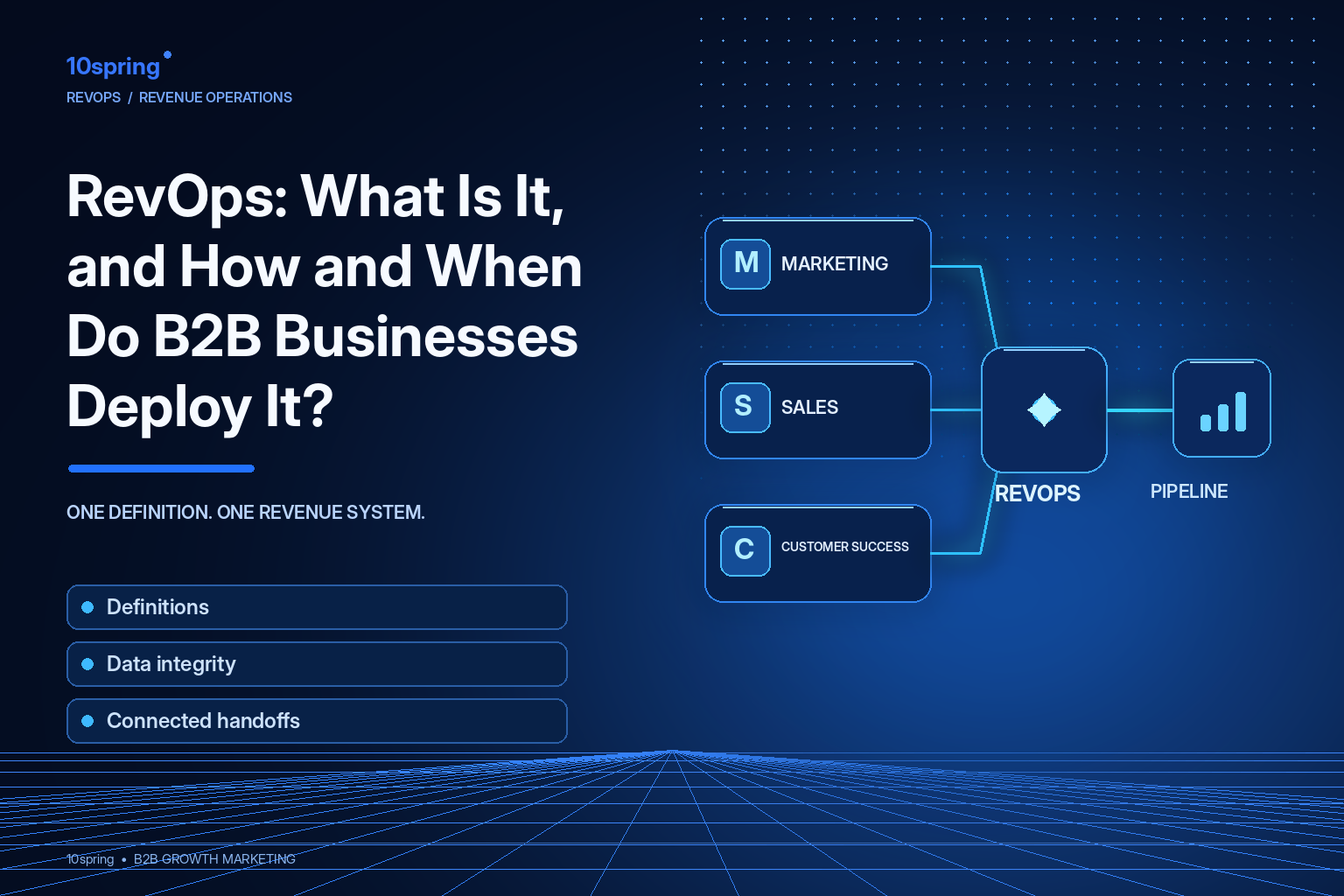
In many B2B companies, marketing, sales, and customer success report different numbers for the same pipeline. Marketing counts leads, sales counts opportunities, and renewals sit in a third system. The disagreement is rarely about effort. It usually comes from definitions, data, and handoffs that nobody owns.
Revenue operations, usually shortened to RevOps, is the function that owns those shared foundations. This article explains what RevOps is and what it covers. It then reviews what the evidence does and does not show, when B2B companies tend to need RevOps, and how to deploy it in a sensible order. It closes with how to measure RevOps against pipeline.
It draws on research from Gartner, McKinsey, and Forrester, surveys from LeanData and LXA, MarketingOps.com, and Salesloft, and guidance from consultancies, an investor, and software vendors. Many figures come from companies that sell RevOps services or software, so it notes where the evidence has limits. It reflects what was published as of November 16, 2026.
What RevOps is
Sources use slightly different wording, but they agree on the core idea. Gartner describes end-to-end revenue operations as a continuous feedback loop across the buyer journey that creates one go-to-market model in place of siloed functions. In a 2022 article, McKinsey partner Jennifer Stanley wrote that revenue operations supports every commercial team, not just sales. The goal is to present "a single face to customers."
This article uses a working definition. RevOps is the function that owns the shared definitions, data, processes, systems, and reporting behind revenue across marketing, sales, and customer success. Its purpose is to make sure the three teams work from the same facts.
It also helps to say what RevOps is not.
- It is not a job title. The Pedowitz Group notes that creating a title does not create the function. A head of revenue operations without a charter, authority, or access to the data holds a title and little else.
- It is not a tool. Software stores and moves the data. RevOps decides what the data means, who owns it, and how it is used.
- It is not sales operations renamed. Sales operations has typically centered on the sales team's process, compensation, and territories. McKinsey describes revenue operations as a move beyond that classic construct, toward supporting every commercial team.
- It is not a replacement for leadership. RevOps builds the shared system. Marketing, sales, and customer success leaders still own strategy, messaging, quota, and customer relationships. That is an inference from the definition above.
What RevOps covers
Sources draw the boundaries differently, but the work falls into six areas.
- Shared definitions. The ideal customer profile, account and contact rules, lifecycle stages, what counts as qualified, and what must be true before a handoff. Every report depends on these.
- Data. The system of record, field ownership, duplicate control, and the matching of leads to accounts. The Pedowitz Group names CRM data governance as the first project for a company starting from scratch.
- Process. Lead and account routing, response-time rules, handoffs between teams, and the flow from new business through renewal and expansion.
- Systems. The CRM, marketing automation, sales engagement, and customer success tools, along with the integrations between them. Someone has to own those integrations.
- Planning and forecasting. Pipeline coverage, capacity, territories, quotas, and the forecast. McKinsey lists sales strategy and planning, commercial process engineering, performance management, and quote-to-cash operations, such as deal desk support, as areas that revenue operations brings together.
- Measurement. Stage conversion, cycle length, win rates, and attribution that leaders trust, with the limits stated.
Forecasting shows why this work matters. A 2020 Gartner survey found that only 45% of sales leaders and sellers had high confidence in their organization's forecasting accuracy. The data are from 2020, and this article did not review a newer measure of the same question. It is an inference that weak definitions and data are common reasons a forecast cannot be trusted.
What the evidence supports, and what it does not
Many articles on RevOps open with a growth statistic. Most of those statistics deserve a closer look before anyone builds a business case on them.
- Gartner's 2021 prediction. Gartner predicted that by 2025, 75% of the highest-growth companies in the world would deploy a RevOps model. It was a forecast. No source reviewed shows whether it came true, and other pages in the search results restate it with a different year or as a completed outcome.
- Forrester's alignment figure. A widely repeated number says strong alignment brings up to 19% faster revenue growth and 15% higher profitability. It comes from Forrester research on the economics of alignment, presented at a 2015 summit. A second Forrester post says it covers alignment among sales, marketing, and product. It is not a measure of RevOps.
- McKinsey's growth comparison. McKinsey wrote that companies with fully integrated revenue operations achieved organic growth at least 5% greater than their peers. The article gives no sample, period, or method. A comparison like this cannot show whether integration drives growth or whether faster-growing companies integrate more.
- Perceptions of RevOps. A MarketingOps.com and Demand Metric survey of more than 250 B2B professionals found that 72% see RevOps as a key contributor to revenue growth. Only 45% believe their organization sees it that way. Among organizations where RevOps is longer established, the share saying their RevOps technology directly supports revenue growth rises from 35% to 63%. That is a difference between groups, not proof of cause. The summary omits sampling and dates, and the full report is gated by a paid membership.
- Adoption without clear goals. A Salesloft-commissioned Wakefield Research survey of 400 US respondents, released in July 2025, found that nearly three-quarters said their company already has a C-suite role dedicated to revenue operations. Yet 89% said RevOps lacks clearly defined strategic goals. Salesloft sells revenue software.
- Operational gaps. The 2026 LeanData and LXA report surveyed 201 senior leaders at enterprises with 2,500 or more employees in April 2026. It found that 42% cite poor alignment on lead qualification as a significant gap. It also found that 32% report duplicate or mismatched lead-to-account records, and 29% have no visibility into what happens after the marketing-to-sales handoff. Process and Operations was the lowest-scoring of its five maturity areas, at 3.66 out of 5.0, for a third year. LeanData sells lead routing and matching software, and the page does not describe its sampling method.
Taken together, the evidence is associational and often sponsored by sellers. It does not show that adding a RevOps function causes growth. What it does show is consistent: the same operational gaps recur, and leaders often lack clear goals for the function. The case for RevOps therefore rests on that mechanism, not on a growth multiple. That is an inference.
When B2B businesses deploy RevOps
The most common question is when. Published answers lean on company size, and they disagree.
- The Pedowitz Group. Its guidance says the need becomes pressing at roughly 10 to 20 go-to-market employees or about 5 million to 10 million dollars in annual revenue. The same page widens the revenue figure to 15 million dollars in its FAQ. The thresholds are the firm's own guidance.
- Prospeo. Its guide puts the first full-time hire at 2 million to 5 million dollars in annual recurring revenue, with a sweet spot of 4 million to 5 million. The page does not tie these bands to a cited study.
- Sendspark. Its guide suggests the first dedicated generalist at about 50 to 100 employees. Another section of the same page says 50 to 150. The headcount bands are uncited.
- Stage 2 Capital. A venture investor's view gives no single trigger. It suggests outsourcing at product-market fit, making a Director-level hire at go-to-market fit, and building a team at scale. Its practical signal is data from many sources that is hard to tie together.
- Unify. Its guide uses workload-based gates and calls them "planning criteria, not staffing benchmarks or a universal maturity timeline." They are not size thresholds.
These sources measure different things, from go-to-market headcount to total employees to recurring revenue, and none of the threshold figures cites a study. The practical conclusion is an inference. Use symptoms, not size, to decide when. The signs below recur across the sources.
- Leaders disagree on the numbers. Pipeline, bookings, or conversion rates differ by report, and meetings turn into debates about which figure is right.
- Definitions differ by team. Marketing, sales, and customer success use different meanings for lead, qualified, opportunity, or customer.
- Handoffs are invisible. In the LeanData and LXA survey, 29% had no visibility into what happens after the marketing-to-sales handoff.
- The forecast is rebuilt by hand. The Pedowitz Group lists manual forecast rebuilds as a sign that data trust has broken down.
- Tools disagree and nobody owns the integrations. The CRM, marketing automation, and customer success tools report different facts about the same account.
- Leaders do operations work. Stage 2 Capital says a sales leader should not spend about 10 hours a week on CRM workflows and dashboards. Unify treats recurring maintenance that competes with someone's main role as the trigger for a dedicated generalist.
- The motion is getting more complex. New segments, products, regions, partner channels, or account-based programs add handoffs and data that the existing process was not built for.
- AI plans sit on unreliable data. In the LeanData and LXA survey, 82% agreed that clean data and reliable routing must come before scaling AI. Only about one in three said they had the systems to do it.
Long, complex sales cycles raise the stakes. In a long B2B cycle, a record passes through more hands, involves more stakeholders, and takes months to show results. A broken definition or handoff costs more and takes longer to detect. That is an inference.
A company that shows none of these signs may not need a RevOps team yet. The Pedowitz Group's stage matrix describes organizations below about 5 million dollars in revenue, with 10 or fewer go-to-market employees, as having no formal RevOps. A named owner for definitions and data, plus a short written glossary, may be enough at that point. That is an inference.
How to deploy RevOps in order
The guidance reviewed converges on one sequence. Foundations come first, then automation, then advanced analytics and AI. Stage 2 Capital orders responsibilities from basic data infrastructure, to supporting the sales leader, to scale-stage work. The Pedowitz Group suggests diagnosing the current stage, defining the problems, right-sizing the model, assigning an owner, and writing a charter.
The six steps below follow that logic. They are not a fixed timeline, and each company will move through them at its own pace.
Step 1: Diagnose how revenue moves today
Start by mapping the path from first touch to renewal as it actually runs, not as a process slide shows it. Look for places where records, handoffs, or definitions break, and record a baseline before changing anything. Without a baseline, later improvement cannot be shown.
- Trace the path. Follow a sample of recent won, lost, and stalled opportunities from first touch to close, and note where information was lost or delayed.
- Audit the data. Check for duplicates, missing required fields, and whether account and contact records match.
- Check the handoffs. Measure how long leads wait, and whether marketing can see what happened to them after they passed to sales.
- Compare the numbers. Ask whether the same pipeline figure appears in marketing, sales, and finance reports.
- Set a baseline. Record stage conversion rates, cycle length, and response times before any change.
Diagnosis matters because teams often cannot see their own gaps. In Salesloft's 2026 benchmark of 500 US sales and revenue decision-makers, only about 32% could quickly pinpoint why a deal stalled. Another 27% could see win and loss rates but not what happened between stages. Fieldwork dates are not stated, and Salesloft sells revenue software.
Step 2: Agree on definitions and decision rights
Definitions come before configuration. If two people would classify the same record differently, no workflow or report built on it can be trusted. Write the definitions in a short glossary with an owner and a change log.
Unify says a revenue operations function needs an executive sponsor, shared priorities, and explicit decision rights. It adds that a title or reporting line alone does not prevent departmental bias.
- Customer and account definitions. Who belongs in the ideal customer profile, and what counts as an account, a contact, and a buying group.
- Lifecycle stages. Entry and exit criteria for each stage, written so that two people would classify a record the same way.
- Qualification and handoff criteria. What must be true before marketing passes a lead and before sales accepts it. In the LeanData and LXA survey, 42% cited poor alignment on lead qualification.
- Separate pipelines. Keep new business, renewal, and expansion apart. Prospeo says mixing them makes forecasting unreliable.
- Decision rights. Who may change a definition, a field, or a routing rule, and how each change is recorded.
Step 3: Fix the system of record and the handoffs
Once definitions exist, the system of record has to reflect them. Stage 2 Capital puts basic data infrastructure first. The Pedowitz Group names CRM data governance as the first project for a company building from scratch.
- Clean and match. Remove duplicates, standardize required fields, and match leads to accounts so that one account shows one history.
- Write routing rules. Assign leads and accounts by rule, and test the rules against real records before relying on them.
- Set response-time agreements. LeanData lists shared definitions, unified visibility, and enforceable service-level agreements among its priorities. A service-level agreement is a written time limit for acting on a lead.
- Make the handoff visible. Marketing should see what sales did with each lead, and sales should see the marketing history behind it.
Step 4: Connect the stack and automate what is stable
Automation pays off only after the process underneath it is stable. Automating an unclear handoff makes the problem faster, not smaller. Gartner's 2021 advice was to take inventory of sales, marketing, and customer service technologies, then simplify the stack by removing redundant enablement technology. LeanData recommends simplifying platform fragmentation through workflow design rather than procurement.
- Name an integration owner. The Pedowitz Group lists tool sprawl with no integration owner as a trigger for RevOps. One person should answer for how data moves between systems.
- Inventory the tools. List what each tool is for, who uses it, and what data it holds. Retire overlap before adding anything new.
- Automate stable steps first. Routing, lifecycle updates, and alerts that follow written rules are better first candidates than judgment calls. That is an inference.
- Put AI after the foundation. Salesloft's benchmark found that only 20.6% described their AI strategy as production-ready with measurable outcomes. The LeanData and LXA figures above point the same way.
Step 5: Govern change and assign ownership
A RevOps system drifts unless someone governs it. Definitions get edited, fields get added, and integrations break. Governance keeps those changes visible and reversible.
- Change control. Log changes to definitions, fields, routing, and integrations with dates, so that trend lines can be read correctly later.
- Review cadence. The Pedowitz Group suggests revisiting the model annually. A faster review of data quality and routing is an inference.
- A prioritized backlog. Stage 2 Capital suggests treating RevOps like a product organization with a backlog, because there is always more work than capacity.
- AI governance. In the LeanData and LXA survey, only 26% had enforcement mechanisms and 50% felt confident in their AI governance readiness. The report recommends shared ownership across RevOps, marketing, and IT.
Step 6: Choose a structure that fits the workload
Structure should follow workload, not a headcount table. Unify describes three gates.
- Bounded work. Name an internal owner and add project support. A temporary implementation project may justify contract support without a permanent role.
- Recurring maintenance that competes with a main role. Add a dedicated generalist with the authority to set priorities.
- Sustained domain depth. Add a RevOps lead and targeted specialists, such as systems or analytics.
Outside help can fill early gaps. Stage 2 Capital recommends outsourcing at the product-market-fit stage and keeping outside support after the first in-house hire. Guides differ on hiring order, and none of the orders reviewed cites a study.
Sources also disagree on where RevOps should report. Sendspark says to the chief revenue officer or the CEO, and never to the CFO. Prospeo suggests the chief revenue officer as the default, with the CEO and CFO as alternatives. It cites a poll of 102 RevOps professionals in which most voted for the chief revenue officer. The MarketingOps.com survey found no agreement on reporting lines, mandate, or control over tools and data. It also found that many teams report into sales or marketing without clear authority.
The Salesloft-commissioned survey, as MarketScale reported it, found RevOps working most closely with COOs at 26%, CEOs at 25%, and CFOs at 24%. The common thread is authority, not the box on the org chart. A sponsor, shared priorities, and written decision rights matter more than the reporting line. That is an inference.
Prospeo also warns that embedding one operations person inside each department recreates silos, and that teams often revert within six months. Sendspark describes a hybrid model, with shared services reporting to the head of RevOps and embedded analysts holding a dotted line. Both are the authors' own guidance, not research.
How AI-mediated buying changes the job
Buying now mixes self-service, AI, and people. A Gartner survey of 645 B2B buyers, conducted from August through September 2025, found that 69% prefer to validate AI-generated insights with sales reps. A Gartner survey summarized by Demand Gen Report found that 67% prefer a rep-free experience and 70% prefer a completely digital, self-service one. Both can be true. As Demand Gen Report summarizes it, the seller's role is shifting from primary source of information toward validation at key points in the buying process.
For RevOps, that has three implications. All three are inferences.
- Capture the digital trail. Record how buyers say they found the company, alongside campaign tags and referral sessions. Without that, first touch is lost when a buyer researches in AI Search Engines and arrives later through a branded search or a direct visit.
- Capture the human conversation. In Salesloft's benchmark, 55.6% said CRM entries are mostly subjective seller reporting. Structured fields for stall reasons, stakeholders, and competitors turn conversations into data.
- Track accounts, not only leads. B2B purchases involve several people. Lead-to-account matching and account-level views keep a buying group's activity together. In the LeanData and LXA survey, 32% reported duplicate or mismatched lead-to-account records.
How to measure RevOps against pipeline
RevOps work is easy to measure badly. Tickets closed, dashboards built, and fields cleaned describe effort, not outcomes. A revenue-first view keeps those figures in their place. It uses three layers.
- Layer 1: activity and infrastructure signals. Duplicate rate, share of records with required fields, lead response time, routing accuracy, and forecast variance. Use them to diagnose the system, not to judge the program.
- Layer 2: conversion performance. Stage-to-stage conversion, qualified opportunities created, cycle length, and win rate by segment and source. This is where handoffs either work or do not.
- Layer 3: business impact. Pipeline, new customers, and recurring revenue, plus retention and expansion where they apply. Attribute results to RevOps only where reliable data supports it.
Four practices keep the layers honest.
- Baseline first. Record the starting point before any change, so improvement can be shown.
- Compare over quarters. Long sales cycles mean a few weeks of data say little about pipeline. Change one thing at a time where possible.
- Keep definitions stable, or document the change. Redefining a stage breaks the trend line. When a definition must change, log the date and restate prior periods where the data allow.
- State the attribution limits. RevOps improves the conditions for revenue. It cannot claim revenue alone, because pipeline also depends on product, sales execution, and market conditions.
If activity rises without qualified opportunities, diagnose the conversion pathway before adding more activity. Look at lead quality, routing, response time, handoff criteria, and follow-up. Those are the first places to look.
Common ways RevOps fails
- A title without a charter. A new head of revenue operations arrives with no scope, no authority, and no access to the data.
- Tools before definitions. Buying software to fix a problem that is really disagreement over definitions moves the disagreement into a new system.
- No clear goals. In the Salesloft-commissioned survey, 89% said RevOps lacks clearly defined strategic goals.
- No authority across teams. The MarketingOps.com survey found many RevOps teams reporting into sales or marketing without clear authority to influence those functions.
- A perception gap. In the same survey, 72% saw RevOps as a key contributor to growth, but only 45% believed their organization did. Among organizations without RevOps, most said they had not been able to make the case for investing in it.
- Mixed pipelines. Combining new business, renewal, and expansion in one pipeline makes the forecast unreliable, according to Prospeo.
- AI before foundations. Scaling AI on duplicate records and unreliable routing amplifies the problems. That is an inference from the LeanData and LXA findings.
- The report factory. A team that only produces dashboards on request never fixes the process that produces the bad data. That is an inference.
Where RevOps fits among the nine Execution Channels
RevOps supports the other channels by holding the data that shows whether they work.
- RevOps. Definitions, data, routing, systems, forecasting, and measurement decide whether the rest of the revenue system can be trusted.
- GTM Strategy. Ideal customer definitions, segments, and positioning feed the shared definitions that RevOps maintains.
- Account-Based Marketing. Account lists, lead-to-account matching, and account-level reporting depend on clean account data.
- AI Search Readiness + SEO. Buyer-reported source, referral sessions, and landing page data show how AI Search Engines and search contribute to pipeline.
- Content Development. Lifecycle stages and stall reasons show which questions content should answer at each stage.
- Digital PR. Earned visibility is hard to attribute, so buyer-reported source and account-level views help show its role.
- Website Development. Forms, tracking, and CRM integrations determine whether site activity reaches the system of record intact.
- Conversion Rate Optimization (CRO). Stage conversion data shows where friction sits, and CRO work tests ways to reduce it.
- PPC & Paid Media. Sending qualified outcomes back to ad platforms lets them optimize toward pipeline instead of form fills.
10spring treats RevOps as one of nine Execution Channels that work together. It performs best when it serves the other eight and is judged on pipeline, not on reports produced.
Practical takeaways
- Define RevOps by scope, not title. It owns shared definitions, data, processes, systems, and measurement across marketing, sales, and customer success.
- Treat growth statistics with care. Check whether a figure measures RevOps, who produced it, and whether it shows cause or only association.
- Use symptoms, not size, to decide when. Conflicting numbers, invisible handoffs, hand-built forecasts, and tool sprawl matter more than headcount.
- Diagnose before you build. Map the path from first touch to renewal, audit the data, and record a baseline.
- Agree on definitions and decision rights first. Write a glossary with an owner and a change log.
- Fix the system of record and handoffs before adding tools. Clean data, tested routing, and visible handoffs come before new software.
- Put automation and AI after stable process. Automate steps that follow written rules, and govern anything that acts on its own.
- Match structure to workload. Give the function an executive sponsor, shared priorities, and written decision rights, whatever the reporting line.
- Capture both the digital trail and the human conversation. Buyer-reported source and structured sales notes fill the gaps that platform data leaves.
- Measure in layers. Judge RevOps on qualified opportunities, pipeline, customers, and recurring revenue, and use operational metrics as diagnostics.
10spring works alongside internal marketing teams. If you want to pressure-test how your revenue operations support pipeline, Book A Call. Let's accelerate your pipeline together.
Sources and further reading
All sources accessed November 16, 2026.
- Gartner. Gartner Predicts 75% of the Highest Growth Companies in the World Will Deploy a RevOps Model by 2025. Press release, May 17, 2021. Read through search excerpts only. Used for the prediction, the description of end-to-end revenue operations, and the advice to inventory and simplify technology. Other pages seen in search results restate the prediction with a different year or as a completed outcome.
- McKinsey & Company, by Jennifer Stanley. The big unlock for B2B sales: Modernizing revenue operations. Article republished in the Selling Power blog, October 31, 2022. The title is descriptive. Used for the definition, the merged areas, and the organic growth comparison. The article gives no sample size, period, or method. McKinsey sells advisory services.
- Forrester. Summit 2015 Highlights: The Economics of Alignment. Analyst blog post, read through a search excerpt only. The excerpt reviewed does not state a date, and the year comes from the title. Used for the 19% and 15% alignment figures.
- Forrester. The New Frontiers of B2B Alignment. Analyst blog post, read through a search excerpt only. The excerpt reviewed does not state a date. Used to confirm that the alignment research covers sales, marketing, and product.
- Gartner. Gartner Says Less Than 50% of Sales Leaders and Sellers Have High Confidence in Forecasting Accuracy. Press release, February 12, 2020. Read through a search excerpt only. Used for the 45% forecasting confidence figure from Gartner's State of Sales Operations survey. The data are older than most sources here, and the URL is shortened in the form shown in search results.
- LeanData and LXA. The 2026 B2B State of Martech and Revenue Operations Report. Vendor research report. The page metadata shows a last-modified date of June 17, 2026, and fieldwork in April 2026. Survey of 201 senior leaders at enterprises with 2,500 or more employees in seven countries. Used for the data quality, handoff, AI readiness, and governance figures. The page does not describe sampling method, question wording, or response rate, and it contains minor inconsistencies. LeanData sells lead routing and matching software.
- MarketingOps.com. The Rise of RevOps: From Buzzword to Backbone. Community article, October 8, 2025, summarizing a survey run with Demand Metric of more than 250 B2B professionals. Used for perceptions of RevOps, reporting lines, and the 35% to 63% comparison. The summary omits sampling, dates, and question wording. The full report is gated by a paid membership, and MarketingOps.com sells memberships.
- MarketScale. 73% of Companies Now Put RevOps in the C-Suite, but 89% Still Lack Goals. News article, published September 4, 2026 and updated September 5, 2026, on a survey of 400 US respondents released in July 2025, commissioned by Salesloft and fielded by Wakefield Research. The title is descriptive. Used for the C-suite role, clear goals, and executive partner figures. Salesloft sells revenue software.
- MarketScale. 100% of Revenue Teams Say They Use AI, but Only 20.6% Can Show Measurable Results. News article, September 5, 2026, on Salesloft's 2026 Revenue Benchmark of 500 US sales and revenue decision-makers. The title is descriptive. Fieldwork dates are not stated. Used for the deal visibility, CRM data, and AI maturity figures. Salesloft sells revenue software.
- Stage 2 Capital. RevOps: When, How, and Who to Hire. Article by Liz Christo, a venture investor. The page shows no publication date. The title is descriptive. Used for the stage-based guidance and the order of responsibilities. It is an investor's opinion.
- The Pedowitz Group. What Size Company Needs Revenue Operations?. Consultancy page. The page shows no date. Used for the thresholds, triggers, and suggested sequence. The thresholds are the firm's own guidance, not research. The Pedowitz Group sells RevOps and revenue marketing services.
- The Pedowitz Group. What Is RevOps? Why Every B2B Company Needs Revenue Operations. Consultancy blog post by Jeff Pedowitz, April 23, 2026. Read through a search excerpt only. Used for the point that a title does not create the function and for CRM data governance as a first project.
- Unify. RevOps Team Structure: A Stage-by-Stage Hiring Guide. Vendor guide, updated October 22, 2026. The title is shortened. Used for the workload gates and the reporting-line guidance. Unify sells go-to-market software.
- Sendspark. Revenue Operations Team Structure. Vendor blog post by Abe Dearmer, published June 8, 2026 and updated September 1, 2026. The title is descriptive. Used for headcount and reporting-line guidance, which is uncited author opinion. Sendspark sells AI video software.
- Prospeo. Revenue Operations Team Structure in 2026. Vendor guide. The page shows no publication date. Used for the recurring revenue bands, reporting lines, and failure modes, which the page does not tie to a cited study. The poll of 102 RevOps professionals is cited on the page and was not reviewed. Prospeo sells data and sales software.
- Gartner. Gartner Survey Finds 69% of B2B Buyers Turn to Sales Reps to Validate AI-Generated Insights. Press release distributed by Business Wire, May 20, 2026. Read through search excerpts only. Used for the 69% figure and the survey sample of 645 buyers, conducted from August through September 2025.
- Demand Gen Report. Gartner: AI Is Reshaping B2B Buying, but Human Sellers Still Close the Confidence Gap. Trade article, May 26, 2026. Read through search excerpts only. Used for the 67% and 70% buyer preference figures.