Most B2B teams ask whether to redesign their website for one of three reasons. The site was not built for how buyers now research with AI Search Engines. The design looks dated. Or the company has new products or services that the site does not reflect.
Each is a legitimate reason to look hard at the website. None of them proves, on its own, that a redesign is the right answer. A redesign is expensive, slow, and can put existing search visibility at risk. Often the better move is a narrower one.
This article offers a way to separate the symptom from the cause. It covers what the evidence says about each of the three triggers, what a rebuild puts at risk, and how to measure the result against business outcomes instead of traffic. It draws on public guidance from Google, Nielsen Norman Group, Gartner, Forrester, G2, and Vercel, and it notes where that research has limits.
Decide the problem before you decide the project
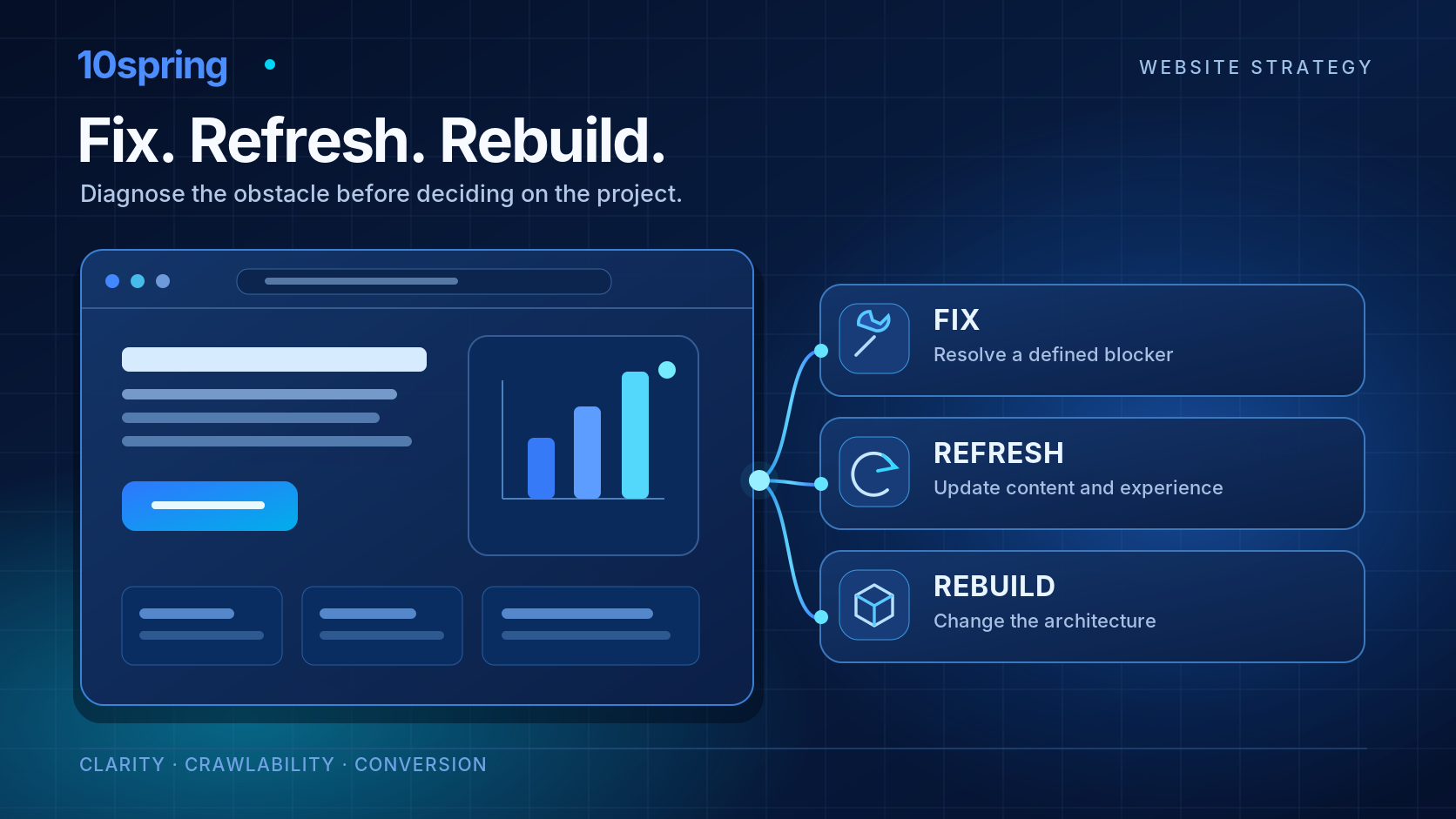
A redesign is one of three options, and the three are easy to confuse.
- Fix: a targeted correction to a specific page, template, form, or technical issue.
- Refresh: an update to design, content, and messaging that keeps the existing structure and platform.
- Rebuild: a new architecture, platform, or design, usually with new URLs.
Nielsen Norman Group has argued for years that the smallest change that solves the problem usually beats a total overhaul. Its guidance on radical versus incremental redesign was published in 2015, before AI Search Engines existed, but the logic holds. It recommends basing any redesign on user data and clear measures of success. It also warns that big changes can disorient users and break things they rely on.
The same guidance names the cases where a major overhaul is justified:
- Incremental fixes have reached diminishing returns.
- Outdated technology blocks critical user journeys.
- Years of patchwork have left the site's structure incoherent.
- Site-wide conversion is very low, and no incremental fix can lift it.
- The site has fallen far behind competitors that buyers are choosing instead.
Those are conditions to test for, not to assume.
Why the website carries more weight now
Many buyers prefer to research and buy without a seller's involvement, which puts weight on the website. Gartner's March 2026 release reported that 67% of surveyed B2B buyers preferred a rep-free experience. An earlier Gartner survey of 632 buyers found that 69% reported inconsistencies between a seller's website and what sellers told them. Gartner's view is that mismatched information erodes trust and can put a deal at risk.
Research on how buyers use AI points the same way. G2's 2026 survey of 1,076 B2B software buyers found that 51% start with an AI chatbot more often than with Google, and 71% rely on AI chatbots at some point. Forrester found that buyers check AI output with trusted people and are more likely to engage a provider based on expert input than on AI tools.
That makes the website one of several places where buyers confirm what an AI-generated answer or a colleague told them. It does not need to be perfect. It does need to be clear, current, and consistent with what sales says.
Trigger one: the site is not ready for AI search
This is the trigger most often overstated. Google's guide to its generative AI features was last updated July 10, 2026. It says a page must be indexed and eligible to appear in Google Search with a snippet before it can appear in AI Overviews or AI Mode. The guide does not call for special markup, an llms.txt file, or content rewritten into smaller chunks. Structured data is not required. Google also notes that these features can reflect what people say across the web, so the site is one input among several.
For Google's AI features, then, readiness mostly means search fundamentals. Pages need to be crawlable, indexable, and understandable, with content that helps visitors. Most sites that already meet those fundamentals do not need a redesign to qualify.
Rendering is the exception worth checking. Google's JavaScript SEO basics explain that Googlebot crawls, renders, and indexes pages, and that it runs JavaScript using headless Chromium. The same page recommends server-side rendering or pre-rendering, because not all bots can run JavaScript. If a site builds its content in the visitor's browser (client-side rendering), the HTML the server returns may not contain the real content.
Other AI Search Engines may handle this differently. A December 2024 analysis by Vercel and MERJ found that crawlers from OpenAI, Anthropic, Meta, ByteDance, and Perplexity did not render JavaScript, while Gemini used Googlebot's rendering. Treat that finding with care. It rests mainly on data from one documentation site and Vercel's network, it was validated on two job-board sites, and it excluded Microsoft Copilot. Vercel is also a web hosting company, and it published the study on its own blog. Crawler behavior can change, so test your own pages instead of relying on any single study.
A simple check helps. View your key pages with JavaScript turned off, or look at the page source. If headlines, product descriptions, and navigation links are missing, a crawler that skips scripts cannot read them.
This is where a rebuild can be warranted: core content is hard for crawlers to read, and the platform cannot be fixed in place. If the content is crawlable but thin, outdated, or unclear, a new design will not make it clearer. That takes content and structure work, which can happen on the current site.
Trigger two: the design looks dated
This is the hardest trigger to judge, because it is easy to feel and hard to measure. Public research that isolates visual age as a cause of lost B2B opportunities is thin, and much of what circulates comes from firms that sell redesigns. Nielsen Norman Group cautions that design teams can lean toward trendy changes and away from fixing content, structure, and interaction problems.
That does not make design cosmetic. A dated site often has real problems underneath, and these are worth testing for.
- Performance and usability. Google says its ranking systems use Core Web Vitals and recommends good scores. Good scores do not guarantee top rankings, and relevance still comes first. Google adds that other page experience factors do not directly boost rankings but still make a site more satisfying to use.
- Editability. If the platform blocks the changes the business needs, such as updating offerings or building new conversion paths, the site will keep falling behind. Nielsen Norman Group lists this as a case where a major overhaul can be warranted.
- Consistency. Outdated claims, positioning, and product descriptions create the mismatch Gartner describes. That is a content problem first and a design problem second.
- Conversion path. If buyers cannot tell what to do next, a new look will not change that.
A practical test is to ask whether the dated look is stopping buyers from understanding, trusting, or acting, or whether it mainly bothers the internal team. Usability testing with real buyers, drop-off analysis in analytics, and conversations with sales about what prospects say can answer that. Nielsen Norman Group recommends usability testing the existing site before committing to a change.
Trigger three: new products or services
This is often the strongest reason to change the site, and the one most likely to be handled in the wrong order. When offerings change, the navigation, page hierarchy, and messaging usually still describe the old company. A buyer who reads the website and then talks to sales may hear two different stories. That is the inconsistency in Gartner's survey.
The sequence matters.
- Settle the positioning. Decide how you describe the problems you solve and for whom, in the words buyers use.
- Reshape the structure. Decide which pages exist, how they connect, and how a buyer finds the right one.
- Then design and build. Visual and technical work comes last, because it can carry unresolved positioning into a new look.
Scale matters too. If the new offerings fit the existing structure, adding and updating pages may be enough. If they change who you serve or how the business is organized, the architecture may need rethinking. That is where the patchwork problem in Nielsen Norman Group's guidance applies: pages added one at a time until the structure no longer makes sense.
What a rebuild puts at risk
If the answer is a rebuild, the main risk to manage is search visibility. Google's guidance on site moves with URL changes, last updated August 20, 2026, lays out the process.
- Map every old URL to a new one. Build the map before launch, and test the new site before it goes live.
- Use server-side redirects. Google recommends 301 or 308 redirects, advises against redirect chains, and warns against sending many old URLs to one unrelated page such as the homepage.
- Update the references. Canonicals, internal links, and the sitemap should point to the new URLs.
- Keep the redirects in place. Google advises keeping them for at least a year.
- Monitor after launch. Watch Search Console and server logs.
Google also says rankings can fluctuate during a move, and that new URLs can take weeks or longer to appear. A redesign that keeps every URL carries less of this risk. Templates, internal links, and rendering still change, so the same discipline applies in lighter form.
A simple way to decide
Match the evidence to the smallest option that solves the problem.
- Fix when the problem is specific and located. Examples include a slow template, a confusing form, content that renders only in the browser, or outdated claims on a handful of pages.
- Refresh when the structure and platform are sound, but the content, messaging, or visual design no longer reflect the business.
- Rebuild when the platform or architecture blocks what the business needs, positioning has changed enough that the structure no longer fits, and targeted fixes have reached diminishing returns.
Whichever path fits, write down the problem the work is meant to solve before anyone opens a design tool. If the team cannot name a specific problem, it is not yet ready to choose a solution.
Measure the website the way the business is measured
A website project should be judged on the same hierarchy as the rest of marketing. Traffic, rankings, and visibility in AI Search Engines are useful diagnostic signals. They show whether the site is being found. The next question is conversion: whether visitors become qualified opportunities. The most important is business impact, meaning qualified pipeline, new customers, and recurring revenue where it applies.
Four habits keep the measurement honest.
- Set baselines before the change. Capture traffic, conversion rates by page and path, and qualified opportunities that start on the website, so before and after can be compared.
- Expect noise at launch. Google says rankings can fluctuate during a move, so read early traffic movement with that in mind.
- Attribute carefully. If the redesign launches alongside a new campaign or offer, the site cannot take all the credit or blame. Attribute outcomes only where reliable data supports it.
- Diagnose when traffic and outcomes diverge. If visits rise while qualified opportunities do not, look for friction in the conversion pathway before changing anything else.
No redesign can guarantee more citations, rankings, leads, or revenue. What it can do is remove specific obstacles, and the baselines show whether it did.
Practical takeaways
- Treat "should I redesign?" as a diagnostic question, and name the specific problem first.
- For AI search readiness, check the fundamentals before touching design: indexability, crawlability, and whether key content appears in the HTML the server returns.
- Google says its AI features need no special markup or llms.txt file, so do not rebuild for those alone.
- Judge a dated design by whether it affects buyers' understanding, trust, or action, not by internal taste.
- When offerings change, settle positioning and structure before design.
- If you rebuild, plan the URL map, redirects, and monitoring before launch.
- Set baselines, and measure against qualified pipeline, not traffic alone.
10spring works alongside internal marketing teams. If you want to pressure-test whether your website needs a fix, a refresh, or a rebuild, Book A Call. Let's accelerate your pipeline together.
Sources and further reading
All sources accessed November 13, 2026.
- Hoa Loranger, Nielsen Norman Group. Radical Redesign or Incremental Change? Article, February 8, 2015.
- Google Search Central. Optimizing your website for generative AI features on Google Search. Documentation, last updated July 10, 2026.
- Google Search Central. Understand JavaScript SEO basics. Documentation, last updated March 4, 2026.
- Google Search Central. Site move with URL changes. Documentation, last updated August 20, 2026.
- Google Search Central. Understanding page experience in Google Search results. Documentation, last updated September 22, 2026.
- Vercel and MERJ. The Rise of the AI Crawler. Blog post, December 17, 2024. Published by a hosting vendor; the data comes mainly from nextjs.org and the Vercel network.
- Gartner. Gartner Sales Survey Finds 61% of B2B Buyers Prefer a Rep-Free Buying Experience. Press release, June 25, 2025. Survey of 632 B2B buyers, August to September 2024.
- Gartner. Gartner Sales Survey Finds 67% of B2B Buyers Prefer a Rep-Free Experience. Press release, March 9, 2026. Survey of 646 B2B buyers, August to September 2025.
- Barbara Winters, Forrester. The State Of Business Buying: Risk-Averse Buyers Demand Proof, Not Promises. Blog post, January 21, 2026. Based on Forrester's Buyers' Journey Survey of nearly 18,000 business buyers. The full report is not publicly available.
- G2. In the Answer Economy, Don't Win the Click, Win the Answer. Research summary, April 15, 2026. Survey of 1,076 B2B software buyers and decision-makers, fielded March 2026.