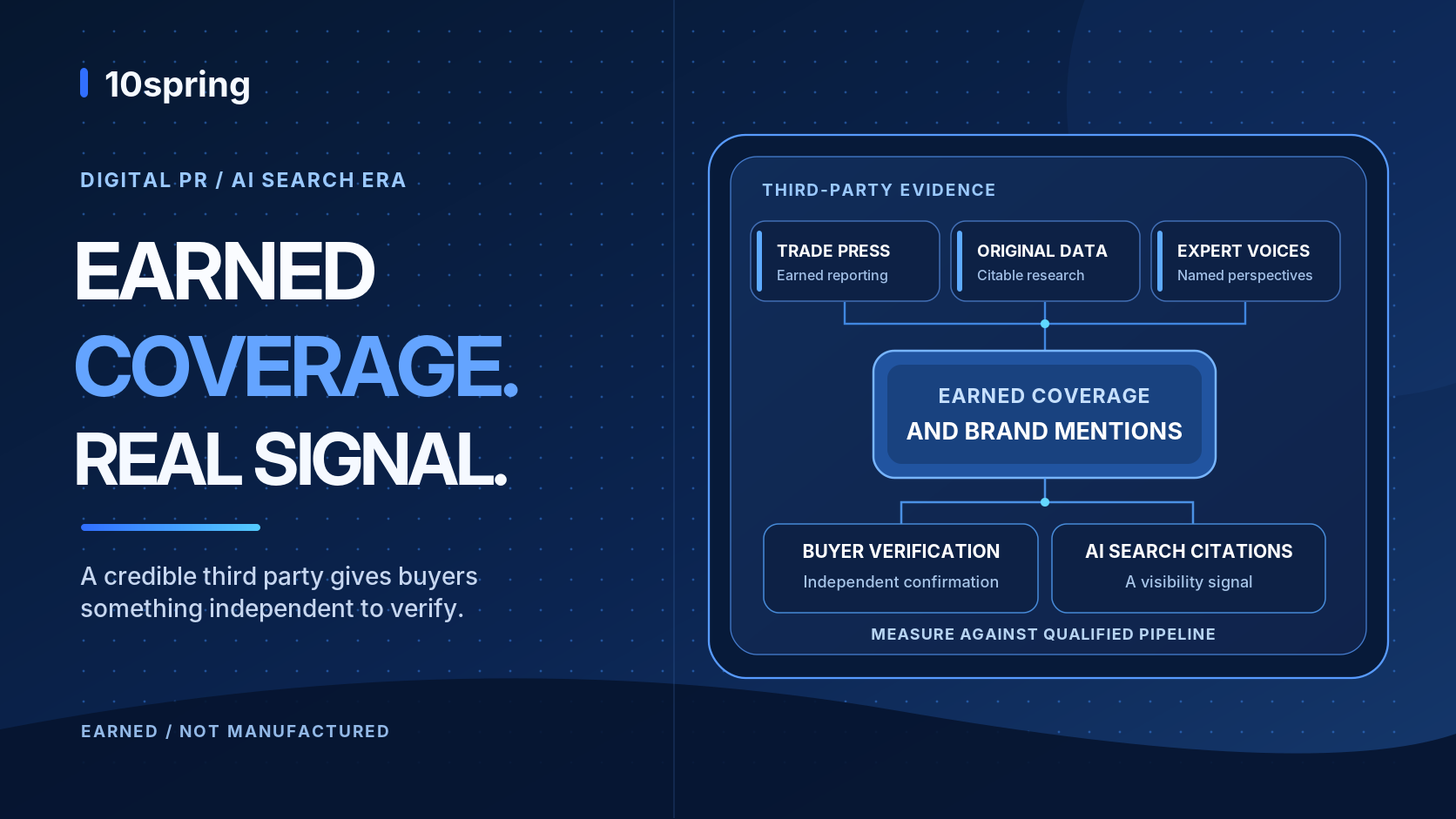
For years, teams judged digital PR by the links it earned. That measure is now too narrow. Several studies suggest that AI Search Engines lean heavily on third-party sources, so what others publish about your company can shape the answer a buyer reads before they ever visit your site. The studies also disagree with one another, and the disagreements matter.
This article defines digital PR and separates it from traditional public relations, link building, and press release distribution. It walks through what the research says about earned coverage and AI citations, why the numbers differ, and what the evidence cannot prove. It covers what Google's link rules mean for how coverage is earned. It closes with a way to measure digital PR against qualified opportunities and pipeline, not coverage counts.
It draws on research from Muck Rack, Meltwater, BuzzStream and Citation Labs, Ahrefs, Edelman and LinkedIn, G2, and Cision. It also uses an academic preprint on how AI search sources its answers and Google's published spam policies. Several of these organizations sell PR software, media intelligence, or SEO tools, and their studies use different definitions and short time windows. It notes where research has limits. It reflects what was published as of November 13, 2026, and AI Search Engine citation behavior changes often.
What digital PR is
Digital PR is the practice of earning coverage, mentions, and links from third-party online publications by giving journalists, editors, and creators something worth reporting. The word earned carries the weight. No one pays for the placement, and the publication decides what runs.
One placement can produce three assets. It creates a published page on a site your buyers already trust. It creates a mention of your company or your people, with or without a link. Sometimes it also creates a link to your site.
Practitioners describe the work in four common forms.
- Expert commentary. A named expert gives a journalist a quote, a perspective, or a data point for a story already in progress.
- Original data. A study, survey, or analysis that a publication can cite because no one else has it.
- Feature and trade placements. Articles, interviews, and profiles in the trade publications, newsletters, and podcasts your buyers follow.
- Press releases. Announcements pitched directly to reporters or sent through a wire service.
BuzzStream interviewed more than 150 digital PR professionals for its State of Digital PR report, published in February 2026. Respondents mainly described expert commentary, data-led content, press release pitching, and creative hero content, meaning large flagship pieces. Pitching data-led content was the most common tactic, at 95.9%. BuzzStream sells digital PR software, and the respondents describe their own field, so weigh the report with that in mind.
How digital PR differs from nearby practices
Four neighboring practices get confused with digital PR. The differences affect what you measure.
- Traditional PR. It builds reputation across print, broadcast, and online media, and it often reports reach and sentiment. Digital PR applies the same earned-media logic, but it reports results that online tools can count, such as links, mentions, branded search, and AI Search Engine citations.
- Link building. Link building starts with the link. Digital PR starts with coverage, and a link is one possible byproduct. Whether links still matter is a separate question, and this article focuses on coverage and mentions.
- Content marketing. Content marketing publishes your ideas on your own site. Digital PR places them on other people's sites. The two depend on each other, because original research on your site gives a journalist something to cite.
- Press release distribution. A wire release announces news. Distribution is not the same as earning coverage, and the evidence below shows why the difference matters to AI Search Engines.
Why earned coverage matters to AI Search Engines
Four sources of evidence point in a similar direction, though they disagree on the size of the effect. Each has limits.
Muck Rack. Its May 2026 What Is AI Reading? report analyzed more than 25 million links cited by ChatGPT, Claude, and Gemini across 17 industries. It attributed about 84% of citations to earned media and about 27% to journalism. Paid and advertorial content made up 0.3%, and press releases made up 1.1%. The prompts were realistic consumer questions. Muck Rack sells PR software, including the Generative Pulse product behind the report.
Meltwater. Its monthly tracking covers eight systems: ChatGPT, Claude, Gemini, Perplexity, Grok, Google AI Overviews, Google AI Mode, and Copilot. Its April 2026 analysis covered about 5.35 million citations and put Earned/News at 39.5%, up from 38.3% in March. Meltwater sells media intelligence tools.
BuzzStream and Citation Labs. A March 2026 study analyzed about 4 million citations from 3,600 prompts across 10 industries on ChatGPT, Google AI Mode, Google AI Overviews, and Gemini. News publications made up 14% of all citations. Syndicated press releases made up 0.04%, and direct newswire links made up 0.21%. The data covers one week and focuses on large brands. BuzzStream sells digital PR tools.
An academic preprint. Researchers posted a preprint in September 2025 that compared Google with web-enabled models from OpenAI, Perplexity, Anthropic, and Google. They reported a systematic bias in AI search toward earned sources, meaning third-party authoritative sites, over brand-owned and social content. Google's own results showed a more balanced mix. The authors also flagged a big-brand bias that makes visibility harder for niche companies. The model versions tested have since changed.
Where the studies overlap, the message is consistent. Third-party editorial coverage supplies a substantial share of what AI Search Engines cite. Muck Rack and BuzzStream also find that paid placements and wire releases supply very little.
Why the studies disagree
Muck Rack reports 84% earned. Meltwater reports under 40%. Both can be accurate, because the labels mean different things.
- Different buckets. Muck Rack's earned category is broad. It includes journalism, academic research, government and NGO sources, encyclopedic sites such as Wikipedia, social platforms, and third-party corporate blogs. Journalism alone is about 27%. Meltwater's Earned/News category appears narrower, but its August 2026 report defines only the separate Other category, which covers corporate sites, research databases, and similar sources.
- Different samples. The studies use different systems, prompts, industries, and time windows. BuzzStream collected one week of data. Meltwater reports monthly, with prompts spread across categories such as retail banking, automotive, and fast food. Muck Rack publishes an edition every few months.
- Moving targets. Meltwater's August analysis put Earned/News at 29.4%, down from 33.1% in July, 35.0% in June, and 37.6% in May. Muck Rack's October 2026 edition, read here through trade coverage, reported journalism falling from about 27% in May to 22% in September. Meltwater warns that its rising Other share should not be read as owned content growing.
Muck Rack's own report warns that the behaviors it observed may shift as models are updated or retrained. Within Muck Rack's definition, the earned share stayed between 82% and 89% across its first three editions. The mix inside that share moves.
Two cautions apply to B2B teams. Where the studies describe their prompts, those prompts lean toward consumer categories, not B2B buying questions. Read the results as direction, not as a benchmark for your category. Also, Muck Rack counts third-party corporate blogs as earned, so some earned citations may not be coverage that a PR team could pitch for.
Mentions, links, and what correlation can show
Ahrefs analyzed 75,000 brands and compared several signals with how often each brand appeared in Google AI Overviews. Its study from May 2025 used Spearman correlations. Branded web mentions, linked or unlinked, showed the strongest relationship at 0.664. Branded anchors came next at 0.527, then branded search volume at 0.392. Backlink counts came in at 0.218.
That finding is often summarized as "mentions beat links." The study supports a narrower claim. Across the brands it examined, mentions moved together with AI Overview visibility more closely than link counts did. It did not test whether earning more mentions causes more visibility.
Three limits apply.
- Size confounds the result. Large, well-known brands tend to have more of everything, including mentions, links, search demand, and AI visibility. A correlation cannot separate those effects.
- One surface only. The study covers Google AI Overviews, not the other AI Search Engines. About 26% of the brands it started with had no AI Overview mentions, and Ahrefs studied the remaining 74%.
- Vendor interest. Ahrefs sells SEO software, including a product that tracks brand mentions across AI Search Engines.
Digital PR tends to produce mentions and links at the same time. So this study cannot say which of the two does the work. Treat both as outputs worth earning, and judge the program on what happens next.
Why results differ by AI Search Engine and by month
The research agrees on one point more than any other: AI Search Engines do not behave alike. Muck Rack's May 2026 data shows the range.
- Citation habits. ChatGPT cited sources in 96% of responses, averaging about five. Gemini cited in 82%, averaging about eight. Claude cited in 55% of responses but averaged 13 sources when it did.
- Favorite domains. Wikipedia led for ChatGPT, PubMed Central for Claude, and Reddit for Gemini. Beyond Wikipedia, the overlap among the three was limited.
- Few reliable outlets. Axios appeared among ChatGPT's top three cited domains in 13 of 17 industries, while The New York Times and Reuters did not make the top three for any industry. Journalism citations spread across thousands of outlets.
- Owned content differs too. BuzzStream found that company-owned newsroom content made up 18% of ChatGPT citations but about 3% on the Google systems it tested.
Question type matters as much as the engine. Muck Rack found that industry trend questions cited journalism in 46% of responses, more than twice the rate of how-to and comparative questions. For how-to questions, the systems leaned on reference content and brand-owned material instead. Coverage and owned content serve different questions.
Time matters too. Among journalism citations with known dates, 57% came from the previous 12 months. Citations peaked in the first month after publication and fell quickly through month six before leveling into a long tail. That describes journalism in general, not the life of any single placement. It does suggest that one burst of coverage may fade and a steady program may hold up better. That is an inference, not a finding.
Three implications follow. No single outlet list fits every AI Search Engine. A plan built on one engine's habits may not transfer. And a result from one test prompt is a sample, not a verdict.
Why buyers care about what others say
AI Search Engines are not the only audience for coverage. G2 surveyed 1,076 B2B software buyers in March 2026 and reported that 51% start their research with an AI chatbot more often than with Google.
The 2026 Edelman-LinkedIn B2B Thought Leadership Impact Report adds a second signal. It surveyed more than 1,100 business executives across seven countries, and Edelman reports that 84% of B2B decision-makers used AI to summarize thought leadership during vendor evaluation. ContentGrip's coverage adds that 82% of surveyed decision-makers believe thought leadership is becoming more valuable as AI becomes a common source of business answers. Among respondents who shared thought leadership, 89% did so through private channels such as email, direct messages, work chats, or meetings.
Two points follow. First, buyers may meet your ideas as an AI summary, so the substance has to hold up when it is compressed. Edelman argues that AI can summarize a company's argument but cannot supply one. Second, much sharing happens where analytics cannot see it. Coverage can influence a deal without leaving a trail, which is why the measurement section below leans on what buyers say, not only on what tools record. Edelman is a communications firm and LinkedIn sells B2B advertising, so both have an interest in thought leadership.
What earns coverage
Coverage is not easy to earn. Cision's 2026 State of the Media report surveyed more than 1,800 journalists. Cision reports that most receive 50 or more pitches a week, and most of those pitches are not relevant to their coverage. In Muck Rack's State of Journalism 2026 survey, 47% of respondents said PR pitches are seldom or never relevant to their work. Both vendors sell PR software, so they have an interest in better pitching.
What journalists say they want is consistent. PR Daily's summary of the Cision report lists data, embargoed stories, and access to experts. That points to four habits.
- Offer something that did not exist yesterday. Original data and firsthand analysis give a publication a reason to cite you. Data-led pitching is common, so originality is what separates one pitch from another.
- Put named experts forward. Journalists need sources who can speak with specifics. A person with real operating experience is more useful to a reporter than a brand statement.
- Pitch to the beat. Relevance is a consistent complaint in the surveys, so fewer, better-matched pitches beat volume.
- Choose outlets by evidence. Muck Rack reported only a 2% overlap between the journalists PR teams pitched most and the journalists AI Search Engines cited most, across the brands it analyzed in an earlier edition. That figure is one vendor's data, so treat it as a prompt to check your own list, not as a rule.
Muck Rack also reported, in an earlier edition, that the AI Search Engines it studied often chose niche-appropriate outlets for industry-specific questions. For B2B, that favors the trade publications that cover your category over general business outlets.
The practical starting point is diagnostic. Before pitching anyone, run the questions your buyers ask through the AI Search Engines you care about and record which publications they cite. That list is a better starting point than a list of famous outlets.
Where press releases fit
Press releases deserve a separate look, because they are the tactic most often confused with digital PR. The evidence on citations is thin. Muck Rack put press releases at 1.1% of citations in May 2026, down from about 6% in its December 2025 report. It attributes most of the drop to ChatGPT citing releases less often. BuzzStream's sample put syndicated releases at 0.04% of citations.
Releases do show up in one place. Muck Rack found that they appear almost exclusively in industry trend responses, at about 3.5 times the rate seen in best-of questions. An earlier edition found that the releases AI Search Engines cited carried about twice as many statistics as those they did not. That describes what was cited. It is not a recipe.
Practitioners still use releases heavily. In BuzzStream's survey, 79.1% of respondents pitched press releases, a rise from 68.8%. The gap between that habit and the citation data is worth noticing.
A release still has a role. It records an announcement on a page you control, and it gives a reporter a source to quote. It should not be counted as coverage, and wire pickup should not be reported as AI visibility.
Google's link rules and the risk of buying coverage
Programs sometimes drift toward whatever is easiest to buy. Google's spam policies list buying or selling links for ranking purposes as link spam, including exchanging money for links or for posts that contain links. They also flag advertorials and native ads where payment buys articles with links that pass ranking credit. They flag links with optimized anchor text in guest posts or press releases as well. Paid links for advertising or sponsorship do not violate the policy if they carry a rel="nofollow" or rel="sponsored" attribute.
The policy page's introduction defines spam to include attempts to manipulate generative AI responses in Google Search. Its link spam section does not separately address those responses. Muck Rack's 0.3% figure for paid and advertorial content suggests paid placements are rarely cited anyway. That does not prove they never help, but it weakens the case for paying.
Four rules follow. Label paid placements clearly and qualify their links. Never report a paid placement as earned coverage. Avoid keyword-rich anchor text in releases and guest articles. And judge each placement by whether the publication's readers include your buyers, not by the authority score of the domain.
How to measure digital PR
Coverage counts are easy to report and easy to misread. In BuzzStream's survey, the most common success measures were the number of quality links (85.1%), total mentions (72.3%), and total links (70.9%). About 55% tracked AI citation mentions as a success measure. Those are activity measures. They show what the program produced, not what the business received.
A revenue-first approach separates three layers.
- Layer 1: activity and infrastructure signals. These are diagnostic. Track placements in publications your buyers read, named experts quoted, and linked and unlinked mentions. Add correctly qualified links, branded search demand, and the publications AI Search Engines cite for a fixed set of category prompts. Repeat those prompts on a schedule and report ranges, because single runs vary.
- Layer 2: conversion performance. Track qualified opportunities, not sessions. Look at visits from coverage to pages built to convert, branded and direct demand, and opportunities where the buyer names a publication, a quote, or a study as how they found you. Capture that in a free-text field on forms and in discovery calls.
- Layer 3: business impact. Connect the program to pipeline, customers, and recurring revenue. Attribute only where reliable data supports it, and say plainly where it does not.
If coverage rises and outcomes do not, diagnose the conversion pathway before adding more coverage. Check whether the pages that coverage points to answer the buyer's next question, whether the offer is clear, and whether sales hears the same story the article told.
Set baselines before the program starts and compare quarter over quarter. In BuzzStream's survey, 85.2% of respondents said measurable results take no more than six months, and 51.4% said three to six months. Those figures are self-reported by practitioners about their own work, and no program can promise a result or a timeline. Use them only to see why a single month of data tells you little.
Where digital PR fits in the larger system
Digital PR works as one part of a coordinated plan. It cannot carry a pipeline alone.
- Coverage needs substance. The research, data, and expert access that journalists want usually come from inside the business, from product, sales, and customer-facing teams. Content Development turns those into material worth pitching.
- Coverage needs a destination. Coverage sends buyers and AI Search Engines to your site. AI Search Readiness + SEO makes the site understandable to both. If visits do not convert, the problem sits in the conversion pathway, which is Conversion Rate Optimization (CRO) territory.
- Coverage needs a trail. RevOps work, such as capturing how buyers heard about you and keeping that data in the CRM, is what lets you connect coverage to opportunities.
Practical takeaways
- Define digital PR by what it earns. Coverage, mentions, and links from third-party publications are the output, and press release distribution is one tactic, not the practice.
- Read the studies by their definitions. Check what each study counts as earned, which systems and prompts it used, and when it collected data before you quote a percentage.
- Treat the research as direction. Most prompt sets lean consumer, and results shift by month and by engine, so test your own category's questions.
- Start with a citation audit. Run buyer questions through the AI Search Engines you care about and record which publications they cite.
- Choose outlets by evidence. Favor the trade and category publications that the audit shows are cited and that your buyers read.
- Lead with something original. Data, firsthand analysis, and named experts give reporters a reason to cite you.
- Do not buy your way into coverage. Qualify paid links, label sponsored content, and do not report paid placements as earned.
- Do not count wire pickup as AI visibility. Press releases are cited rarely, so judge them by the stories they help create.
- Measure in layers. Judge the program on qualified opportunities, pipeline, and customers, and use mentions and citations as diagnostics.
- Ask buyers what they read. Private sharing and AI summaries hide influence from analytics, so capture how buyers heard about you.
- Set a baseline and compare over quarters. One month of data, or one prompt run, shows little.
10spring works alongside internal marketing teams. If you want to pressure-test how earned coverage connects to pipeline for your team, Book A Call. Let's accelerate your pipeline together.
Sources and further reading
All sources accessed November 13, 2026.
- Muck Rack. What Is AI Reading? May 2026. Report summary PDF, May 2026. More than 25 million links from ChatGPT, Claude, and Gemini responses across 17 industries, using realistic consumer prompts. Muck Rack sells PR software, including Generative Pulse. The full report and methodology were not reviewed beyond this summary.
- Muck Rack. Earned media still drives 84% of AI citations. Blog post, last updated May 7, 2026. Used for the 82% to 89% range across three editions.
- Muck Rack. Inside Muck Rack's first-ever Generative Pulse Summit. Blog post. The page excerpt reviewed does not state a date. Used for the 2% overlap, which comes from an earlier edition's analysis of the brands Muck Rack studied.
- Muck Rack. What is AI reading? Takeaways from a report on AI brand visibility. Blog post on an earlier edition. The page excerpt reviewed does not state a date. Used for the finding about niche-appropriate outlets.
- Muck Rack. Updated for 2026: What Is AI Reading? a study of 1 million+ links cited by AI models. Blog post on an earlier edition. The page excerpt reviewed does not state a date. Used for the finding about statistics in cited press releases. The page lists press release shares that differ from the later report's figures, so treat press release shares as snapshots.
- Unite.AI. Coverage of Muck Rack's October 2026 What Is AI Reading? report. Trade summary. The page excerpt reviewed does not state a date. Muck Rack's own October report was not reviewed.
- Meltwater. AI Search Visibility, March and April 2026. Blog post, May 28, 2026. About 5.35 million citations in April across eight systems. The page has no methodology section, and Meltwater sells media intelligence tools.
- Meltwater. AI Search Visibility Report, August 2026. Blog post, September 11, 2026. About 7.3 million citations. The page gives a formal definition only for the Other category, and the exact prompt count is not stated.
- Search Engine Journal. BuzzStream and Citation Labs study coverage. Article, March 16, 2026. About 4 million citations from 3,600 prompts across 10 industries, collected over one week, with a focus on large brands. BuzzStream's own study page was not reviewed, and BuzzStream sells digital PR tools.
- BuzzStream. State of Digital PR Report (2026). Report page, published February 9, 2026, and updated February 19, 2026. Survey of more than 150 digital PR professionals. The country breakdown appears only in a chart that could not be read. Responses are self-reported, and BuzzStream sells outreach and digital PR tools.
- Ahrefs. An Analysis of AI Overview Brand Visibility Factors (75K Brands Studied). Study, May 26, 2025. Spearman correlations for Google AI Overviews only. Ahrefs sells SEO software.
- Chen, Wang, Chen, and Koudas. Generative Engine Optimization: How to Dominate AI Search. Preprint, submitted September 10, 2025. Read through the abstract page and secondary summaries because the full text could not be fetched. The model versions tested have since changed.
- Edelman. 2026 Edelman-LinkedIn B2B Thought Leadership Impact Report overview. Company page. The page excerpt reviewed does not state a date. Edelman is a communications firm.
- ContentGrip. Edelman finds 84% of B2B buyers use AI to summarize thought leadership. Trade coverage. The page excerpt reviewed does not state a date and describes the report as released in November. Survey of 1,135 business professionals across seven markets. LinkedIn sells B2B advertising.
- G2. In the Answer Economy, Don't Win the Click, Win the Answer. Research summary, April 15, 2026. Survey of 1,076 B2B software buyers and decision-makers, fielded March 2026. G2 sells software review and marketing products.
- Google Search Central. Spam policies for Google web search. Documentation. The page excerpt reviewed does not state a date, and the policies change, so check the current text.
- Cision. 5 PR Lessons to Shape Your Media Relations Strategy. Vendor article on the 2026 State of the Media Report, a survey of more than 1,800 journalists. The page excerpt reviewed does not state a date. Cision sells PR software.
- PR Daily. Data, experts and early access: What journalists want in 2026. Article on the Cision survey. A syndicated listing shows May 13, 2026.
- PR Daily. Journalists want your help, but say most pitches miss the mark. Article on Muck Rack's State of Journalism 2026 survey. The page excerpt reviewed does not state a date. Muck Rack's release reports 1,044 journalists surveyed from January 30 to March 2, 2026, with 897 responses analyzed.
- AI Magazine (GlobeNewswire release). Muck Rack's 2026 State of Journalism Report Finds 82% of Journalists Use AI. Press release republished by AI Magazine. The page excerpt reviewed does not state a date. Used only for the survey methodology. Muck Rack sells PR software.